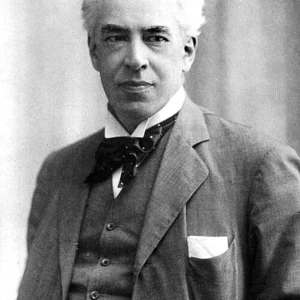

Russian actor, director and theorist, co-founder of the Moscow Art Theatre in 1898. He developed an acting method grounded in emotional sincerity that revolutionized dramatic art worldwide.
Konstantin Stanislavski(1863 — 1938)
Konstantin Stanislavski
Union soviétique, Empire russe
6 min read
Frequently asked questions
Famous Quotes
« Love the art in yourself and not yourself in the art.»
« There are no small parts, only small actors.»
Key Facts
- Born in 1863 in Moscow into a wealthy family of industrialists
- Co-founded the Moscow Art Theatre in 1898 with Vladimir Nemirovich-Danchenko
- Staged Anton Chekhov's major plays in 1898, including 'The Seagull'
- Developed his 'method' (system) for training actors, set out in 'An Actor Prepares' (1936)
- Died in 1938 in Moscow
Works & Achievements
Landmark production that rescued the play and Chekhov's reputation, and launched the Moscow Art Theatre.
Cemented the partnership between Stanislavski and Chekhov and the company's intimate, psychological style.
A peak of the Art Theatre's psychological realism, attentive to silences and to what goes unsaid.
A plunge into social misery that revealed the committed reach of naturalist theatre.
Chekhov's last great play, premiered by the company and now a classic of the world repertoire.
Autobiography in which he recounts his career and explains how his ideas about acting were born.
An acting method grounded in emotional truth that shaped all of twentieth-century theatre and film.
A major work in which he presents his method as the diary of a young acting student.
Anecdotes
Born Konstantin Alekseyev into one of the wealthiest industrial families in Moscow, he chose the stage name "Stanislavski" so that his relatives would not be ashamed to see him tread the boards as an amateur. For years he led a double life: a gold-thread factory owner by day, a passionate actor by night.
In June 1897, Stanislavski and Vladimir Nemirovich-Danchenko met at the Slavic Bazaar restaurant in Moscow to discuss a new kind of theatre. The conversation lasted eighteen hours, from the afternoon until the early morning: there they sketched out in detail what would become the Moscow Art Theatre.
Chekhov's play "The Seagull" had been a resounding flop in Saint Petersburg in 1896, so much so that the author swore he would never again write for the stage. Its revival by the Art Theatre in 1898 was such a triumph that the seagull became the emblem of the company, embroidered on its curtain to this day.
In rehearsals, Stanislavski would shout his famous "I don't believe it!
(Ne veryu!) the moment an actor rang false. This demand for truth pushed the performers to dig into their memories and emotions to make every gesture sincere.
In October 1928, during the gala marking the thirtieth anniversary of the Art Theatre, Stanislavski suffered a heart attack in the middle of a performance. He would never set foot on stage again and devoted his final decade to writing down and passing on his "method".
Primary Sources
Love the art in yourself, not yourself in the art.
This little word “if” acts as a lever that lifts us out of the world of reality and carries us into the world of imagination.
There are no small parts, only small actors.
The theatre begins at the cloakroom: everything in the house must breathe respect for the work of the actor and of the spectator.
Key Places
Stanislavski's birthplace, where he lived, worked and died. The Russian cultural capital where he revolutionized the dramatic arts.
The theatre he co-founded in 1898 and where he staged the plays of Chekhov and Gorky. The laboratory of his famous “system.”
Site of the eighteen-hour conversation with Nemirovich-Danchenko in 1897 that gave birth to the Art Theatre. A famous restaurant on Nikolskaya Street.
The family's country estate near Moscow where Stanislavski spent his summers and performed amateur theatre from his youth. Chekhov stayed there and drew inspiration from it.
A town on the French Riviera where Stanislavski stayed to tend to his fragile health and worked on writing his theoretical works.
Typical Objects

Silhouette of a seagull that became the symbol of the Moscow Art Theatre after the triumph of Chekhov's play in 1898. It adorns the stage curtain and the company's logo.

A staging notebook in which Stanislavski meticulously recorded the movements, intentions, and emotions of every role. The central working tool of his rehearsal method.

Small glasses perched on the nose without temple arms, a common accessory among cultivated men of the late 19th century. Stanislavski wore them, like many Russian intellectuals of his time.

A large Russian metal kettle used to brew tea continuously, found in almost every household. For his naturalistic theatre, Stanislavski demanded real everyday objects like this one on stage.

A faithful reconstruction of interiors, with furniture, hangings, and real objects, where traditional theatre made do with painted backdrops. This pursuit of true illusion was a hallmark of the Art Theatre.

A drape that opens and closes at the beginning and end of acts, marking the entry into fiction. The one at the Art Theatre bore the emblematic seagull.
School Curriculum
Vocabulary & Tags
Key Vocabulary
Daily Life
Morning
As a young man, Stanislavski began his day with the family business: he ran a gold and silver thread factory inherited from his father. The morning was devoted to the accounts, the workers and the running of the company.
Afternoon
The afternoon gradually drifted toward his true passion: reading plays, sketching sets and long rehearsals at the theatre. There he worked on every detail, tirelessly correcting the actors until he achieved the right truthfulness.
Evening
The evening belonged to the stage: performances before the public or late-night rehearsals. Stanislavski himself played major roles while observing and directing his troupe from the house.
Food
Like the Moscow bourgeoisie of his time, he ate hearty meals punctuated by scalding tea served from the samovar. Soups (such as borscht), black bread, fish and traditional Russian dishes made up his everyday fare.
Clothing
He wore the dark suit, the starched collar and the pince-nez of the cultured man of the Russian Belle Époque. Tall and elegant, he took care of his appearance, in town as on the stage.
Housing
Born into a wealthy family, he lived in vast Moscow residences and spent his summers at the country estate of Lyubimovka. After the revolution of 1917, his property was confiscated, but the Soviet state left him a home in Moscow.
Historical Timeline
Period Vocabulary
Liens externes & ressources
Références
Œuvres
Mise en scène de « La Mouette » (Tchekhov)
1898
Mise en scène d'« Oncle Vania » (Tchekhov)
1899
Mise en scène des « Trois Sœurs » (Tchekhov)
1901
Mise en scène des « Bas-fonds » (Gorki)
1902
Mise en scène de « La Cerisaie » (Tchekhov)
1904
Ma vie dans l'art
1924