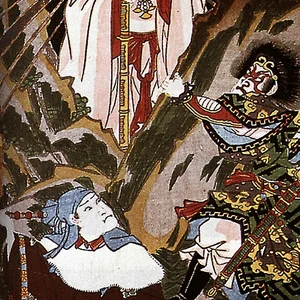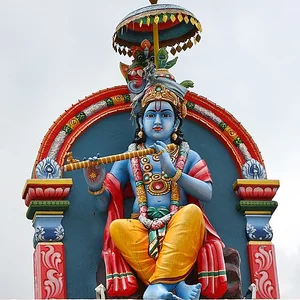

A major deity of Hinduism, Krishna is venerated as an avatar of Vishnu. A central figure of the Bhagavad Gita, he embodies divine wisdom and plays a crucial role in the Mahabharata epic as the spiritual guide of the warrior Arjuna.
Frequently asked questions
Famous Quotes
« He who abandons all desires and acts without attachment, without selfishness — he attains peace.»
« You have the right to perform your duty, but you have no right to the fruits of your actions.»
« Among all beings, I am the Supreme Self, the one who transcends all.»
Key Facts
- Central figure of the Bhagavad Gita, a foundational philosophical and religious text of Hinduism composed between the 5th and 2nd centuries BCE.
- Presented as an avatar (incarnation) of Vishnu, one of the three principal deities of the Hindu Trimurti.
- Spiritual guide of Arjuna on the battlefield of Kurukshetra in the Mahabharata, where he teaches the principles of dharma and righteous action.
- A key figure in Hindu mythology, particularly in the Puranas, with numerous stories of his childhood and divine feats.
- A major source of inspiration for Hindu philosophy, teaching the three paths to liberation: karma yoga, bhakti yoga, and jnana yoga.
Works & Achievements
A philosophical and spiritual dialogue between Krishna and the warrior Arjuna at the heart of the Mahabharata, setting out the principles of dharma (duty), karma, and bhakti (devotion). It is one of the foundational texts of Hinduism and Indian philosophy.
The great Sanskrit epic in which Krishna plays a central role as advisor, spiritual guide, and warrior in the Battle of Kurukshetra. He embodies divine wisdom and guides the course of both historical and mythological events.
The epic battle in which Krishna acts as guide and advisor to Arjuna, imparting ethical and spiritual principles. This event marks the climax of the Mahabharata and symbolizes the triumph of dharma.
Krishna teaches several spiritual paths, including karma yoga (the yoga of action), bhakti yoga (the yoga of devotion), and jnana yoga (the yoga of knowledge). These teachings form the backbone of Hindu spiritual practice.
Krishna is celebrated for his legendary miracles and feats, including the defeat of the tyrant Kamsa and the protection of his devotees. These deeds symbolize the triumph of good over evil.
A companion text to the Mahabharata recounting the life of Krishna — his early years, his loves, and his divine exploits. It is a major source of Krishnaite mythology in the Hindu tradition.
Anecdotes
Krishna is the central figure of the Bhagavad Gita, a sacred Hindu text composed between the 5th and 2nd centuries BCE. In this dialogue, Krishna teaches the warrior Arjuna the principles of dharma (duty) and spiritual wisdom on the battlefield of Kurukshetra. This philosophical text remains one of the most influential works in Hindu literature and is studied in schools across India.
According to the epic tradition of the Mahabharata, Krishna is presented as the cousin and advisor of Prince Arjuna, one of the greatest warrior figures in Hindu mythology. He acts as a mediator in the dynastic conflict and uses his strategic intelligence to shape the course of the Great War. His role as a spiritual guide makes him one of the most revered religious figures in Hinduism.
Krishna is worshipped in Hinduism as an avatar (incarnation) of Vishnu, the god of preservation. This belief is documented in the Puranas, sacred Hindu texts compiled between the 4th and 16th centuries. Millions of devotees regard him as a divine manifestation who guided humanity toward the path of justice and morality.
The flute (bansuri) is Krishna's most iconic symbolic attribute in Hindu iconography. According to religious tradition, Krishna used his divine music to teach and enchant those around him. This poetic image has inspired countless stories, paintings, and sculptures in Indian culture since ancient times.
Krishna stands at the heart of Hindu devotional worship, particularly within the Bhakti traditions that flourished from the medieval period onward. His teachings on divine love, personal devotion, and spiritual liberation have shaped the religious practice of millions of Hindus across the centuries and remain as relevant as ever in contemporary Hinduism.
Primary Sources
When Arjuna, his heart troubled by doubt, refused to fight, Krishna revealed to him: "You have the right to perform your duty, but not to expect its fruits. Let action be your sole concern, never its results."
Krishna, the avatar of Vishnu, intervened in the great battle of Kurukshetra as Arjuna's charioteer, imparting divine wisdom and guiding the hero toward his spiritual and warrior fulfillment.
The text recounts the miraculous birth of Krishna, his exploits as a child and young man, including his victory over the tyrant Kamsa and his love for Radha.
This Purana describes in detail the life of Krishna from his birth in Kamsa's prison to his reign in Mathura and Dwarka, emphasizing his divine pastimes and spiritual teachings.
Key Places
Sacred city in Uttar Pradesh considered the birthplace of Krishna according to Hindu tradition. It is one of the most important pilgrimage sites in Hinduism and a major spiritual center associated with Krishna's divine childhood.
Sacred region of Uttar Pradesh where Krishna is said to have spent his childhood and youth according to Hindu scriptures. This place is the heart of Krishnaite devotion and home to numerous temples and rituals linked to the young god's deeds.
Historic region of Haryana where the battle of the Mahabharata takes place. Krishna serves there as Arjuna's spiritual guide and delivers the Bhagavad Gita, a foundational text of Hindu philosophy.
Legendary capital founded by Krishna in Gujarat according to Hindu tradition. This site symbolizes Krishna's earthly reign and remains an important place of pilgrimage, most notably home to the Dwarkadhish Temple.
Sacred mountain in Uttar Pradesh where Krishna is said to have lifted the mountain to shelter cattle and herdsmen from storms. This place symbolizes divine protection and is a major pilgrimage site.
Village in Uttar Pradesh where Krishna is said to have grown up with his foster family. It is the setting of legends about his miraculous childhood and his first feats against demons.
Typical Objects
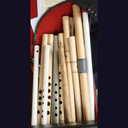
A traditional bamboo musical instrument closely associated with Krishna, who plays it throughout Hindu legends. The flute symbolizes divine charm and the god's spiritual connection with his devotees.
📷 Domaine public · Wikimedia Commons ↗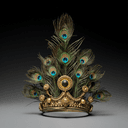
A royal ornament adorned with peacock feathers, worn by Krishna to symbolize his divine kingship and transcendent beauty. This attribute distinguishes him as a major deity in Hindu iconography.
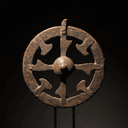
A circular divine weapon with sharp edges, an attribute of Vishnu of whom Krishna is an avatar. This chakra represents cosmic justice and the destructive force against evil.

A traditional weapon wielded by Krishna, particularly in the battles of the Mahabharata. It embodies warrior strength and the divine protection offered to his devotees.
📷 CC BY-SA 3.0 · Wikimedia Commons ↗
An ornament made of pearls and flowers, worn by Krishna to symbolize his divine nature and his bond with the natural world. This accessory is a symbol of his celestial splendor.

A divine bow used by Krishna and Vishnu, representing the defense of dharma (cosmic order). This weapon symbolizes Krishna's ability to maintain universal balance.
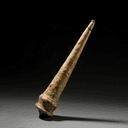
An instrument sounded by Krishna before the battles of the Mahabharata, most notably at Kurukshetra. Its call symbolizes the summons to justice and heralds the triumph of good over evil.

A symbolic flower associated with Krishna and Hindu spirituality as a whole, representing purity and spiritual enlightenment. The lotus illustrates the emergence of divine consciousness into earthly existence.
School Curriculum
Vocabulary & Tags
Key Vocabulary
Daily Life
Morning
Krishna begins his day with spiritual practices and meditation, in keeping with the teachings of yoga and Hindu philosophy. He takes part in religious rituals and morning worship, then devotes time to sharing spiritual wisdom with his disciples and with Arjuna.
Afternoon
The afternoon is given over to martial and administrative activities, including combat training and military strategy within the context of the Mahabharata. Krishna also engages in counsel with princes and kings, offering guidance and diplomatic advice.
Evening
The evening is marked by contemplative activities and deeper spiritual teachings. Krishna leads philosophical discussions with his closest disciples — particularly with Arjuna — from which the teachings of the Bhagavad Gita emerge.
Food
Krishna's diet follows the principles of traditional Hindu vegetarianism, including grains, legumes, dairy products, and fruits. As a divine incarnation, his diet symbolizes spiritual purity, though tradition also acknowledges his ties to pastoral life and cattle herding.
Clothing
Krishna is typically depicted wearing simple yet distinguished garments characteristic of princes in ancient India. He often wears a peacock-feather crown (mukuta) and divine ornaments, with the flute (bansuri) as his defining iconographic attribute, symbolizing his wisdom.
Housing
Krishna resides in royal palaces befitting his status as a prince and divine incarnation. His main dwelling places are Mathura and Dwarka, built in the palatial architectural style of ancient India, featuring reception halls, private chambers, and religious sanctuaries.
Historical Timeline
Period Vocabulary
Visual Style
Un style inspiré de l'art indien classique, combinant les techniques de la peinture miniature hindoue avec des motifs floraux ornementaux, une dorure généreuse et une atmosphère spirituelle lumineuse. Les teintes riches et saturées évoquent la divinité transcendante de Krishna dans la tradition hindoue.
Sound Ambience
Une ambiance sonore sacrée et méditative évoquant les temples hindous anciens, mêlant chants dévotionnels en sanskrit, instruments traditionnels indiens et bruits rituels sacrés pour incarner la sagesse spirituelle de Krishna.
Liens externes & ressources
Références
Œuvres
Bhagavad-Gîtâ
Entre -400 et -200 av. J.-C. (composition du texte)
Le Mahabharata
Entre -400 et -100 av. J.-C. (rédaction du texte)
La Bataille de Kurukshetra
Environ -3102 av. J.-C. (datation mythologique)
Enseignement du yoga et de la devoción
Datation mythologique
Les Dix Avatars et miracles
Datation mythologique
Le Harivamsa
Entre -400 et -100 av. J.-C. (composition)