
Adam and Eve are the first human beings according to biblical and Judeo-Christian tradition. Created in the image of God, they live in the Garden of Eden before committing the original sin by eating the forbidden fruit, which leads to their expulsion and marks the beginning of humanity.
Frequently asked questions
Key Facts
- Creation of the first human couple in the image of God, according to the Book of Genesis
- Life in the Garden of Eden, earthly paradise
- Transgression of the divine commandment: eating the forbidden fruit
- Expulsion from the Garden of Eden and the beginning of human suffering
- Foundation of the concept of original sin in Christian theology
Works & Achievements
Adam is created in God's image and becomes the first human being according to biblical tradition. This act of creation marks the beginning of humanity and establishes the fundamental relationship between God and humankind.
Eve is created from one of Adam's ribs to be his companion. She represents the feminine principle in creation and establishes the first human partnership.
Adam and Eve live in paradise in harmony with nature and divine creation, before transgressing God's commandment. This period symbolizes innocence and original perfection.
Adam and Eve eat the forbidden fruit from the Tree of Knowledge, thereby disobeying God. This act of transgression marks a fundamental turning point in human history according to the Judeo-Christian tradition.
Following the original sin, Adam and Eve are cast out of the Garden of Eden and condemned to live in the earthly world. This expulsion symbolizes the consequences of sin and inaugurates the mortal human condition.
Adam and Eve become the ancestors of all humanity and give rise to the first human generation. They represent the origin point of the biblical genealogy of humankind.
Anecdotes
In the biblical tradition, Adam and Eve live in the Garden of Eden, a paradise where all their needs are met. God allows them to eat the fruit of every tree except the tree of the knowledge of good and evil. This prohibition tests their obedience and free will, marking the beginnings of human morality according to the religious narrative.
The serpent, described as the most cunning of all animals, tempts Eve by suggesting that eating the forbidden fruit will not kill them but will make them like God. Eve gives in to temptation, eats the fruit, and offers some to Adam, who also accepts. This act, known as original sin, is fundamental in Christian and Jewish theology because it explains the mortal condition of humanity.
After eating the forbidden fruit, Adam and Eve become aware of their nakedness and feel shame for the first time. They hide when God arrives in the garden, revealing that sin has created a distance between humanity and the divine. This symbolic separation becomes the starting point of humanity's spiritual story in the biblical tradition.
As punishment for their disobedience, God expels Adam and Eve from the Garden of Eden, condemning humanity to hard labor, suffering, and death. Adam must till the ground by the sweat of his brow, while Eve will bear children in pain. This expulsion marks the transition from paradise to the human condition as we know it.
After his expulsion from paradise, Adam fathers children including Cain and Abel, according to the biblical account. These first descendants mark the expansion of humanity beyond the Garden of Eden, with Cain becoming a farmer and Abel a shepherd. This narrative establishes the foundations of early human society in the Western religious tradition.
Primary Sources
So God created mankind in his own image, in the image of God he created them; male and female he created them. [...] Then the Lord God formed a man from the dust of the ground and breathed into his nostrils the breath of life, and the man became a living being.
Therefore, just as sin entered the world through one man, and death through sin, and in this way death came to all people, because all sinned.
Adam, the first man, having lived nine hundred and thirty years, begat Seth; and Seth having lived nine hundred and twelve years, begat Enos.
Adam was created alone, not because there was no need of a companion, but so that from him alone a woman might proceed, who would be called Eve, for she is the mother of all the living.
Key Places
The place of creation and residence of the first humans according to biblical tradition. Adam and Eve live there in harmony before committing original sin by eating the forbidden fruit.
Region of the Fertile Crescent where some traditions locate the Garden of Eden, between the Tigris and Euphrates rivers. The cradle of the earliest human civilizations.
The peak where Noah's Ark is said to have come to rest according to the Bible. A symbolic place of survival after the flood and of a new humanity descended from Noah, himself a descendant of Adam and Eve.
Holy city of Judaism and Christianity where the story of Adam and Eve is transmitted and taught. A major spiritual center of the founding religious tradition.
Typical Objects

The forbidden fruit of the Garden of Eden, symbolizing original sin. By eating this fruit, Adam and Eve transgress the divine order and bring sin and mortality upon all of humanity.

The earthly paradise created by God where Adam and Eve live in innocence and abundance. It is a place of primordial perfection, depicted as a lush and bountiful natural world.

The central tree of the Garden of Eden whose fruit is forbidden by God. Transgressing this command marks the defining moment in human destiny and the birth of moral consciousness.

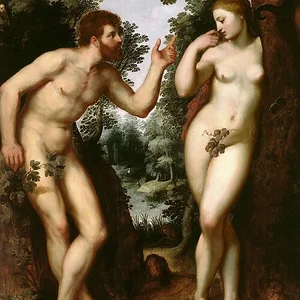
A symbol of modesty and awareness of nakedness. After the original sin, Adam and Eve cover themselves with fig leaves, revealing their newfound shame and their separation from divine innocence.

According to the biblical account, Eve is created from a rib taken from Adam. This element symbolizes the union and complementarity between man and woman in the act of creation.

The tempting creature of the Garden of Eden who persuades Eve to eat the forbidden fruit. It represents evil and cunning, and becomes the symbol of the devil in the Christian tradition.

A tool of human labor symbolizing the toil and suffering imposed on humanity after the expulsion from Paradise. It represents the mortal and burdensome condition of post-Edenic existence.

A symbol of the divine image in which Adam and Eve are created. It represents the original dignity of humanity and the privileged relationship between the first humans and their Creator.
School Curriculum
Vocabulary & Tags
Key Vocabulary
Tags
Mythologie
Daily Life
Morning
According to the biblical account, Adam and Eve wake in the Garden of Eden in a state of perfect innocence. They begin their day by contemplating the divine creation around them and tending to the garden, as described in Genesis.
Afternoon
They continue their work caring for the garden, naming the animals and exploring the riches of this earthly paradise. According to the biblical text, they enjoy a life of harmony with creation and with God, free from toil or suffering.
Evening
As day turns to evening, Adam and Eve rest and commune with the divine creation. The biblical account describes a close relationship with God, who would walk in the garden in the cool of the day — before the original sin.
Food
Adam and Eve eat the fruits and plants of the Garden of Eden, particularly the fruits of the trees, with the exception of the forbidden fruit. Genesis states that God gives them every plant bearing seed and every fruit tree for their food.
Clothing
Before the original sin, Adam and Eve live naked without shame, in their state of original innocence. After eating the forbidden fruit, they become aware of their nakedness and cover themselves with fig leaves, marking a fundamental change in their condition.
Housing
Adam and Eve dwell in the Garden of Eden, an earthly paradise created by God himself, filled with trees, flowers, and an abundance of life. This garden represents the ideal home without any artificial construction, characterized by perfect harmony between humanity and nature.
Historical Timeline
Period Vocabulary
Visual Style
Un style de peinture religieuse Renaissance, mêlant idéalisme classique et réalisme naturiste, avec une lumière dorée divine baignant un jardin paradisiaque abondant. L'atmosphère atemporelle et mystique évoque l'innocence originelle à travers des techniques de clair-obscur et un rendu détaillé des textures naturelles.
Sound Ambience
Une ambiance sonore paradisiaque et sereine évoquant le Jardin d'Éden : mélange de sons naturels apaisants (ruisseau, oiseaux exotiques, feuillages), de mélodies célestes et de whispers divins, créant une atmosphère d'innocence divine teintée de tension spirituelle.
Liens externes & ressources
Références
Œuvres
Création de l'humanité
sans datation historique
Création d'Ève
sans datation historique
Vie au Jardin d'Éden
sans datation historique
Le péché originel
sans datation historique
L'expulsion du Paradis
sans datation historique
Fondation de l'humanité
sans datation historique