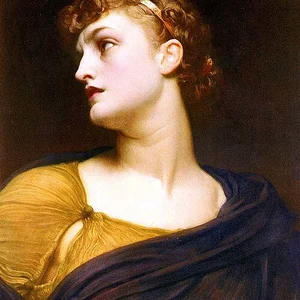

Heroine of Greek mythology, daughter of Oedipus and Jocasta, princess of Thebes. Antigone embodies the conflict between divine law and human law by daring to defy the decree of King Creon in order to give her brother Polynices a proper burial, which leads to her condemnation to death.
Antigone
Antigone
Thèbes
8 min read
Frequently asked questions
Famous Quotes
« I was not born to share in hatred, but to share in love. (Sophocles, Antigone)»
« We must obey the city's law, even against our conscience. (Creon's position, Sophocles, Antigone)»
Key Facts
- Daughter of Oedipus and Jocasta, sister of Polynices and Eteocles
- Defies King Creon's edict forbidding the burial of Polynices (killed as an enemy of Thebes)
- Secretly performs her brother's burial rites, an act of piety and civil disobedience
- Is captured and sentenced to death by Creon for violating his decree
- Takes her own life in her tomb, triggering the death of Haemon (Creon's son), who loved her
Works & Achievements
Antigone defies the order of King Creon, who had forbidden the burial of Polynices, her brother. This act of civil disobedience embodies the conflict between divine law (*nomos*) and human law (*psephisma*).
Antigone performs the funeral rite for her brother Polynices by pouring earth over his body, fulfilling her duty to family despite the royal prohibition. This act is central to Sophocles' play.
Antigone directly challenges King Creon to defend her moral and religious convictions. This dramatic confrontation highlights the heroine's courage in the face of absolute authority.
Sentenced to be buried alive, Antigone takes her own life in her cell, setting off a chain of tragic deaths that devastates Creon. Her sacrifice becomes a symbol of resistance against injustice.
Antigone appears in the Theban cycle and inspires several major dramatic works, most notably Sophocles' *Antigone*, establishing her as an archetype of the tragic heroine in Western literature.
Anecdotes
In Sophocles' play, written around 441 BC, Antigone does not actually bury Polynices' body with a proper funeral ceremony: she simply scatters three handfuls of dust over the corpse. According to Greek belief, this symbolic gesture was enough to allow the soul of the dead to reach the Underworld. A tiny act — but one with enormous consequences.
Antigone is the daughter of Oedipus and Jocasta, which makes her both Jocasta's daughter and granddaughter — since Oedipus had unknowingly married his own mother. This tragic family fate, marked by the curse of the Labdacids, shadows Antigone's entire life from the moment of her birth.
Creon sentences Antigone to be walled up alive in a cave, so as not to defile the city by shedding her blood directly. But when he changes his mind, warned by the seer Tiresias, he arrives too late: Antigone has hanged herself in her prison. Her fiancé Haemon, Creon's own son, then kills himself over her body. Antigone's death thus triggers a chain reaction that destroys the entire royal family.
The myth of Antigone has endured through the centuries to become a symbol of resistance to injustice. In 1944, during the Nazi Occupation of France, the playwright Jean Anouilh staged the play in Paris. Audiences immediately saw a metaphor: some identified with Antigone, who refuses to yield, others with Creon, who invokes order and reason of state. The ancient play suddenly spoke to the present.
Antigone is often cited as one of the earliest literary examples of civil disobedience: she breaks a human law in the name of a higher law, divine or moral. Philosophers such as Hegel analyzed her conflict with Creon as the collision of two legitimate orders — family and state — each carrying a share of truth, which is what makes the tragedy so profound and so enduring.
Primary Sources
I did not believe your edicts had such force as to override the unwritten and unfailing laws of the gods. For these laws are not of today or yesterday, but are eternal; no one knows when they first came into being.
Polynices lies unburied, without libations, without mourning; citizens are forbidden to bury or mourn him, on pain of death.
Antigone dared to bury Polynices in defiance of King Creon's edict, braving the ban to honor the divine laws and the duties owed to the dead.
The Greeks recount that it was a young woman, Antigone, who stood against tyrannical power by claiming the right to honor the dead according to divine rites.
Key Places
Capital of Boeotia where the entirety of Antigone's tragedy takes place. It is in Thebes that Antigone defies the order of King Creon by giving a burial to her brother Polynices.
Seat of royal power where Creon rules. It is from the royal palace that orders are issued regarding the ban on burying Polynices, and where the confrontations between Antigone and the king unfold.
Battlefield where the bodies of warriors lie fallen during the fratricidal conflict between Eteocles and Polynices. It is here that Antigone commits her act of defiance by burying her brother Polynices.
A locality in Attica where Oedipus, Antigone's father, is said to have found refuge and where he is venerated. Antigone accompanies her father into exile there in Sophocles' version of the myth.
The place of Antigone's imprisonment and death, where, depending on the version, she hangs herself in a sealed chamber or is stoned to death. She thus becomes a symbol of martyrdom for family honor and divine law.
Typical Objects

Symbol of the funeral rite Antigone performs by sprinkling earth over the body of her brother Polynices. This simple yet transgressive act becomes the heart of her defiance against King Creon and his decree forbidding burial.

A ceramic vessel used to hold the ashes of the dead after cremation. It represents the funeral traditions of ancient Greece that Antigone seeks to uphold by giving her brother a proper burial.

A draped and belted garment typical of ancient Greek women's dress. Antigone wears it during her act of rebellion and at her condemnation, embodying both feminine dignity and vulnerability in the face of tyrannical power.

A weapon symbolizing Antigone's tragic end — she takes her own life in her cell rather than submit to Creon's authority. It represents the ultimate sacrifice made in the name of family devotion and divine justice.

Elements of Greek funeral ritual and symbols of respect for the dead. Antigone would have wished to honor her brother with these tokens of piety, reflecting the central importance of funeral rites in ancient Greek culture.

Writing materials of the ancient world. They symbolically represent the written laws of King Creon that Antigone defies by obeying the unwritten law of the gods, illustrating the play's central conflict between human justice and divine justice.

A symbol of King Creon's absolute power and the established order that Antigone dares to challenge. The contrast between royal authority and the act of a young woman captures the play's central theme about the limits of human power.
School Curriculum
Vocabulary & Tags
Key Vocabulary
Tags
Daily Life
Morning
Antigone wakes before dawn in the royal palace of Thebes. She takes part in the morning religious rituals, performing libations to the gods and ancestors — an essential practice for a high-ranking princess. Her handmaidens attend to her and help prepare her for the day ahead.
Afternoon
Antigone tends to the affairs of the palace and oversees the servants responsible for household tasks. She spins wool and weaves — prestigious occupations for a woman of the Greek elite — while conversing with the women of her household. She may also attend formal meals or receive diplomatic visitors.
Evening
As night falls, Antigone joins her family for the evening meal, an important moment in aristocratic social life. She likely attends musical performances or song. She spends time in prayer to the gods who watch over her household before retiring for the night.
Food
Like other aristocratic women, Antigone's diet consists mainly of barley bread, vegetables (lentils, broad beans), dried fruits, and cheese. She drinks wine mixed with water, and also consumes honey, fish at religious feasts, and occasionally meat from sacrificial offerings to the gods.
Clothing
Antigone wears a long chiton — a tunic of linen or wool — gathered at the waist with a belt. Over it she drapes a himation, a cloak that covers her shoulders. As a princess, she likely wears precious jewelry, including earrings and a diadem, as symbols of her royal status.
Housing
Antigone lives in the royal palace of Thebes, an impressive structure typical of Greek aristocratic residences, built around several interior courtyards. The palace includes separate women's quarters (the gyneceum), reception halls, and spaces set aside for religious rites. The walls are adorned with frescoes and mosaics.
Historical Timeline
Period Vocabulary
Visual Style
Un style inspiré de la céramique grecque antique et des peintures de vases, associant la technique des figures rouges à une dramaturgie Renaissance. L'ambiance mêle solennité tragique et noblesse héroïque, avec un jeu d'ombre et lumière qui souligne le conflit moral et le sacrifice du personnage.
Sound Ambience
Une ambiance sonore sombre et tragique mêlant les bruits d'un palais grec antique, des instruments de musique funèbres et une atmosphère de conflit moral entre les lois divines et humaines. Les sons évoquent la tension dramatique et l'inéluctabilité du destin d'Antigone.
Liens externes & ressources
Références
Œuvres
Défiance envers l'édit de Créon
Période légendaire
Sépulture de Polynice
Période légendaire
Confrontation avec Créon
Période légendaire
Tragédie et mort volontaire
Période légendaire
Inspiration des Tragédies grecques
Antiquité classique