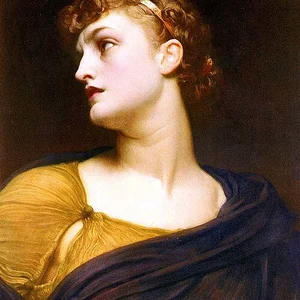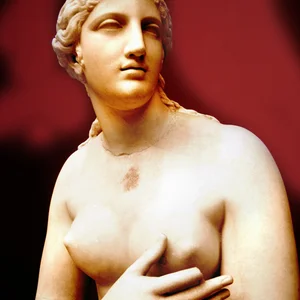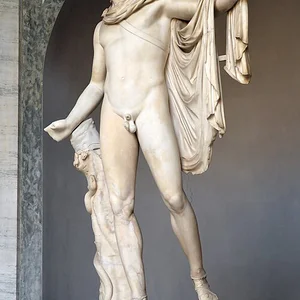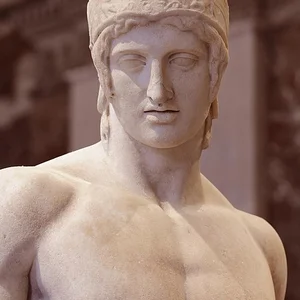

Achilles is the greatest Greek warrior in mythology and the central hero of Homer's Iliad. Son of Thetis and Peleus, he is invulnerable except for his heel — his legendary weak point. He embodies the ideal of the Greek warrior hero, renowned for his strength, courage, and pride.
Achilles
Achilles
8 min read
Frequently asked questions
Key Facts
- Main protagonist of Homer's Iliad, a foundational epic of Western literature
- Fights in the Trojan War as leader of the Myrmidons, warriors renowned as invincible
- Kills Hector, the Trojans' greatest warrior, avenging the death of his companion Patroclus
- Dies during the Trojan War, according to legend, killed by an arrow from Apollo that strikes his heel
- Symbolizes the Greek heroic ideal: strength, courage, honor, and total commitment to battle
Works & Achievements
The legendary battle in which Achilles defeats and kills Hector, the Trojan champion, before the walls of Troy. This event marks the climax of the Iliad and represents the triumph of the Greek hero.
Achilles is the most formidable warrior in the Greek coalition that besieges Troy for ten years. His decisive role in the final victory makes him the preeminent hero of the Trojan legend.
Achilles is killed by Paris with an arrow to the heel — his only vulnerable spot — after dominating every battle. This symbolic death illustrates the inevitability of fate and the fragility of even the greatest hero.
The legendary contest between Achilles and Ajax the Great to determine the mightiest warrior in the Greek army. This clash symbolizes the rivalry between the two greatest Greek heroes.
The central conflict of the Iliad, in which Achilles refuses to fight after Agamemnon takes his captive Briseis. This quarrel highlights the themes of honor and pride at the heart of the Greek warrior ethos.
Achilles defeats and kills Penthesilea, queen of the Amazons, who came to aid the Trojans. This victory demonstrates his unrivaled dominance over every opponent on the battlefield.
Achilles is raised and trained in combat by the centaur Chiron, who prepares him to become an invulnerable warrior. This exemplary upbringing illustrates the importance of education in shaping the ideal Greek hero.
Anecdotes
Achilles is the main hero of Homer's Iliad, the Greek epic composed in the 8th century BCE that recounts the Trojan War. In this foundational text of Western literature, Homer portrays Achilles as the greatest of the Greek warriors, capable of defeating any opponent through his superhuman strength. His legendary courage made him the model of the perfect hero in ancient Greek culture.
According to Greek mythology as recorded by ancient authors, Achilles was the son of the sea-nymph Thetis and King Peleus. Legend holds that his mother made him invulnerable by dipping him in the river Styx, all except the heel by which she held him. This story of Achilles' heel — his only weak point — has become one of the most famous tales in ancient mythology.
Homer's Iliad tells how, during the siege of Troy, Achilles grows furious with Agamemnon over a captive woman and refuses to fight. This quarrel between two great Greek warriors illustrates how pride and personal honor were paramount in the heroic culture of ancient Greece. The conflict between Achilles and Agamemnon shapes the entire arc of the epic.
In the Greek mythological tradition, recorded by several ancient authors including Homer and Ovid, Achilles was killed by Paris, the Trojan prince, who struck him in the heel with an arrow. This death marks the end of the greatest Greek warrior and symbolizes how even the mightiest can be brought down by a single weakness. The tragic fate of Achilles embodies a central theme of mythology: no one escapes their destiny.
The ancient Greeks saw in Achilles the embodiment of the warrior ideal: physical strength, courage in battle, martial pride, and personal honor. For more than two millennia, young Greeks and future soldiers studied Homer's Iliad to learn heroic values through the example of Achilles. His influence on Greek education and culture was immense and enduring.
Primary Sources
Sing, O goddess, the anger of Achilles son of Peleus, that brought countless ills upon the Achaeans, hurled in their multitudes to the house of Hades strong souls of heroes, and gave their bodies to be the prey of dogs and all winged fowls.
I descended to the dwelling of Pluto to consult the shade of the prophet Tiresias. And I saw the shade of great Achilles, who asked whether any news from the world above had reached him.
Thetis dipped Achilles in the waters of the Styx to make him invulnerable, but the heel by which she held him remained mortal. And it was there that Paris struck him with an arrow.
Achilles, that dreaded warrior, that hero whose strength was nearly equal to the gods, falls, struck in the heel by an arrow from the son of Priam.
Key Places
Region of northern Greece where Achilles was born, son of King Peleus. It is his homeland and the seat of his royal family.
City in Thessaly, capital of Peleus's kingdom and homeland of Achilles. It is from here that he sets out for the Trojan War with his Myrmidons.
City in Asia Minor besieged for ten years by the Greeks. Achilles performs his greatest feats of war here and meets his death, struck in the heel by an arrow fired by Paris.
Greek island in the Aegean Sea where, according to legend, Thetis hid the young Achilles to keep him from the Trojan War.
Strait separating Greece from Asia Minor, the scene of many of Achilles's battles during the crossing and the siege of Troy.
Home of the Greek gods, where his mother Thetis, a Nereid, resides. Achilles maintains direct ties with the gods who intervene in his destiny.
Typical Objects

A complete suit of armor forged by Hephaestus, including a helmet, breastplate, and bronze greaves. It represents the war gear of the most prestigious Greek warrior and symbolizes his status as an unrivaled hero.

Achilles' primary weapon — a long wooden pike tipped with bronze. It is the signature fighting instrument of the Greek hoplite and the weapon with which Achilles performs his greatest feats of war.

A decorated circular shield, the typical defensive armament of the ancient Greek warrior. Achilles' shield, forged by Hephaestus, is adorned with mythological scenes and embodies the hero's protection.

A bronze headpiece characteristic of ancient Greece, protecting the warrior's skull and face. It is an essential piece of Greek military equipment from the 7th to 5th centuries BCE.

A close-combat bronze weapon used by ancient Greek warriors. Achilles carries it as a secondary arm for hand-to-hand fighting during the Trojan War.

A two-wheeled horse-drawn vehicle typical of the Mycenaean era and the Trojan War. Greek heroes used it to move across and fight on the battlefield.

Ancient Greek garments made of linen or wool: the short tunic (chiton) worn beneath the armor and the cloak (himation) draped around the body. Together they make up the everyday and military dress of the Greek warrior.

Though immaterial, the heel represents Achilles' single weak point — the place where he is fatally wounded during the siege of Troy. It is the symbol of his tragic destiny and the limits of the greatest Greek hero's near-invulnerability.
School Curriculum
Vocabulary & Tags
Key Vocabulary
Daily Life
Morning
Achilles wakes at dawn in his tent at the Greek camp outside Troy. He begins with intense physical training: combat drills with his weapons (sword, spear, shield) and running to maintain his exceptional condition. After training, he takes a light meal before joining the assemblies of the Greek commanders or helping plan battle strategies.
Afternoon
The afternoon is devoted to fighting and raids against the Trojans, or to training alongside his companion Patroclus and his Myrmidons. Achilles takes an active part in the fighting to assert his martial supremacy and accumulate spoils and glory (kleos). Between engagements, he may rest in his tent or tend to his prized weapons.
Evening
In the evening, Achilles joins the communal meals in the Greek camp, where roasted meat and wine are shared. He may listen to a bard sing of heroic deeds, discuss strategy with the other commanders (Agamemnon, Ajax), or withdraw to his tent to reflect. At night he sleeps little, often troubled by the stakes of the war and his own fate.
Food
Achilles follows the typical diet of a warrior aristocrat: grilled or roasted beef or mutton (his main source of protein), bread or flatbreads, dried fruits, cheese, and wine mixed with water. Meals are hearty to fuel his intense physical activity, and meat roasted in sacrifice to the gods precedes the warriors' feasts.
Clothing
Achilles wears the full armor of a Homeric warrior: an ornate bronze helmet, rigid breastplate, greaves protecting the shins, and a decorated round shield. He wears a short tunic (chiton) beneath his armor in battle. Sandals or leather shoes complete his outfit. Outside of combat, he dons the himation — a draped length of cloth that marks his aristocratic status.
Housing
Achilles lives in a large military tent typical of the Greek camp besieging Troy, furnished with raised beds and chests for his valuables and equipment. The tent also serves as a reception space for gatherings with the other commanders. The camp is organized into sections, and Achilles holds a central position within it — a reflection of his standing as the supreme warrior among the Greeks.
Historical Timeline
Period Vocabulary
Visual Style
Un style inspiré de la céramique grecque antique associant la technique du vase grec (figures noires et rouges) à la statuaire classique. L'ambiance privilégie les tonalités terracotta et dorées, avec un éclairage dramatique évoquant les scènes épiques de l'Iliade et la grandeur héroïque de la Grèce antique.
Sound Ambience
Une ambiance sonore épique de camp guerrier grec avant la bataille, mélangeant les bruits métalliques d'entraînement martial, les voix de soldats, le crépitement des feux de camp et les instruments antiques dramatiques, évoquant la gloire et le danger imminent de la Guerre de Troie.
Liens externes & ressources
Références
Œuvres
Duel contre Hector
Guerre de Troie (légende du XIIIe siècle av. J.-C.)
Prise de Troie (rôle dans)
Guerre de Troie (légende du XIIIe siècle av. J.-C.)
Mort d'Achille au talon
Guerre de Troie (légende du XIIIe siècle av. J.-C.)
Duel contre Ajax
Guerre de Troie (légende du XIIIe siècle av. J.-C.)
Querelle avec Agamemnon
Guerre de Troie (légende du XIIIe siècle av. J.-C.)
Victoire contre Penthésilée, reine des Amazones
Guerre de Troie (légende du XIIIe siècle av. J.-C.)
Entraînement par le centaure Chiron
Jeunesse d'Achille (légende du XIIIe siècle av. J.-C.)