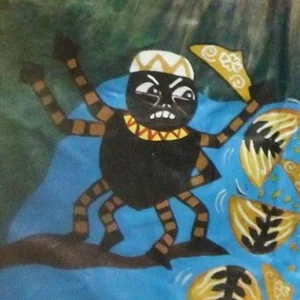

Anansi is a cunning and mischievous spider from Akan and Ashanti mythology, originating in West Africa. A central figure in folk tales, he represents intelligence, trickery, and survival through wit. These stories crossed the Atlantic through the slave trade and continue to influence the oral traditions of the Caribbean and the Americas.
Anansi
Anansi
8 min read
Frequently asked questions
Key Facts
- Central figure of Akan and Ashanti mythology, rooted in oral traditions thousands of years old
- Embodies the trickster archetype, relying on intelligence and cunning rather than brute strength
- Anansi tales traveled to the Americas through the African diaspora (16th–19th centuries)
- Became a symbol of resistance and survival for enslaved peoples
- Major influence on contemporary Creole and Caribbean storytelling traditions
Works & Achievements
A foundational tale in which Anansi outsmarts others to gain ownership of all the world's stories. This tale symbolizes the transmission of knowledge and the importance of cunning over brute strength in Akan cosmology.
A story in which Anansi attempts to hide all the world's wisdom in a pot, revealing his greedy nature and the absurdity of trying to monopolize knowledge. A moral tale conveying educational values about humility and sharing.
A story in which Anansi faces an environmental crisis through his wit, demonstrating how intelligence can overcome natural obstacles. A tale illustrating adaptation and survival in challenging circumstances.
A tale of opposition between Anansi's cunning and the leopard's strength, staging the victory of intelligence over physical power. An allegory of the struggle between oppressors and the oppressed, particularly meaningful in diasporic traditions.
The transmission and adaptation of Anansi tales in Afro-Caribbean and African-American cultures through oral tradition. These stories served as cultural resistance and a means of preserving values during and after slavery.
A series of tales in which Anansi interacts with the deities, challenging the cosmic order through his mischief and cunning. These stories establish Anansi as a figure of transgression and transformation in Akan mythology.
Anecdotes
In Akan mythology, Anansi was originally the owner of all the world's stories. According to the founding narrative, the sky god Nyame once possessed all tales. Anansi negotiated with him to acquire them, in exchange for a task deemed impossible: capturing a python, hornets, a leopard, and an invisible being. Thanks to his cunning, he succeeded, and from that point on, all traditional Akan stories bore the name "Anansesem" — literally "words of Anansi".
The name "Anansesem" refers in the Twi language (spoken in present-day Ghana) to the entire body of tales and narratives in the Akan oral tradition. This name reflects Anansi's central importance in Ashanti culture: he is not merely one character among others, but the symbolic keeper of the people's entire narrative memory. Griots and storytellers would invoke his name at the opening of each tale.
During the transatlantic slave trade (16th–19th centuries), enslaved Africans brought Anansi's stories with them. In the Caribbean islands, particularly in Jamaica and Trinidad, these tales were transformed into "Nancy stories". For enslaved populations, Anansi embodied a form of resistance: where physical strength was impossible, intelligence and cunning made it possible to survive against far more powerful adversaries.
Folklore scholars, such as Joel Chandler Harris in the 19th century, noted striking similarities between Anansi and the character of Brer Rabbit in the African-American folktales of the American South. These parallels suggest that African trickster traditions directly influenced American folklore, transmitted by enslaved people from West Africa. Anansi thus stands among the cultural ancestors of many characters in American popular literature.
In Ashanti lands (present-day Ghana), Anansi tales were not intended solely for children: they served an important social and moral function. Told in the evenings, they transmitted values such as prudence, ingenuity, and wariness of pride. Unlike European fables with an explicit moral, Anansesem often left listeners to draw their own lesson, thereby fostering critical thinking from a very young age.
Primary Sources
Anansi, the trickster spider of the Akan and Ashanti peoples, embodies wisdom through cunning and intelligence. Across generations, these tales have passed down cultural values and survival strategies in the context of colonial domination.
Anansi stories, documented by collectors of oral traditions in the 19th and 20th centuries, reveal how enslaved Africans preserved and transformed their mythological heritage in the Americas, particularly through Jamaica and Suriname.
Anansi tales serve as vehicles for Akan proverbs: 'Even the cleverest spider cannot catch its own shadow,' illustrating ethical principles passed down orally within Ashanti societies.
Caribbean variants of Anansi, collected from the 19th century onward, bear witness to the persistence and adaptation of West African mythologies in the context of the African diaspora, known in particular under the names Anancy or Nancy.
Key Places
Located in present-day Ghana, this region is the birthplace of Ashanti culture, from which the tales of Anansi originate. Ashanti oral traditions have preserved and passed down the stories of the cunning spider across generations.
A West African country where Akan and Ashanti mythology was born and remains deeply rooted. Anansi is considered a major cultural symbol there and an important piece of intangible heritage.
The destination of enslaved people brought from West Africa, where the tales of Anansi were transplanted and adapted. Caribbean oral traditions absorbed and reinterpreted Anansi's stories within their own cultures.
A Caribbean island where the tradition of Anansi stories took particularly strong root among Afro-descendant communities. These tales have remained alive there as a central element of oral culture.
A territory where Anansi tales were carried by enslaved people and their descendants, influencing African American folk traditions and the oral literature of the American South.
The broader geographic region encompassing the Akan peoples from whom the tales of Anansi originate. This area remains the historical and cultural homeland of the mythological traditions that gave rise to the character.
Typical Objects

Anansi's central symbol, representing his nature as a spider and his ability to weave complex schemes. The web embodies cunning intelligence and the capacity to trap adversaries through subtlety.

An everyday object in Akan and Ashanti culture, often featured in Anansi stories where he captures creatures or collects treasures. Symbolizes the character's trickery and ingenuity.

A basic tool in Anansi's tales, used to build traps or create complex situations. Represents the threads of intrigue the character weaves to achieve his goals.

An instrument for communicating and passing down Anansi's stories in West Africa. A vehicle for the oral transmission of tales across generations and continents.

A recurring object in the tales, which Anansi uses to lure or deceive other creatures. Symbolizes bait and manipulation — key elements of his strategy.

A disguise that Anansi wears in his stories to deceive others. Represents his talent for camouflage and illusion as a means of survival and success.

A common material in everyday West African life, often used by Anansi to build traps or clever structures. Symbolizes the creative use of available resources.
School Curriculum
Vocabulary & Tags
Key Vocabulary
Daily Life
Morning
Anansi, a mythological being rather than a human, has no daily life in any realistic sense. In Akan and Ashanti tales, he appears at daybreak to spin his webs or devise his tricks. He is often depicted setting out in search of food or looking for opportunities to outwit others and secure resources.
Afternoon
In the afternoon, Anansi puts his clever schemes into motion: he sets narrative traps, manipulates other characters in the stories, or takes on various challenges. These tales reflect the moral lessons and survival tactics passed down through the Akan oral tradition.
Evening
As night falls, Anansi retreats to his dwelling or becomes the subject of stories told around the fire. Griots and storytellers use his daytime adventures to entertain, educate, and pass on Ashanti cultural values to the next generation.
Food
As a spider in mythology, Anansi feeds on insects. However, the tales often show him coveting other people's food through trickery — fruits, harvests, and prepared dishes that he seeks to obtain through cunning rather than honest work.
Clothing
Anansi is depicted as an anthropomorphic spider and wears no clothing in the human sense. In modern illustrations of the tales, he sometimes sports symbolic accessories (a hat, bracelets) that set him apart, reflecting his status as a clever, superior figure in the story's social hierarchy.
Housing
Anansi lives in natural spaces: webs spun between trees, burrows, or dark corners of the West African bush. The tales place him in the Akan environment, blending elements of the savanna and forest where spiders actually live and where the stories unfold.
Historical Timeline
Period Vocabulary
Visual Style
Style fusionnant l'art textile et les motifs géométriques de l'Afrique de l'Ouest (Akan et Ashanti) avec une palette de terres chaudes, dorées et ocres. L'imagerie privilégie les patterns tribaux authentiques, l'éclairage doré chaleureux et les influences des masques rituels, créant une esthétique de contes populaires anciens revisitée avec une sensibilité artistique contemporaine.
Sound Ambience
Une ambiance sonore envoûtante mêlant les bruits naturels de la savane africaine (bruissement de feuilles, chants d'oiseaux lointains) avec les percussions douces de traditions akan et ashanti, créant une atmosphère mystérieuse et malicieuse propice aux contes rusés d'Anansi l'araignée.
Liens externes & ressources
Références
Œuvres
Comment Anansi obtint toutes les histoires
Tradition orale ancienne
Anansi et le pot de sagesse
Tradition orale ancienne
Anansi et la sécheresse
Tradition orale ancienne
Anansi et le léopard
Tradition orale ancienne
Cycle narratif des Caraïbes et des Amériques
XVIe-XXe siècles
Anansi et Nyame (le Créateur)
Tradition orale ancienne