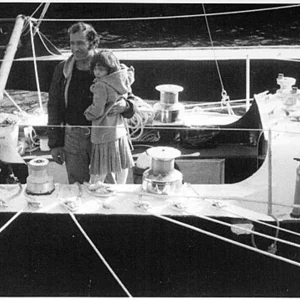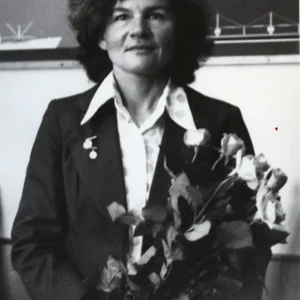

A Polish sailor born in 1936, she became in 1978 the first woman to complete a solo circumnavigation of the globe by sailboat. Her achievement, accomplished aboard the sailboat Mazurek, took 401 days.
Krystyna Chojnowska-Liskiewicz(1936 — 2021)
Krystyna Chojnowska-Liskiewicz
Pologne
7 min read
Frequently asked questions
Key Facts
- Born on July 15, 1936, in Poznań, Poland
- 1978: first woman to complete a solo circumnavigation by sail
- The voyage lasted 401 days (1976–1978) aboard the Mazurek
- A trained naval engineer, she combined technical expertise with athletic achievement
- Honored with numerous Polish awards and distinctions for this achievement
Works & Achievements
A sporting and human achievement consisting of sailing alone around the globe aboard the Mazurek in 401 days. This accomplishment permanently inscribed the name of Chojnowska-Liskiewicz in the history of world navigation.
An autobiographical account of the circumnavigation published in Polish and translated into several languages. The work is considered a valuable testimony on the conditions of solo sailing in the 1970s.
Before her round-the-world voyage, Chojnowska-Liskiewicz worked as an engineer in the Polish shipyards. This technical expertise proved decisive in the preparation and maintenance of the Mazurek during the circumnavigation.
Before her round-the-world voyage, she established herself as one of Poland's top competitive sailors at the national level, accumulating the technical experience essential to her future achievement.
Anecdotes
Krystyna Chojnowska-Liskiewicz was first and foremost a trained naval engineer. A graduate of the Gdańsk University of Technology, she designed ships before deciding to sail one solo around the globe — an unusual path for the era, when women were virtually absent from both shipyards and great ocean crossings.
Her sailboat, the *Mazurek*, was a 9.5-metre Ohlson 33 — a relatively modest vessel for a circumnavigation. Chojnowska-Liskiewicz had been actively involved in its outfitting and technical preparation, drawing on her engineering skills to fine-tune every detail before departing from Las Palmas de Gran Canaria.
The feat took place against the particular backdrop of communist Poland: her voyage enjoyed state support, which saw it as an opportunity for international prestige. Yet radio contact with her family remained rare and difficult from the middle of the ocean, making her isolation all the more oppressive.
As she completed her round-the-world voyage in March 1978, she was in an unofficial race with British sailor Naomi James, who had also set out on a solo circumnavigation. Chojnowska-Liskiewicz arrived first in Las Palmas, securing her place as the first woman ever to have accomplished this feat in the history of world sailing.
On her return to Poland, she was welcomed as a national hero. The government awarded her numerous honours, including the Order of the Banner of Labour. Her achievement was celebrated both as a symbol of Polish national pride and as striking proof of women's emancipation in elite sport.
Primary Sources
An autobiographical account in which Krystyna Chojnowska-Liskiewicz describes, day by day, each leg of her circumnavigation — the storms she weathered in the South Atlantic, technical stopovers, and moments of absolute solitude on the open sea.
Document certifying the departure from Las Palmas de Gran Canaria on 28 March 1976 and the return on 21 March 1978, officially ratifying Krystyna Chojnowska-Liskiewicz's solo circumnavigation as the first ever completed by a woman.
Poland's leading daily newspaper of the era devoted its front page to the sailor's homecoming, hailing her as “the pride of the Polish navy and an ambassador for her country on every ocean in the world.”
Key Places
Birthplace of Krystyna Chojnowska-Liskiewicz in 1936. An industrial and university city in western Poland, it shaped the rigorous and methodical character of the future sailor.
A Baltic port city where Chojnowska-Liskiewicz studied naval engineering and developed her passion for sailing. It was in this maritime environment that she conceived and planned her circumnavigation project.
The port of departure and arrival for Chojnowska-Liskiewicz's round-the-world voyage. She set sail on 28 March 1976 and returned triumphant on 21 March 1978, officially completing her historic circumnavigation.
The artificial waterway linking the Atlantic to the Pacific, crossed by the *Mazurek* during the first leg of the voyage. This passage was a crucial technical milestone in the westward circumnavigation.
The southern tip of Africa, feared by sailors for its fierce winds and rough seas. Rounding this cape marked one of the most perilous stages of Chojnowska-Liskiewicz's journey.
Typical Objects

A 9.5-metre sailing yacht built to a Swedish design. It was aboard the Mazurek that Chojnowska-Liskiewicz covered more than 40,000 nautical miles in 401 days, facing every ocean on the globe.

An astronomical navigation instrument used to measure the angle of celestial bodies in order to determine a vessel's position on the open sea. In 1976–1978, GPS did not yet exist, and the sextant was indispensable for any long-distance voyage.

Maritime charts showing seabed features, currents, ports, and hazardous zones. Chojnowska-Liskiewicz carried dozens of charts covering every ocean she crossed during her circumnavigation.

A shortwave transceiver capable of communication over long distances. It was the only means for the sailor to maintain sporadic contact with Poland and to receive weather bulletins.

The official record in which a navigator notes the position, speed, weather, and incidents each day. The Mazurek's logbook served as the basis for the autobiographical account that Chojnowska-Liskiewicz published after her return.

Waterproof overalls and thermal clothing essential for holding the helm in bad weather. During the storms of the South Atlantic and the rounding of the Cape of Good Hope, this equipment was vital for the sailor.
School Curriculum
Vocabulary & Tags
Key Vocabulary
Daily Life
Morning
At dawn, Chojnowska-Liskiewicz would take her position at the sextant, observing the rising sun, calculating her course, and logging the data in her logbook. She would then inspect the sails, rigging, and hull for any damage sustained during the night.
Afternoon
The afternoon was devoted to active navigation: trimming the sails to the wind, making minor equipment repairs, listening to weather bulletins on the HF radio, and servicing the auxiliary engine or navigation instruments whenever sea conditions allowed.
Evening
In the evening, she would take another astronomical fix by the stars, plan the next day's leg, and write up her logbook. Before allowing herself a few hours of sleep in watches, she would set an alarm to check her course regularly and avoid any risk of collision.
Food
Aboard the *Mazurek*, the diet relied mainly on tinned food, freeze-dried meals, and dry provisions (rice, pasta, legumes) taken on at departure. When the sea was calm, she could supplement her meals with fish caught by trolling.
Clothing
At sea, Chojnowska-Liskiewicz wore functional clothing: a wool sweater, a waterproof watch suit, and sea boots in bad weather. In tropical waters, she opted for lighter garments but always kept an oilskin within reach.
Housing
The *Mazurek* offered very limited living space: a narrow bunk in the forward cabin, a saloon fitted with a chart table, a gas stove, and a radio set. Living in this confined space for more than a year demanded strict organisation and constant adaptation to the boat's movements.
Historical Timeline
Period Vocabulary
Liens externes & ressources
Références
Œuvres
Circumnavigation en solitaire à la voile — première mondiale féminine
28 mars 1976 – 21 mars 1978
Pierwsza dookoła świata (La première autour du monde)
1979
Carrière d'ingénieure navale à Gdańsk
Années 1960–1970
Palmarès national de voile en compétition
Années 1960–1970