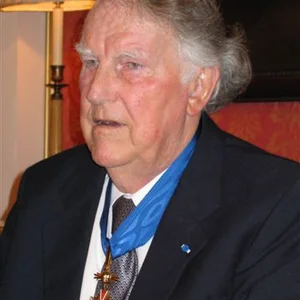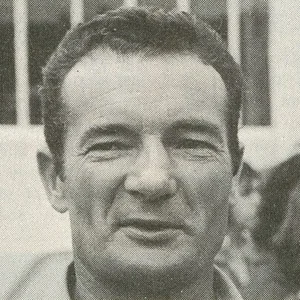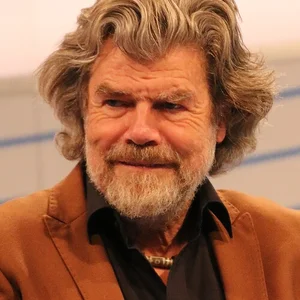

Italian mountaineer born in 1944, Reinhold Messner was the first person to climb all 14 peaks above 8,000 metres. He was also the first to summit Everest solo and without supplemental oxygen.
Reinhold Messner(1944 — ?)
Reinhold Messner
Italie
7 min read
Frequently asked questions
Famous Quotes
« The mountain is not conquered; one conquers oneself.»
« True mountaineering is exposing yourself to danger with intelligence.»
Key Facts
- 1970: first ascent of the Rupal Face of Nanga Parbat (8,125 m)
- 1978: first ascent of Everest without supplemental oxygen, with Peter Habeler
- 1980: first solo ascent of Everest
- 1986: last of the 14 eight-thousanders summited, a feat unique in the world at the time
- 2010: elected to the European Parliament as a member for Italy
Works & Achievements
Considered one of the greatest achievements in the history of mountaineering, this feat demonstrated that human beings can survive and function at the summit of the world without artificial respiratory assistance.
Messner climbed Everest alone, from Tibet, in three days from the north base camp. This entirely solo achievement remains one of the most admired and discussed performances in contemporary mountaineering.
Over sixteen years, Messner summited all 14 peaks above 8,000 metres, often in alpine style and without supplemental oxygen. He became the first mountaineer to complete this full collection, a standard now recognised worldwide.
Together with Arved Fuchs, Messner crossed the Antarctic continent in 92 days over 2,800 kilometres, without mechanical assistance or aerial resupply, demonstrating exceptional versatility in extreme exploration.
Six museums housed in various castles and sites across the Dolomites, dedicated to mountains, Alpine and Himalayan cultures, and the history of mountaineering. This major cultural project is recognised by UNESCO.
A landmark book in which Messner chronicles the story of his fourteen Himalayan ascents. Translated into numerous languages, it has become a classic of adventure literature and an invaluable historical document.
Anecdotes
In 1970, Reinhold Messner and his brother Günther completed the first ascent of the Rupal Face of Nanga Parbat, the highest rock face in the world. On the descent, however, Günther was swept away by an avalanche. Reinhold survived, but lost seven toes to frostbite — an injury that would mark his life forever.
In 1978, Messner and his partner Peter Habeler climbed Everest without using a single bottle of supplemental oxygen. The scientific community had declared this physiologically impossible: doctors believed the human brain could not function at 8,848 metres without additional oxygen. Messner and Habeler proved them wrong, upending the accepted wisdom of world mountaineering.
In August 1980, Messner completed the first solo ascent of Everest, without supplemental oxygen and without any climbing partner. It took him three days to reach the summit from the Tibetan north base camp, sleeping alone in a small tent above 8,000 metres, in extreme silence and solitude.
On 16 October 1986, Messner reached the summit of Lhotse, becoming the first mountaineer to have climbed all 14 peaks above 8,000 metres. He had accomplished this feat over sixteen years, often in alpine style (without high-altitude porters or supplemental oxygen), redefining the standards of Himalayan mountaineering.
In 1989–1990, Messner crossed Antarctica on foot with German adventurer Arved Fuchs in 92 days, without any mechanical assistance. This 2,800-kilometre journey across the polar ice showed that his taste for extreme challenge extended far beyond the boundaries of mountaineering.
Primary Sources
We climbed the highest face in the world. But on the way back, I lost my brother. I still don't know how to speak of it.
Without oxygen, every step above 8,000 metres demands absolute concentration. The world shrinks to the width of a crampon.
I am alone on the highest mountain on Earth. No voice, no rope, no safety net. Just the mountain and me.
It wasn't competition that drove me to climb all fourteen eight-thousanders, but curiosity: how far can a human being go on their own?
Key Places
Reinhold Messner's hometown, located in the South Tyrolean Alps. Messner grew up in a large German-speaking family at the foot of the Dolomites, where he learned to climb from childhood.
Messner's main residence since the 1980s, a medieval castle he restored and transformed into a home and place of memory. He grows vines there and keeps collections of Himalayan sacred art.
The world's highest peak (8,849 m), which Messner climbed twice: in 1978 without oxygen alongside Peter Habeler, then in 1980 solo and without supplemental oxygen — two landmark achievements that define modern mountaineering.
The world's ninth-highest mountain (8,126 m), where in 1970 the Messner brothers made the first ascent of the Rupal Face, during which Günther died tragically. This ordeal profoundly shaped Reinhold's life and philosophy.
The southernmost point on Earth, reached on foot by Messner and Arved Fuchs during their crossing of Antarctica in 1989–1990, proving that Messner's spirit of adventure extended far beyond mountain summits.
Liens externes & ressources
Références
Œuvres
Première ascension de l'Everest sans oxygène artificiel (avec Peter Habeler)
8 mai 1978
Première ascension solitaire de l'Everest
20 août 1980
Accomplissement des 14 huit-milles
1970–1986
Traversée de l'Antarctique à pied
1989–1990
Réseau MMM — Messner Mountain Museum
2006–2015
Alle 14 Achttausender (Tous les 8000)
1988