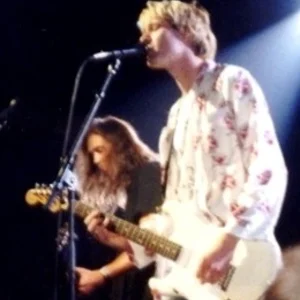

Kurt Cobain (1967-1994) was an American musician, singer, guitarist, and songwriter for the band Nirvana. A major figure of the grunge movement, he became one of the icons of the 1990s alternative rock scene before his untimely death at the age of 27.
Kurt Cobain(1967 — 1994)
Kurt Cobain
États-Unis
6 min read
Frequently asked questions
Famous Quotes
« It's better to burn out than to fade away.»
Key Facts
- Born on February 20, 1967, in Aberdeen, Washington (United States)
- Co-founded the band Nirvana in 1987 with Krist Novoselic
- Released the album Nevermind in 1991, which popularized grunge worldwide
- Died on April 5, 1994, in Seattle, at the age of 27
Works & Achievements
Nirvana's first album, released on the independent label Sub Pop, with the heavy, raw sound typical of early grunge.
The album that propelled Nirvana to global stardom and turned grunge into a cultural phenomenon; it contains "Smells Like Teen Spirit."
An iconic single that became the anthem of a disenchanted teenage generation in the 1990s.
Another major single from "Nevermind," famous for its distinctive guitar line.
The third studio album, harder and more personal, on which Cobain returned to a raw and sincere sound.
The flagship single from "In Utero," noted for its enigmatic lyrics and surreal music video.
An acoustic live album released after his death, considered one of the finest testaments to his artistry.
Anecdotes
Kurt Cobain grew up in Aberdeen, a small working-class town in Washington State shaped by the timber industry. As a teenager, he sometimes slept under a bridge near the Wishkah River when things at home grew too tense, a difficult period that later fed into his songs.
Left-handed, Kurt nonetheless played guitars built for right-handers that he simply flipped over, lacking the money to buy a model suited to him. He had a habit of smashing his instruments at the end of concerts, to the point that the band was constantly buying cheap gear to replace them.
In 1991, Nirvana's album *Nevermind* knocked *Dangerous* by Michael Pop King... sorry, by Michael Jackson, off the top of the American charts, an event that surprised everyone, including the record label. The phenomenal success thrust grunge, until then an underground genre, onto the world stage.
Kurt Cobain was uncomfortable with his sudden fame and often criticized the idea that his rebellious songs had become commercial hits. He publicly denounced sexism, racism, and homophobia, stances that were rare for a rock star of his stature at the time.
The acoustic *MTV Unplugged* concert recorded in November 1993 shows a stripped-down Cobain, playing unexpected covers rather than his hits. Released after his death, this recording has become one of the most moving testaments to his talent.
Primary Sources
“With the lights out, it's less dangerous / Here we are now, entertain us” — a chorus that became the disillusioned anthem of an entire generation.
Cobain's handwritten notebooks blend song lyrics, drawings, lists, and reflections on music and his life, revealing his creative process.
Acoustic concert recorded on November 18, 1993, where Cobain performs Nirvana songs and covers (Lead Belly, David Bowie, Meat Puppets).
In it, Cobain expresses his unease with fame and his refusal to see Nirvana embraced by a section of the audience he felt was contrary to his values.
Key Places
Kurt Cobain's hometown, a small working-class city in the American Northwest. Its grey, gloomy atmosphere shaped his sensibility.
The birthplace of the grunge movement where Nirvana broke through, and the city where Cobain died in 1994.
A university town at the heart of the independent music scene where Cobain lived and mixed with other artists during Nirvana's early days.
The recording studio where Nirvana recorded the album “Nevermind” in 1991. Its raw atmosphere matched the band's sound.
The recording location for the acoustic concert “MTV Unplugged in New York” in November 1993.