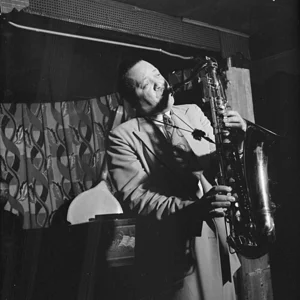

Lester Young (1909-1959) was an American tenor saxophonist considered one of the fathers of cool jazz. His lyrical, airy style influenced generations of musicians, most notably Charlie Parker.
Lester Young(1909 — 1959)
Lester Young
États-Unis
8 min read
Frequently asked questions
Famous Quotes
« I'm not going to play nothing that ain't pretty.»
Key Facts
- Born on August 27, 1909 in Woodville, Mississippi
- Collaborated with Count Basie from 1936 to 1940, a foundational period
- Developed a revolutionary tenor style, lighter than Coleman Hawkins
- Nicknamed 'Pres' (President) by Billie Holiday, his musical companion
- Died on March 15, 1959 in New York
Works & Achievements
Lester Young's first major recording with Count Basie, revealing his lyrical and innovative style from the very start of his career. This George Gershwin standard served as his calling card and marked the beginning of his national recognition.
A composition recorded with the Kansas City Six that became his signature theme. The title, a pun on his first name, captures his buoyant, airborne style that renewed the vocabulary of the tenor saxophone.
A legendary series of recording sessions for the Vocalion and Columbia labels, representing the peak of their artistic bond. These records are now considered among the finest pages in the history of jazz.
A blues recorded just after his release from military detention, its title taken from the abbreviation "Detention Barracks." A deeply personal and painful work, it stands as a direct musical testament to the trauma he endured.
A vast body of recordings produced by Norman Granz for his Clef and later Verve labels, spanning the last two decades of his life. These records document his evolution toward a more introspective and melancholic style.
A filmed solo performed alongside Billie Holiday on the television broadcast *The Sound of Jazz*. Played with extreme economy of notes and rare emotional intensity, this solo is widely regarded as one of the most moving in the history of jazz.
Anecdotes
Billie Holiday and Lester Young invented nicknames for each other that became part of jazz history: she called him "Pres
(short for
President
)
because she considered him the president of the saxophone. In return
he gave her the nickname
Lady Day." This deep and tender friendship lasted their entire lives and inspired some of the most moving recordings in American jazz.
Lester Young held his tenor saxophone in a highly unusual way: he tilted it horizontally to the right, nearly parallel to the floor, in stark contrast to the standard vertical hold. This distinctive posture, mocked by some of his peers, became one of his most recognizable visual signatures on stage.
In 1944, Lester Young was forcibly drafted into the U.S. Army. Arrested for possession of marijuana and barbiturates, he was court-martialed and imprisoned for fifteen months in a disciplinary battalion. This traumatic experience broke something in him; his physical and mental health never fully recovered.
Lester Young was the inventor of an original jazz slang that eventually made its way into mainstream American culture. He coined expressions such as "bread" for money
eyes" to express desire, and "Von Hangman" for boredom. His linguistic innovations had a lasting influence on the way jazz musicians spoke.
On December 8, 1957, Lester Young and Billie Holiday came together one final time in front of CBS cameras for the broadcast "The Sound of Jazz." Both artists, worn down by hard lives, played together with a heartbreaking intimacy. Less than two years later, they were both dead — each passing in 1959, just a few months apart.
Primary Sources
"I was born in Mississippi, but I grew up in Kansas City… I played everything — drums, violin, French horn — before settling on the saxophone." Lester Young reflects on his origins, his musical training, and his vision of jazz in a candid, relaxed conversation.
Lester Young's first official recording, captured during the November 9, 1936 session in Chicago with Count Basie's orchestra. The record already reveals his airy phrasing and warm tone, radically different from the dominant style of Coleman Hawkins.
An exceptional audiovisual document capturing the last public meeting between Lester Young and Billie Holiday. Young plays 'Fine and Mellow' with a heartbreaking economy of notes, illustrating his mastery of lyricism and musical space.
A composition recorded just after his release from the military disciplinary battalion ("DB" standing for Detention Barracks). This slow, melancholic blues is read as a direct testament to the trauma he suffered during his imprisonment.
Key Places
Lester Young's hometown, deep in the American South marked by racial segregation. Being born into this hostile environment shaped his sensitivity and his painful relationship with the world.
The city where Lester Young fully developed his style in the 1930s, alongside Count Basie. Kansas City was then the capital of American territorial jazz, with a late-night jam session scene renowned across the country.
Nicknamed "The Street" by musicians, this Manhattan thoroughfare was home in the 1940s to the most important jazz clubs in the United States: the Three Deuces, the Onyx Club, and the Famous Door. Lester Young performed there regularly at the height of his fame.
Lester Young made several visits to Paris, a city where Black American musicians were welcomed without racial discrimination. He was celebrated there as a living legend and found a freedom and dignity that American segregation denied him.
Typical Objects

Lester Young's instrument of choice, which he held tilted horizontally to the right. His choice of mouthpiece and reed allowed him to produce a soft, airy sound, very different from the powerful tone of contemporaries like Coleman Hawkins.

This flat-brimmed, low-crowned hat was Lester Young's distinctive sartorial trademark, worn on every occasion both on stage and in everyday life. He turned it into a style icon in the New York jazz scene of the 1940s and 1950s.

The standard recording medium of the era, made of shellac and spinning at 78 revolutions per minute. Lester Young built most of his recorded catalog on this fragile format before the 33 rpm LP became widespread.

Lester Young was highly particular about his choice of reeds, seeking a flexibility that allowed him to produce the vibratos and glissandos characteristic of his lyrical, song-like style.

Like many jazz musicians of his era, Lester Young regularly drank bourbon. This habit, worsened after the trauma of his military service, contributed to his declining health throughout the 1950s.

The blues — the American roots music from which Lester Young came — formed the foundation of his musical education. He always preserved its structure and emotional expressiveness in his improvisations throughout his career.
School Curriculum
Vocabulary & Tags
Key Vocabulary
Tags
Daily Life
Morning
Lester Young woke up late, often after noon — a common habit among jazz musicians whose gigs ended at dawn. He would have a light breakfast, usually black coffee and toast, before reading the newspapers or listening to records in his hotel room or Harlem apartment.
Afternoon
Afternoons were devoted to tending his instruments, working on new compositions, and rehearsing with his sidemen. He also frequented the neighborhood bars and small restaurants, watching the world go by with the quiet, melancholy gaze that defined him.
Evening
In the evening, Lester Young dressed with care, pulling on his trademark porkpie hat and a well-cut suit. He would head to the club where he was booked, playing several sets into the small hours of the morning, punctuated by conversations with fellow musicians and jazz fans who came out to hear him.
Food
Like many Black jazz musicians of his era, Lester Young ate simply: grilled meats, beans, cornbread — Southern cooking inherited from his Mississippi childhood. Life on the road meant meals at cheap diners; his alcohol consumption grew steadily worse after the trauma he suffered during military service.
Clothing
Lester Young was known for his effortlessly cool elegance. His black porkpie hat was his absolute trademark, worn even on stage. He favored wide-lapel suits, open-collar shirts, and pointed-toe shoes, blending postwar Harlem style with Midwest influences.
Housing
Lester Young spent most of his adult life in furnished hotel rooms in Harlem and Midtown Manhattan, moving frequently as musical engagements took him from place to place. These modest spaces stood in stark contrast to the artist's fame — he passed the better part of his time in the clubs and streets of New York.