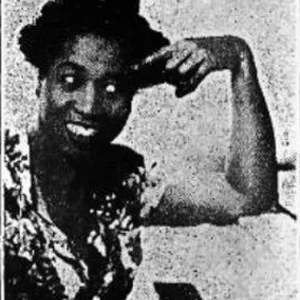

American pianist, composer, and bandleader, one of the first major female figures in jazz. A member of King Oliver's Creole Jazz Band and then a mainstay of Louis Armstrong's Hot Five and Hot Seven, she was also his wife.
Lil Hardin Armstrong(1898 — 1971)
Lil Armstrong
États-Unis
6 min read
Frequently asked questions
Key Facts
- Born on February 3, 1898, in Memphis, Tennessee; died on August 27, 1971, in Chicago.
- Pianist in King Oliver's Creole Jazz Band in Chicago in the early 1920s.
- Founding member of Louis Armstrong's Hot Five and Hot Seven, whom she married in 1924.
- Composer of standards such as “Struttin' with Some Barbecue” and “Bad Boy.”
- A female jazz pioneer: she led her own bands in the 1930s.
Works & Achievements
Pianist, composer, and organizer of these legendary sessions that revolutionized jazz and launched Louis Armstrong as a soloist of genius.
One of her most famous compositions, which became a standard covered by countless jazz musicians.
A song she composed that would go on to enormous success in 1959 thanks to Ray Charles's cover.
She played piano in one of the first major jazz bands ever to record, alongside King Oliver and the young Louis Armstrong.
A composition that would be covered much later by Ringo Starr, a testament to the longevity of her songwriting.
Recorded memoirs in which she recounts her early days, her meeting with Louis, and the role she played in his career — a precious firsthand account.
Anecdotes
When Louis Armstrong arrived in Chicago in 1922 to play alongside King Oliver, it was Lil who spotted his genius and pushed him to stop staying in the shadows. She is said to have declared that she didn't want to be married to a “second trumpeter”: she convinced him to leave Oliver, helped him lose weight, dress better and put himself forward. Without her, Louis Armstrong's solo career might never have taken off.
As a teenager and then a young woman in Chicago, Lil earned a few dollars a week as a “sheet-music demonstrator” at the Jones music store: she played the latest hit songs on the piano so that customers would want to buy them. An excellent reader, she could sight-read any piece, which opened the doors of the city's jazz orchestras to her.
Unlike many jazz musicians of her time, who were trained “by ear,” Lil had studied music at Fisk University and earned diplomas from music schools. Able to read and write music, she composed, arranged and organized the famous recording sessions of the Hot Five and Hot Seven.
On August 27, 1971, six weeks after the death of Louis Armstrong, Lil took part in a televised concert held in his memory in Chicago. As she played “St. Louis Blues” on the piano, she collapsed on stage and died instantly. Her life thus ended in the midst of music, dedicated to the man whose legend she had launched.
Primary Sources
Lil recounts how she pushed Louis to become a leading soloist, explaining that she did not want to be married to a “second trumpeter.”
She recalls that when he arrived from New Orleans, the young Louis had not impressed her: pudgy, poorly dressed, and sporting bangs, he made an unremarkable impression before she discovered his talent.
The sleeves and credits bear the name “Lil Hardin Armstrong” on piano, and credit her with compositions such as “Struttin' with Some Barbecue.”
Key Places
Lillian Hardin's birthplace, in the American South, the cradle of her musical roots.
The institution where she studied music, gaining a solid classical training unusual among jazz musicians.
The heart of her career: she worked there as a sheet-music demonstrator, joined King Oliver, recorded the Hot Five, and would live out the rest of her life there.
In the 1930s and 1940s, she led her own orchestras there, hosted radio shows, and continued her career as a bandleader.
Typical Objects

Her lifelong instrument: she used it to accompany King Oliver, drive the Hot Five sessions, and compose her own pieces.

As a young woman, she earned a living playing the latest sheet music for customers at a Chicago music store, and could read and write music better than most jazzmen.

The OKeh recordings of the Hot Five and Hot Seven, pressed onto 78 rpm records, secured her piano playing a place in jazz history.

Trained at Fisk University and then at music schools, she earned degrees that were rare among the jazz musicians of her time.

An elegant bandleader, she designed and sewed some of her own performance outfits, having also trained as a dressmaker.

Beyond music, she trained in dressmaking and worked as a tailor, creating clothes with her own hands.
School Curriculum
Vocabulary & Tags
Key Vocabulary
Tags
Daily Life
Morning
Like any cabaret musician, Lil sleeps in late, since she has played until the early hours. The morning is devoted to rest, correspondence, and managing the band's bookings.
Afternoon
In the afternoon, she rehearses, composes, and arranges at the piano, or goes to the OKeh recording studios. She also takes music classes to earn her degrees.
Evening
The evening is the heart of her day: she performs in the clubs of Chicago's South Side, such as the Dreamland Café and the Lincoln Gardens, leading the band or playing piano late into the night.
Food
Her cooking reflects her Southern roots in Memphis: fried chicken, red beans and rice, and barbecue — the latter even inspiring the title “Struttin' with Some Barbecue.” Meals are eaten at irregular hours, between gigs.
Clothing
On stage, she wears elegant, eye-catching dresses, some of which she designs and sews herself. Around town, she adopts the refined outfits and fashionable cuts of the “Roaring Twenties.”
Housing
She lives in an apartment and then a house in Chicago's South Side (the Bronzeville neighborhood), the heart of the Black community during the Great Migration, and would keep her Chicago home for the rest of her life.