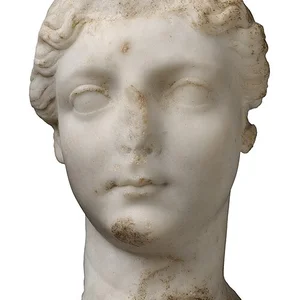

Wife of Emperor Augustus, Livia was one of the most powerful women in ancient Rome. For more than fifty years, she wielded considerable influence over imperial politics. Mother of Emperor Tiberius, she was granted the title of "Augusta" after her death.
Livia(58 av. J.-C. — 29)
Livia
Rome antique
7 min read
Frequently asked questions
Key Facts
- Born in 58 BC, Livia married Augustus in 38 BC after he had her divorced from her first husband, Tiberius Claudius Nero
- She remained Augustus's wife for 51 years until his death in AD 14
- In his will, Augustus adopted her and granted her the title of Augusta, making her the first woman in Roman history to bear that title
- Her son Tiberius succeeded Augustus as the second Roman emperor in AD 14, ensuring the dynastic continuity of the Julio-Claudians
- She died in AD 29 and was deified under Emperor Claudius in AD 42
Works & Achievements
A public monument erected on the Esquiline Hill in Rome, dedicated by Augustus in honor of Livia. This portico surrounded a sanctuary dedicated to Concordia and symbolized the marital harmony of the imperial couple.
Livia had this temple restored and rededicated to Bona Dea, a Roman female deity. This act of piety reinforced her role as a guardian of traditional religious values.
A series of wall paintings adorning the underground triclinium of her villa, depicting a trompe-l'œil garden of remarkable botanical richness. Preserved in the National Roman Museum, they rank among the masterpieces of ancient painting.
Livia funded assistance programs for children from modest families in Rome, anticipating the alimenta later institutionalized by Trajan. These actions contributed to her public image as a benevolent mother of the fatherland.
In his will, Augustus adopted Livia into the Julian family and bequeathed her a third of his fortune, conferring upon her the title of Augusta. This exceptional legal act granted her a formal authority unprecedented for a Roman woman.
Anecdotes
Livia was renowned for her sobriety and restraint, traditional Roman virtues she displayed conspicuously. It is said she spun wool herself and wore clothing woven by the women of her household, deliberately emulating the matrons of the old Republic.
Augustus and Livia married in 38 BC while she was pregnant with her second son by her first husband. This hasty marriage, considered scandalous by some, nevertheless lasted fifty-two years until Augustus's death in AD 14.
Livia owned a magnificent villa on the Palatine Hill, adorned with frescoes depicting a lush garden — the famous 'Villa di Livia' at Prima Porta. These paintings, now preserved in the National Roman Museum, depict birds, fruit trees, and flowers with striking realism.
After Augustus's death, Livia was deified by her grandson Emperor Claudius in AD 42, who granted her the title 'Diva Augusta.' Her cult was celebrated throughout the Empire, which was entirely exceptional for a Roman woman.
Tacitus and other ancient sources credit her with great influence over Augustus in political decisions, particularly in securing pardons or condemnations. Some ancient authors hostile to the Julio-Claudian dynasty even accused her of eliminating potential rivals to place her son Tiberius on the throne.
Primary Sources
Augustus mentions Livia in the context of his testamentary arrangements, bequeathing her a third of his fortune and granting her the title of Augusta.
"Livia, a woman of resolute spirit and masculine judgment, had a mother's indulgence toward Augustus, a wife's compliance; but she was ill-suited to Tiberius's scheming."
"Augustus never wrote anything of importance without first dictating and noting it down, for fear of saying too much or too little from memory. He consulted Livia on affairs of state."
"Livia wielded more power than any woman before her. She attended Augustus's deliberations and received ambassadors in audience."
Key Places
The hill where the imperial family resided. Livia lived here with Augustus in a modest palace, receiving ambassadors and political dignitaries from across the Empire.
Livia's country residence, renowned for its extraordinarily well-preserved garden frescoes. It was here that the famous Augustus of Prima Porta statue was discovered.
A monumental public space built by Augustus where Livia took part in major religious and civic ceremonies. She was honored there alongside her husband as an embodiment of Roman virtues.
After Augustus's death, Livia oversaw the construction and dedication of the temple consecrated to her deified husband, taking on the role of priestess of his cult.
A large public portico built by Augustus in honor of Livia in 7 BC. This monument on the Esquiline Hill reflected her significance in Augustan dynastic propaganda.
Typical Objects

Symbols of Roman domestic virtue, Livia spun wool to display her commitment to traditional values. This practice, mentioned by Suetonius, reinforced her image as an exemplary matron.

The long robe worn by married Roman women, the stola was the emblematic garment of a matrona's status. Livia wore simple ones, woven in her own household, to embody Republican modesty.

Common writing instruments in Rome, Livia used them for her private correspondence and political notes. Augustus consulted her regularly, and she kept personal archives of their exchanges.

Numerous statues of Livia were erected throughout the Empire, depicting her as a goddess or ideal matron. These images served to spread her reputation as the prince's virtuous companion.

After receiving the title of Augusta, Livia was depicted on coins and sculptures wearing the laurel wreath, a symbol typically reserved for emperors and gods.

An exceptional privilege granted to Livia by the Senate, the right to travel by lectica conferred upon her a dignity equal to that of the Vestal Virgins. This mode of transport underscored her unique standing in Rome.
School Curriculum
Vocabulary & Tags
Key Vocabulary
Daily Life
Morning
Rising before dawn, Livia performed her religious devotions to the household Lares at the lararium of her home. She then oversaw the running of her household — stewardship, accounts, instructions to freedmen — before receiving the first visitors of the morning salutatio.
Afternoon
Afternoons were devoted to managing her landed estates and her political correspondence. Livia received female clients (women seeking her intercession), senators, and sometimes foreign ambassadors who solicited her good offices with Augustus.
Evening
The evening meal (cena) was held with family or selected guests. Livia, known for her sobriety, ate frugally — coarse bread, small fish, figs, and wine diluted with water — while observing her fellow diners with careful attention.
Food
Livia was known for her exceptional dietary restraint. Her longevity (87 years) was attributed in antiquity to her consumption of Pucinum wine, a wine from Istria, and to a diet moderate in meat and rich in vegetables, figs, and olive oil.
Clothing
Livia wore the stola, a long woolen or linen robe, and the palla, a large shawl covering the shoulders. She deliberately displayed garments woven within her own household to embody the virtues of the Republican matron, even though her fabrics were in reality of excellent quality.
Housing
Livia resided on the Palatine Hill in the Domus Augustana, a relatively modest house by imperial standards, in keeping with the Augustan propaganda of simplicity. She also owned the splendid Villa di Livia at Prima Porta, complete with gardens, baths, and the celebrated underground garden fresco room.
Historical Timeline
Period Vocabulary
Visual Style
Le style visuel de Livie s'ancre dans l'art de la Rome augustéenne : sobriété aristocratique, marbre blanc, pourpre impérial et fresques de jardins luxuriants, reflets d'un pouvoir discret mais absolu.
Sound Ambience
L'univers sonore de Livie mêle le calme feutré d'une villa patricienne — fontaines, tissage, murmures de conseillers — aux sons discrets du pouvoir romain s'exerçant dans l'ombre.
Liens externes & ressources
Références
Œuvres
Portique de Livie
7 av. J.-C.
Temple de la Bona Dea Subsaxana
vers 10 av. J.-C.
Fresques de la Villa di Livia (Prima Porta)
vers 30-20 av. J.-C.
Institutions caritatives en faveur des enfants pauvres
début Ier siècle ap. J.-C.
Testament d'Auguste — rôle de Livie
14 ap. J.-C.