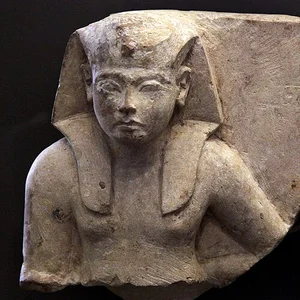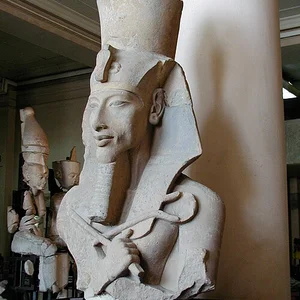

Pharaoh of the 18th Dynasty of Egypt (c. 1353–1336 BCE), Akhenaten revolutionized religion by imposing the monotheistic worship of Aten, the solar disk. He relocated the capital to Akhetaten (Amarna) and profoundly transformed Egyptian art.
Akhenaten(1400 av. J.-C. — 1335 av. J.-C.)
Akhenaten
Égypte antique
8 min read
Frequently asked questions
Key Facts
- c. 1353 BCE: Accession to the throne under the name Amenhotep IV
- c. 1346 BCE: Changed his name to Akhenaten and banned traditional cults
- c. 1346 BCE: Founded the new capital Akhetaten (Akhenaten) at Amarna
- c. 1336 BCE: Death of Akhenaten; restoration of polytheism under his successors
- After his death: Damnatio memoriae — his name was erased from monuments by his successors
Works & Achievements
A major religious poem attributed to Akhenaten himself, inscribed in the tomb of vizier Ay at Amarna. Celebrating the unique creative power of Aten, it bears striking similarities to Psalm 104 of the Hebrew Bible.
The creation from scratch of a royal and religious capital entirely dedicated to Aten, featuring the Great Temple of Aten, the Royal Palace, residential districts, and rock-cut tombs. The earliest known example of a planned city built for ideological purposes.
The first historically attested attempt to impose a monotheistic state cult. Akhenaten suppressed the official polytheistic religion, closed the temples of other gods, and concentrated worship on Aten — of whom the pharaoh alone served as high priest.
A stylistic revolution imposed by Akhenaten that broke with a thousand years of Egyptian artistic conventions: elongated forms, naturalistic family scenes, and depictions of Aten's rays. This unique style disappeared with his reign but left a lasting mark on the art of the 18th Dynasty.
Colossal statues erected in the temples of Aten at Karnak, depicting the pharaoh in the distinctive Amarna style. Smashed after his death, the fragments were rediscovered in 1925 and are now held in the Cairo Museum.
A corpus of 382 clay tablets forming the archive of Akhenaten's international diplomacy with the major powers of the ancient Near East. An exceptional historical source on international relations during the Late Bronze Age.
Anecdotes
Akhenaten first bore the name Amenhotep IV, meaning "Amun is satisfied." Around the fifth year of his reign, he abandoned this name in favor of Akhenaten, meaning "He who is beneficial to Aten," symbolically breaking with the priesthood of Amun that had dominated Egypt for centuries.
To cement his religious revolution, Akhenaten had an entirely new capital city, Akhetaten (present-day Tell el-Amarna), built in less than five years on a virgin site along the Nile. Foundation stelae carved into the cliffs marked the sacred boundaries of the city, which the pharaoh swore never to leave.
Under Akhenaten, Egyptian art underwent a radical transformation: depictions of the pharaoh show him with an elongated face, wide hips, and a protruding belly — the opposite of the traditional artistic conventions. Egyptologists still debate whether this so-called "Amarna style" reflected his actual physical appearance, a symbolic convention, or a deliberate assertion of divine uniqueness.
Akhenaten had at least six daughters with Queen Nefertiti, but no known son by her. The identity of Tutankhamun's mother remains disputed: some scholars believe she was a secondary wife named Kiya, which would make the famous boy pharaoh the direct son of Akhenaten.
After Akhenaten's death, his successor Horemheb and subsequent pharaohs systematically set about erasing all traces of his reign: Aten's temples were dismantled, his name was chiseled off monuments, and Akhetaten was abandoned. This damnatio memoriae led later Egyptians to refer to Akhenaten as "the enemy of Akhetaten."
Primary Sources
How beautiful you are, how great, how dazzling, high above every land. Your rays embrace the lands to the very limits of all that you have created.
His Majesty rode in his electrum chariot… to found Akhetaten for his father the Aten, in this place that he had made for himself, which no god and no goddess has claimed.
Say to the king, my lord, my god, my sun: thus speaks Aziru, your servant. I prostrate myself at the feet of the king, my lord, seven times and seven times.
When you rise, all the flowers bloom; the birds fly from their nests and their wings praise your ka.
Key Places
Capital city founded by Akhenaten around 1346 BCE on the banks of the Nile in Middle Egypt. The city housed royal palaces, temples to Aten, and residential districts. Abandoned after his death, it is now the primary Amarna-period archaeological site.
Great religious complex where Akhenaten, early in his reign, built the Gem-pa-Aten and Hwt-Benben temples dedicated to Aten, before these structures were demolished by his successors.
Royal tomb discovered in 1907, containing a mummy identified by 2010 DNA analysis as the father of Tutankhamun — possibly Akhenaten himself. The mummy's exact identity remains debated.
Ancient administrative capital of Egypt where the cult of Aten also had a presence. Memphis remained a key economic and military center throughout Akhenaten's reign.
Home to the major works from the Amarna period, including the colossal statues of Akhenaten discovered at Karnak and numerous objects found at Amarna that bear witness to the artistic and religious revolution of his reign.
Typical Objects

A blue leather war helmet worn by Akhenaten during official ceremonies. It symbolizes the pharaoh's royal and military authority and appears frequently in Amarna reliefs.

Royal insignia held crossed over the chest, representing sovereignty and mastery over the herds. Akhenaten consistently bears them in official depictions beneath the rays of Aten.

The central symbol of Akhenaten's religious reform: the sun is depicted as a disk whose rays end in hands offering the ankh (symbol of life) to the nostrils of the pharaoh and his family.

Diplomatic archives discovered at Amarna, written in Akkadian, the international language of the Late Bronze Age. They document exchanges between Akhenaten and the kings of Babylon, Mitanni, Cyprus, and the Canaanite vassals.

A vessel used to store embalmed organs during mummification. Canopic jars bearing features of the Amarna style were found in tomb KV55, associated with Akhenaten's immediate circle.

Small private altars depicting Akhenaten, Nefertiti, and their daughters beneath the rays of Aten, found in homes at Amarna. They illustrate the intimate, family-centered dimension the pharaoh gave to his monotheistic cult.
School Curriculum
Vocabulary & Tags
Key Vocabulary
Tags
Daily Life
Morning
Akhenaten rose at dawn to celebrate the rising of Aten, the central liturgical event of his religion. Offering rituals — flowers, bread, fat, and incense — were performed on the open-air altars of the Great Temple of Aten, in the presence of Nefertiti and the royal daughters. The pharaoh was then dressed and adorned by his servants before holding official audiences.
Afternoon
The afternoon was devoted to affairs of state: receiving high officials, reading reports from the viziers, and reviewing diplomatic letters written in Akkadian by the royal scribes. Akhenaten also oversaw the major construction projects at Akhetaten, inspecting the workshops of sculptors and painters who worked in the new Amarna style he had imposed.
Evening
In the evening, Akhenaten retired to the royal palace with Nefertiti and his daughters for the family meal, a recurring theme on the domestic steles found at Amarna. Musicians played harp, lute, and flute during banquets. The day closed with the rites of Aten's setting, mirroring the morning rituals, to ensure the sun's return the following day.
Food
The royal table featured breads made from various flours, fine-quality beer, roasted meats (beef, duck, and goose), and dried or grilled Nile fish. Fruits and vegetables were plentiful: figs, dates, grapes, lettuce, onions, and cucumbers. Vegetable oils and spices imported from Asia and Nubia flavored dishes served on vessels of gold and faience.
Clothing
Akhenaten wore the shendyt, a pleated white linen kilt, often paired with a gilded belt inlaid with faience and semi-precious stones. During ceremonies, he wore the blue crown (khepresh), a broad usekh collar, and gold bracelets. His artistic representations frequently show pleated, translucent garments — an innovation of Amarna fashion that placed greater emphasis on the contours of the body.
Housing
Akhenaten resided in the Great Royal Palace of Akhetaten, a monumental complex comprising hypostyle halls, irrigated gardens, pools, and private quarters whose walls were painted with naturalistic scenes — fish, birds, and marsh plants. The palace also featured the 'Window of Appearances,' from which the pharaoh distributed gold collars to his favored dignitaries, a scene depicted in many tombs of the Amarna nobility.
Historical Timeline
Period Vocabulary
Visual Style
Style amarnien caractéristique : teintes dorées et ocres du calcaire, silhouettes allongées aux formes souples rompant avec les canons classiques, disque solaire Aton aux rayons terminés en mains, scènes familiales intimistes sous une lumière éclatante.
Sound Ambience
Ambiance sonore de la cour royale d'Akhetaton : vent du désert, chants rituels au temple d'Aton à ciel ouvert, sistres et percussions des processions, artisans au travail dans les ateliers du palais.
Liens externes & ressources
Références
Œuvres
Grande Hymne à Aton
vers 1346-1336 av. J.-C.
Fondation d'Akhetaton (Amarna)
vers 1346 av. J.-C.
Réforme religieuse atoniste
vers 1348-1336 av. J.-C.
Programme artistique amarnien
vers 1346-1336 av. J.-C.
Colosses d'Akhenaton (Karnak)
vers 1350 av. J.-C.
Archives diplomatiques (Lettres d'Amarna)
vers 1345-1335 av. J.-C.