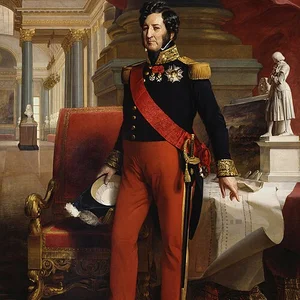

King of the French from 1830 to 1848, Louis-Philippe I came to power following the July Revolution. His July Monarchy embodied the triumph of the liberal bourgeoisie before being overthrown by the Revolution of 1848.
Louis-Philippe I(1773 — 1850)
Louis-Philippe I
France
9 min read
Frequently asked questions
Key Facts
- Born on October 6, 1773, in Paris, son of the Duke of Orléans (Philippe Égalité)
- Proclaimed King of the French on August 9, 1830, following the July Revolution (July 27–29, 1830)
- His reign, the July Monarchy, rested on a revised Charter and a highly restricted property-based suffrage
- Abdicated on February 24, 1848, under pressure from a popular revolution
- Died in exile at Claremont (England) on August 26, 1850
Works & Achievements
Louis-Philippe transformed the Palace of Versailles into a national history museum, bringing together nearly 3,000 paintings and 200 sculptures spanning the entirety of French history. This project of national reconciliation remains his most enduring legacy and established Versailles as the first great museum of French history.
Louis-Philippe organized the solemn transfer of Napoleon's remains from Saint Helena to Paris, witnessed by hundreds of thousands of spectators. This major political event was intended to reconcile France with its imperial past and to strengthen the legitimacy of the Orléanist monarchy.
Begun under Napoleon in 1806, the Arc de Triomphe was completed and inaugurated under Louis-Philippe, who had the list of French military victories engraved upon it. This gesture symbolically united the revolutionary, imperial, and monarchical strands of French heritage.
The obelisk gifted by the Viceroy of Egypt was erected on the very spot where the guillotine had stood during the Revolution, symbolically erasing that traumatic site. This inauguration exemplifies the cultural diplomacy and taste for grand public works that defined the July Monarchy.
Louis-Philippe wrote memoirs recounting his turbulent life, from the Revolution to the July Monarchy. These writings are a valuable source on political life and the extraordinary journey of a prince who became king by the will of the nation.
Anecdotes
Louis-Philippe enjoyed walking the streets of Paris with a simple umbrella, without an escort or ceremony. This habit earned him the nickname "citizen king" and became the symbol of his bourgeois monarchy. The caricaturist Charles Philipon turned it into a mocking emblem, often depicting his head in the shape of a pear — an image that led to repeated legal proceedings.
Before becoming king, Louis-Philippe spent nineteen years in exile. He taught geography at a college in Reichenau, Switzerland, under the pseudonym "Monsieur Chabos." This modest life distanced him from royal formality and shaped his image as a liberal, educated prince in touch with ordinary realities.
As a young man, Louis-Philippe fought in the French Revolutionary armies and was present at the battles of Valmy and Jemappes in 1792 alongside General Dumouriez. He was thus the only King of France to have borne arms under the tricolor flag, which gave him a unique patriotic legitimacy among the monarchs of his era.
In 1837, Louis-Philippe inaugurated the Museum of Versailles, which he had funded out of his own pocket, bearing the motto "To all the glories of France." This monumental project aimed to reconcile all French people around their shared history — from the Merovingians to Napoleon — bringing together nearly 3,000 paintings and 200 sculptures.
On December 15, 1840, Louis-Philippe organized the solemn return of Napoleon I's remains from Saint Helena to Les Invalides in Paris. The event was of extraordinary scale: the coffin passed through Paris in bitter cold before hundreds of thousands of onlookers, in a politically ambiguous gesture designed to appropriate the glory of the Napoleonic legacy.
Primary Sources
I have always regarded myself as a citizen invested with the highest office of the State, and it is as a citizen that I have sought to fulfill my duties toward France.
The Charter will henceforth be a reality. I am French, I have shared your struggles for liberty, and I will never renounce its principles.
The King's government will seek to keep itself equally removed from two excesses equally to be avoided: a return to the institutions of the Ancien Régime and revolutionary enterprises.
We will seek to hold to this middle ground, equally removed from the excesses of popular power and the abuses of royal power.
The King of the French is not the King of France. I reign not by divine right, but by national will, and it is to the nation that I must account for my actions.
Key Places
The ancestral residence of the Orléans family, the Palais-Royal was Louis-Philippe's political cradle before his accession to the throne. It was here that he received the delegation of deputies who offered him the crown in July 1830.
Louis-Philippe transformed Versailles into a national museum of French history, inaugurated in 1837, at considerable personal expense. It remains his most enduring and most visited legacy.
Louis-Philippe's favourite summer residence and a symbol of the bourgeois, family-centred lifestyle of the Orléanist monarchy. The château was demolished after 1848; all that remains today is the avenue that bears its name.
It was on the balcony of the Hôtel de Ville, wrapped in the tricolour flag alongside Lafayette, that Louis-Philippe secured his popular legitimacy in July 1830. This symbolic scene allowed him to prevail over the republicans.
Louis-Philippe's final place of exile after the revolution of 1848, where he died on 26 August 1850. This English country house was his last refuge, as it had been for other deposed European monarchs before him.
Typical Objects

An iconic attribute of Louis-Philippe, the umbrella symbolized his image as a bourgeois king who sought to appear close to ordinary citizens. Caricaturists of the era made it the emblem of his prosaic, unspectacular monarchy.

The founding document of the July Monarchy, the revised Charter limited royal powers and enshrined fundamental civil liberties. Louis-Philippe swore to uphold it, marking a definitive break with the divine conception of kingship.

Louis-Philippe frequently appeared in National Guard uniform to assert his commitment to civic and patriotic values. This symbolic gesture showed that he saw himself more as a citizen-soldier than as an absolute monarch.

Louis-Philippe held a particular reverence for Henry IV, his direct ancestor, regarded as the model of a good king beloved by his people. Portraits and busts of the Vert-Galant adorned his private apartments as a genuine political statement.

The leading newspaper of Orléanist liberalism, which Louis-Philippe read diligently to keep track of bourgeois public opinion. The press played a pivotal role in the political life of the July Monarchy, and the king was one of its most attentive readers.

Louis-Philippe personally oversaw the commissioning of paintings for the Versailles museum, selecting subjects and artists with meticulous care. This passion for the visual arts resulted in hundreds of works being commissioned from painters such as Horace Vernet.
School Curriculum
Vocabulary & Tags
Key Vocabulary
Daily Life
Morning
Louis-Philippe rose early and devoted his mornings to audiences and affairs of state, receiving ministers and ambassadors at the Tuileries. He carefully read the major newspapers of the day to take the pulse of bourgeois public opinion. His grooming was understated for a king: dark frock coat, white cravat, with no excess of pomp.
Afternoon
Afternoons were devoted to cabinet meetings, the signing of decrees, and diplomatic visits. He would occasionally allow himself a stroll through the Tuileries gardens or at Neuilly, umbrella under his arm, affecting the simplicity of a well-to-do bourgeois. He also kept a close eye on the artistic works commissioned for the Versailles museum.
Evening
Evenings at court blended diplomatic receptions, concerts, and theatrical performances in a style far less ostentatious than under the Bourbons. Louis-Philippe and Queen Marie-Amélie favored family dinners and political discussions in small, intimate circles. He retired early, keeping the regular habits he had adopted during his long years of exile.
Food
Louis-Philippe's table reflected the bourgeois sobriety he affected: classic French cuisine, good food without extravagance, Bordeaux and Burgundy wines. He was particularly fond of family meals, an image he carefully cultivated to contrast with the splendor of previous courts. Official banquets nonetheless remained lavish during major diplomatic receptions.
Clothing
Louis-Philippe deliberately adopted bourgeois dress in daily life: a black or midnight-blue frock coat, light-colored trousers, white cravat, and understated waistcoat. He wore full court attire only for official ceremonies, preferring the National Guard uniform for public appearances. His black silk umbrella had become his signature accessory, a symbol of his prosaic monarchy.
Housing
Louis-Philippe officially resided at the Tuileries Palace in Paris — the royal residence since Henry IV — which he inhabited without great enthusiasm. He preferred the Château de Neuilly, less formal, where his large family could live more freely in the bourgeois manner. He stayed at Versailles for inaugurations and major ceremonies at the museum he had created.
Historical Timeline
Period Vocabulary
Visual Style
Style romantique et bourgeois de la Monarchie de Juillet : tons profonds et chauds, intérieurs cossus, peinture historique mêlant néoclassicisme et romantisme à la Horace Vernet.
Sound Ambience
Ambiance sonore parisienne de la Monarchie de Juillet : rues animées au pavé, salons bourgeois feutrés, débats parlementaires et grandes réceptions aux Tuileries.