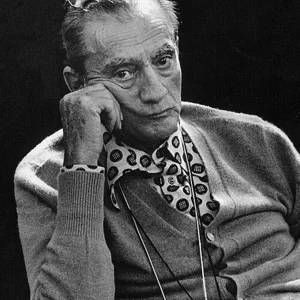

Italian filmmaker and stage director, a count by birth and a Marxist by conviction. A pioneer of neorealism before crafting grand historical frescoes with sumptuous aesthetics, he was also a major director of theatre and opera.
Luchino Visconti(1906 — 1976)
Luchino Visconti
Italie, royaume d'Italie
6 min read
Frequently asked questions
Key Facts
- Born in 1906 in Milan into a family of the high Lombard aristocracy
- Directed Ossessione in 1943, often regarded as the founding work of Italian neorealism
- Shot La terra trema (1948) with real Sicilian fishermen speaking their own dialect
- Adapted Lampedusa's The Leopard in 1963, winning the Palme d'Or at Cannes that same year
- Directed Death in Venice (1971), based on Thomas Mann; died in Rome in 1976
Works & Achievements
Visconti's first film, censored under Fascism; regarded as one of the founding works of Italian neorealism.
A drama shot with real Sicilian fishermen speaking in their own dialect, a manifesto of neorealism.
A grand historical fresco in color about the Risorgimento, marking Visconti's shift toward an aestheticized auteur cinema.
A powerful account of a southern family's migration to Milan, a social fresco of Italy during the economic miracle.
An adaptation of Tomasi di Lampedusa's novel about the decline of the Sicilian aristocracy; Palme d'Or at Cannes.
A celebrated opera production in which Visconti directed Maria Callas, showcasing his genius as an opera director.
An adaptation of Thomas Mann, the pinnacle of Visconti's decadent and melancholic aesthetic.
A sumptuous biography of King Ludwig II of Bavaria, a portrait of the solitude and downfall of a sovereign.
Anecdotes
Luchino Visconti was born in 1906 into one of Italy's oldest aristocratic families: the **Visconti** had ruled over **Milan** in the Middle Ages. A count by birth, raised in luxury and passionate about racehorses, he nonetheless became a committed Marxist and joined the Italian Communist Party. This contrast between his princely origins and his revolutionary ideas marked his entire body of work.
It was the fashion designer **Coco Chanel** who introduced the young Visconti to the French filmmaker **Jean Renoir** in the mid-1930s. Having become his assistant in **Paris**, Visconti learned the director's craft on French film sets before returning to Italy to shoot his own films.
His first film, *Ossessione* (1943), shot in the midst of the fascist dictatorship, shocked **Mussolini**'s censors and the Church with its raw depiction of adultery and crime. The authorities tried to destroy the copies of the film, which was nearly lost; today it is considered one of the founding works of neorealism.
Visconti was famous for his obsessive pursuit of historical accuracy. For his costume epics, he had the dresser drawers of the sets filled with real clothing and real linen, even though the camera would never film them: he wanted his actors to truly “live” in the reconstructed past.
In 1963, his epic *The Leopard*, adapted from **Tomasi di Lampedusa**'s novel about 19th-century Sicily, won the Palme d'Or at the **Cannes** Film Festival. Visconti was also a great opera director: he directed the soprano **Maria Callas** at **La Scala** in Milan in performances that have remained legendary.
Primary Sources
What interests me is anthropomorphic cinema: it is living people who attract me, human things, and not the machine nor abstraction.
I wanted to make a cinema that speaks of the humble, of fishermen and workers, and that shows their lives as they really are, in their own true language.
I want everything to be true, down to the last object in a drawer that no one will ever see; only in this way can the actors believe in their characters.
Key Places
Visconti's birthplace, cradle of his aristocratic family. He would later stage operas there at the famous La Scala theatre.
The city where the young Visconti became Jean Renoir's assistant in the mid-1930s and learned the craft of filmmaking.
The fishing village where Visconti shot “The Earth Trembles” (1948) with the locals themselves, speaking their Sicilian dialect.
Setting of “Death in Venice” (1971), where Visconti filmed the Lido and the city struck by the epidemic.
Island in the Bay of Naples where Visconti owned a villa, a retreat where he welcomed artists and friends.
The city where Visconti lived, worked near the Cinecittà studios, and where he died in 1976.
Typical Objects

Device that records moving images, the director's basic tool. Visconti used it to compose carefully arranged shots like paintings.

A slate fitted with a clapping arm, used at the start of each take to synchronize image and sound and to note the scene number.

Written text that describes the story, the dialogue and the breakdown of the film's scenes, the basis for the whole crew's work.

Painstakingly recreated historical garments that Visconti demanded be authentic down to the smallest detail for his grand epics such as *The Leopard*.

A book of written music that guides singers and orchestra. Visconti, a great opera director, staged operas at La Scala in Milan with Maria Callas.

Antique furniture, chandeliers and drapery brought together to recreate the interiors of the aristocratic palaces Visconti loved to film.

Powerful lamp that lights up filming scenes. Visconti used it to sculpt the light and achieve his sumptuous atmospheres.
School Curriculum
Vocabulary & Tags
Key Vocabulary
Daily Life
Morning
Born into the aristocracy, Visconti often began his days late, but with great discipline in his work. During filming, he would arrive early on set or at the **Cinecittà** studios to check the sets and costumes before the actors arrived.
Afternoon
His afternoons were spent directing the actors, reshooting scenes tirelessly, and attending to every detail of the lighting and framing. When not filming, he prepared his opera and theatre productions, or read the novels he dreamed of adapting.
Evening
In the evenings, Visconti welcomed artists, writers, and actors into his Roman residences or at his villa on **Ischia**. A passionate music lover, he listened to a great deal of classical music and frequented the theatres and opera houses.
Food
A lover of fine Italian dining, he appreciated refined cuisine and wines, a legacy of his aristocratic background. Meals were also occasions for artistic and political discussion with his guests.
Clothing
Elegant and impeccably groomed, Visconti wore tailor-made suits, true to his upbringing as a Milanese grandee. This taste for refinement also fed his extreme demands regarding the costumes in his films.
Housing
He lived in vast residences, including a large house in **Rome** and the villa *La Colombaia* on the island of **Ischia**. These luxurious places, filled with works of art and antique furniture, reflected his world as a count-turned-filmmaker.
Historical Timeline
Period Vocabulary
Liens externes & ressources
Références
Œuvres
La terre tremble (La terra trema)
1948
Rocco et ses frères (Rocco e i suoi fratelli)
1960
Le Guépard (Il Gattopardo)
1963
Mort à Venise (Morte a Venezia)
1971