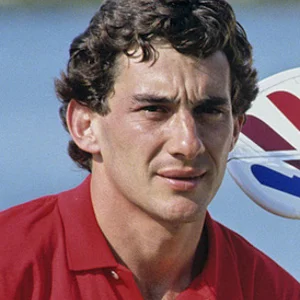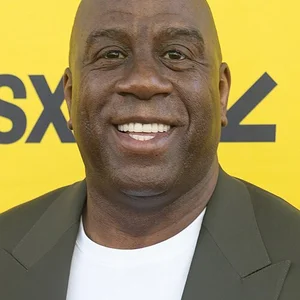

Earvin "Magic" Johnson is an American basketball player, the iconic point guard of the Los Angeles Lakers in the 1980s. Considered one of the greatest players in history, he left his mark on the sport through his court vision and his rivalry with Larry Bird.
Magic Johnson(1959 — ?)
Magic Johnson
États-Unis
5 min read
Frequently asked questions
Key Facts
- Born on August 14, 1959, in Lansing, Michigan.
- NCAA champion in 1979 with Michigan State, defeating Larry Bird and Indiana State.
- Won five NBA titles with the Lakers (1980, 1982, 1985, 1987, 1988), embodying the “Showtime” style of play.
- Announced in 1991 that he was HIV-positive and retired, becoming a spokesperson in the fight against AIDS.
- Olympic champion in 1992 in Barcelona as a member of the American “Dream Team.”
Works & Achievements
College champion at 19 by beating Larry Bird, a foundational duel for American basketball.
At 20, he played center in the deciding game and was named Finals MVP, a unique feat for a rookie.
A pillar of the “Showtime” dynasty, he won five championships during the decade.
Honored as the league's best player, confirming his dominance over the game.
A member of the first U.S. team of professionals, which dominated the Barcelona Games.
A foundation created to support HIV prevention and fund educational programs in underserved communities.
Anecdotes
In 1979, during his freshman year at Michigan State, Magic Johnson faced Larry Bird and his Indiana State team in the NCAA college championship final. That game remains one of the highest-rated television broadcasts in the history of college basketball and launched their legendary rivalry, which would last throughout their careers.
In his very first NBA Finals game in 1980, at just 20 years old, Magic Johnson stepped in to replace the injured center Kareem Abdul-Jabbar at the center position — even though he himself was a point guard. He scored 42 points, grabbed 15 rebounds, and dished out 7 assists, clinching the title for the Lakers and becoming the youngest player ever named Finals MVP.
Magic Johnson stands 6 feet 9 inches tall (2.06 m), an unusual height for a point guard in his era, which allowed him to see over the defense. His spectacular passing and fast-paced style, nicknamed “Showtime,” turned the Lakers into a show and helped popularize the NBA around the world.
On November 7, 1991, Magic Johnson announced at a press conference that he was HIV-positive and ended his career. At a time when the disease was surrounded by fear and prejudice, his courage helped change the public's view of AIDS and promote prevention.
Despite his retirement, Magic was voted to play in the 1992 All-Star Game, where he was named the game's MVP. That same year, he was part of the “Dream Team,” the first U.S. squad made up of professional NBA players, which won gold at the Barcelona Olympic Games.
Primary Sources
“Because of the HIV virus that I have attained, I will have to retire from the Lakers today.”
In it, Johnson recounts his childhood in Lansing, his rise in basketball, and the announcement of his illness, offering a first-hand account of his career.
Magic Johnson reflects on his rivalry with Larry Bird and the friendship born of their clashes, acknowledging how important their duel was for the NBA.
Key Places
Magic Johnson's hometown, where he grew up in a modest family and started playing basketball in high school.
University where Magic led the team to the NCAA title in 1979, before joining the NBA.
The Lakers' legendary arena during the “Showtime” era, where Magic played most of his games and won his titles.
Host city of the 1992 Olympic Games, where Magic won gold with the American Dream Team.
Typical Objects

The purple and gold number 32 jersey became inseparable from Magic Johnson. It was retired by the Lakers in tribute, meaning no other player will ever wear it.

An orange ball with black seams, the central instrument of the game. Magic handled it with exceptional dexterity despite his great height.

The golden trophy awarded each year to the NBA champion team. Magic lifted it five times with the Lakers during the 1980s.

Leather high-top sneakers designed to support the ankle during jumps and changes of direction. The 1980s models accompanied the rise of sports marketing.

A target made of a rim and net attached to a backboard, set at a height of 3.05 m. It is the goal of every shot in basketball.

An international symbol of solidarity with people affected by HIV. Magic Johnson became a leading awareness figure after his 1991 announcement.
School Curriculum
Vocabulary & Tags
Key Vocabulary
Tags
Daily Life
Morning
During his career, mornings were dedicated to physical training and weightlifting sessions. Magic looked after his fitness to sustain the Lakers' fast-paced game.
Afternoon
Afternoons combined team practices, tactical work on the court, and rehearsing passing combinations. He also studied his opponents' game.
Evening
On game nights, the atmosphere at the Los Angeles Forum was electric, full of celebrities and spectacle. There Magic unleashed his spectacular offensive game before sold-out crowds.
Food
Like any top-level athlete, he followed a diet rich in protein and carbohydrates to fuel his effort. Hydration and recovery were essential between games.
Clothing
On the court, he wore the Lakers' purple and gold jersey, shorts, and high-top sneakers. Off the court, he enjoyed elegant suits, the image of the star athlete of the 1980s.
Housing
Having become a star in Los Angeles, he lived in vast California estates, far from the modest house of his childhood in Lansing.
Historical Timeline
Period Vocabulary
Liens externes & ressources
Références
Œuvres
Titre NCAA avec Michigan State
1979
Premier titre NBA et MVP des finales
1980
Cinq titres NBA avec les Lakers
1980-1988
Trois titres de MVP de la saison régulière
1987, 1989, 1990
Médaille d'or olympique avec la Dream Team
1992
Magic Johnson Foundation
1991