
Pakistani activist for girls' education
Malala Yousafzai(1997 — )
Malala Yousafzai
Pakistan
9 min read
Frequently asked questions
Key Facts
- Née en 1997 à Mingora, dans la vallée du Swat au Pakistan, région sous influence des talibans qui interdisent l'éducation des filles à partir de 2007
- En 2009, à 11 ans, elle tient un blog anonyme pour la BBC Ourdou décrivant la vie sous le régime taliban et défendant le droit des filles à l'école
- Le 9 octobre 2012, elle est grièvement blessée par balle dans son bus scolaire par un taliban qui la visait délibérément ; elle survit après des soins au Royaume-Uni
- En 2013, elle fonde le Fonds Malala pour promouvoir l'éducation des filles dans le monde et publie son autobiographie 'Moi, Malala'
- En 2014, à 17 ans, elle reçoit le prix Nobel de la paix, devenant la plus jeune lauréate de l'histoire de ce prix
Works & Achievements
Anonymous chronicles published on the BBC Urdu website, in which the young Malala described life under the Taliban in the Swat Valley. This diary brought Malala to the world's attention and triggered international awareness of the situation facing Pakistani girls.
Autobiography co-written with journalist Christina Lamb, tracing her childhood in the Swat Valley, the rise of the Taliban, the assassination attempt, and her recovery. A global bestseller translated into more than 40 languages, used in numerous international school curricula.
Address delivered to the UN Youth Assembly on her 16th birthday, which has become one of the defining speeches of the 21st century on education and children's rights. It inspired UN Resolution 66/222 on the right to education.
The world's most prestigious award, jointly awarded with Kailash Satyarthi, recognising her fight for the right to education for girls and children. At 17, Malala remains the youngest Nobel laureate in history.
International organisation founded with her father Ziauddin, aimed at ensuring 12 years of quality education for 12 million girls worldwide. Active in around ten countries, the fund finances educational programmes and trains local activists ('Malala Fund Changemakers').
A book gathering testimonies from young refugee girls from around the world whom Malala met on her travels. The work gives a voice to those whom conflict has torn from their homes and their right to education.
Anecdotes
At age 11, Malala began keeping an anonymous blog for the BBC in Urdu under the pseudonym 'Gul Makai', recounting her life under Taliban rule in the Swat Valley. She described the daily fear, the closure of girls' schools, and her determination to keep learning despite the threats.
On October 9, 2012, Malala was targeted by a Taliban gunman on her school bus in Pakistan. The bullet passed through her skull and neck. Rushed to Great Britain for emergency care, she survived after several complex surgeries and was discharged from hospital with minor after-effects, resuming her studies a few months later.
On July 12, 2013, her 16th birthday, Malala delivered a speech before the United Nations General Assembly in New York. Wearing Benazir Bhutto's shawl, she declared before hundreds of world representatives: 'One child, one teacher, one book and one pen can change the world.' This date is now celebrated as Malala Day.
In 2014, at age 17, Malala Yousafzai became the youngest Nobel Peace Prize laureate in history, awarded jointly with Indian activist Kailash Satyarthi for their struggle for children's rights. When the prize was announced, she was in a maths class at her school in Birmingham, England.
Malala founded the Malala Fund in 2013 with her father Ziauddin, an organization working to ensure that 12 million girls around the world can access 12 years of quality education. The fund is active in countries such as Pakistan, Afghanistan, Nigeria, Syria, and Brazil.
Primary Sources
I am terrified. The Taliban radio has banned girls from going to school. From tomorrow, girls will no longer be able to go to school. How many of us will go to school tomorrow, knowing it might be the last time?
The Taliban thought that bullets would silence us. But they failed. And then, out of that silence, thousands of voices emerged. The terrorists thought they would change our goals and stop our ambitions, but nothing in my life has changed, except this: weakness, fear and hopelessness died. Strength, power and courage were born.
My father used to say: 'Malala will be free as a bird.' In our culture, it is said that girls are the property of their husband. My father thought differently. He gave me his family name, whereas in our tradition it is the son who carries it.
I follow in the footsteps of the prophets and heroes who came before me, among them Nelson Mandela, Martin Luther King and Mother Teresa. But I am also Malala. My voice is not my own — it is the voice of all those girls who are asking for education.
Since August 2021, Afghan girls over the age of 12 have been denied schooling. This represents 1.1 million girls. We call on the international community to act immediately to restore their fundamental right to education.
Key Places
Malala's hometown, nestled in a mountainous valley in northwestern Pakistan, once nicknamed the 'Switzerland of the East'. It is here that she grew up, attended her father's school, and began resisting the Taliban occupation.
It was in this hospital, specialised in neurosurgery, that Malala was operated on following the October 2012 attack. She spent several weeks there between life and death before beginning her remarkable recovery.
It was in the hall of the United Nations General Assembly that Malala delivered her historic speech on 12 July 2013, before hundreds of world representatives, to demand universal education for girls.
Venue for the Nobel Peace Prize ceremony, where Malala received the medal on 10 December 2014 in the presence of King Harald V of Norway. Her acceptance speech has become a landmark text in the history of human rights.
Malala studied Philosophy, Politics and Economics (PPE) at Oxford between 2017 and 2020, successfully earning her degree. Studying at one of the world's most prestigious universities represented for her the victory of education over violence.
Typical Objects

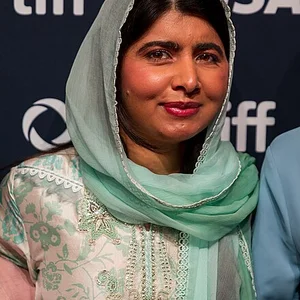
Malala always wears a colorful shawl on her head, a symbol of her Pashtun culture and identity. During her speech at the UN, she wore the pink shawl that had belonged to Benazir Bhutto, as a tribute to the assassinated former Pakistani Prime Minister.

For Malala, the book represents the most powerful weapon against ignorance and oppression. She always carries books over her shoulder and considers education an inalienable right of every child in the world.

The pen is the central symbol of Malala's fight. She declared: 'One child, one teacher, one book and one pen can change the world.' The pen represents the power of words in the face of the violence of weapons.

Presented in Oslo on December 10, 2014, this medal consecrates Malala's fight for universal access to education for girls. She is the youngest person ever to have received it in the entire history of the Nobel Prize.

The school backpack has become the visual emblem of the Malala Fund's campaigns. It symbolizes the right of every girl in the world to go to school, whether in Pakistan, Afghanistan, Syria, or Africa.

Malala uses media and social networks as tools for global advocacy. Her radio-broadcast speech at age 11 against the Taliban, followed by her addresses broadcast around the world, have made her voice an instrument of change.
School Curriculum
Vocabulary & Tags
Key Vocabulary
Daily Life
Morning
Malala woke up early to get ready before school, beginning with the Fajr prayer with her family. She put on her school uniform — a dark shalwar kameez with a dupatta over her head — and had a frugal breakfast of chapati, eggs, and spiced chai tea with her parents and two brothers.
Afternoon
After school, run by her father Ziauddin in their neighborhood of Mingora, Malala would read and do her homework, often discussing politics and current events with her father, who encouraged her to speak her mind. From 2009 onward, she devoted time to writing her columns for the BBC, precisely describing what she observed around her.
Evening
Evenings were spent as a family around a traditional Pashtun meal — pilaf rice, lentil dal, vegetables, and naan bread — accompanied by long conversations. Malala loved listening to the radio and watching the news, developing an interest in political issues from childhood as her father explained them to her. The family recited their prayers before bed.
Food
Traditional Pashtun diet from northern Pakistan: chapati (flatbread), basmati rice, dal (spiced lentils), lamb or chicken in sauce, vegetables sautéed with spices, yogurt, seasonal fruits. Sweet spiced chai tea (with cardamom and cinnamon) was drunk morning, noon, and evening.
Clothing
Malala wears the traditional Pashtun shalwar kameez — a long tunic over loose trousers — paired with a colorful dupatta (soft veil) draped over her head, a symbol of cultural respect rather than oppression. She prefers bright colors — pink, orange, red — which reflect the traditional embroidery of the Swat region.
Housing
The Yousafzai family lived in a modest house in Mingora, the main town of the Swat Valley. The home was simple — a few rooms around an interior courtyard, with colorful rugs, bookshelves, and a radio. Her father's school was attached to their home, making education the center of their daily life.
Historical Timeline
Period Vocabulary
Visual Style
Palette visuelle inspirée des couleurs du Swat — ocres, verts montagnards et roses vifs des broderies pachtounes — mêlant l'esthétique de la miniature sud-asiatique à la force documentaire du photojournalisme contemporain.
Sound Ambience
Ambiance sonore de la vallée de Swat au Pakistan, mêlant les sons quotidiens d'un village de montagne, l'appel à la prière, les voix d'enfants à l'école et la nature verdoyante, évoquant à la fois la beauté du cadre et la tension politique sous-jacente.
Liens externes & ressources
Références
Œuvres
Blog BBC Ourdou — Journal de Gul Makai
2009
Moi, Malala (I Am Malala)
2013
Discours devant l'ONU — Journée Malala
12 juillet 2013
Prix Nobel de la paix
2014
Fondation du Fonds Malala
2013
We Are Displaced (Nous sommes déplacés)
2019