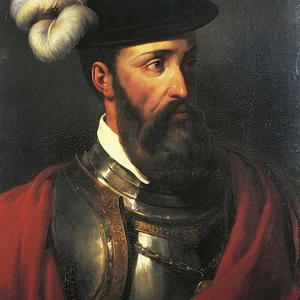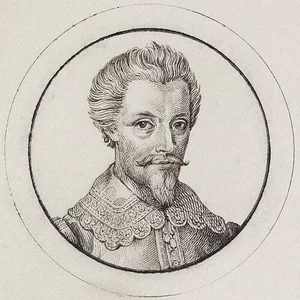

Abel Tasman was a Dutch navigator and explorer in the service of the Dutch East India Company (VOC). In 1642, he became the first European to reach Tasmania and New Zealand, pushing the boundaries of geographical knowledge of his time.
Abel Tasman(1603 — 1659)
Abel Tasman
Provinces-Unies
7 min read
Frequently asked questions
Key Facts
- Born around 1603 in Lutjegast, in the Dutch Republic
- Entered the service of the Dutch East India Company (VOC)
- In 1642, reached the land he named Van Diemen's Land, now Tasmania
- In 1642, first European to sight New Zealand
- Second expedition in 1644 along the northern coasts of Australia; died in 1659 in Batavia
Works & Achievements
Major expedition during which Tasman discovered Tasmania, New Zealand, Tonga, and Fiji, completing the first partial circumnavigation of the Australian continent from the south.
Handwritten document kept during the expedition, preserved in the Dutch National Archives. It constitutes the main historical source on the European discovery of Tasmania and New Zealand.
Second expedition during which Tasman mapped approximately 4,000 km of Australia's northern coast, demonstrating that New Holland and New Guinea are two distinct landmasses.
Map resulting from the second voyage, which remained for a century the most complete representation of the Australian coasts and was used as a reference by European navigators until the explorations of James Cook.
Anecdotes
During his 1642 expedition, Tasman sighted a coast he named **Van Diemen's Land** in honor of Anthony van Diemen, Governor-General of the VOC who financed the voyage. He never set foot on the island, merely sailing along its shores from his ships. It was not until 1856 that the island was renamed **Tasmania** in his honor.
In December 1642, when his men attempted to make contact with Māori warriors off the coast of New Zealand, the encounter turned tragic: four Dutch sailors were killed in their boats. Tasman immediately named the site **'Murderers' Bay'** (Moordenaar's Bay) and made no further attempts to land, departing without ever setting foot on solid ground.
Despite two major expeditions covering thousands of kilometers, the VOC was disappointed with Tasman's results: he had found neither gold, nor valuable spices, nor wealthy civilizations to trade with. His discoveries were deemed unprofitable, and no further major expeditions were funded in the region for decades.
During his first voyage, Tasman became the first European to sight the **Tonga** and **Fiji** islands. In Tonga, the encounter with local inhabitants was friendly and festive, allowing the sailors to replenish their supplies of fresh water and fruit — a precious luxury after weeks at sea.
His second voyage in 1644 enabled him to map some 4,000 km of Australia's northern coast, proving that **New Holland** and **New Guinea** are two distinct landmasses. This map remained one of the most accurate representations of the region for a century.
Primary Sources
In his journal, Tasman describes sighting the coast of Van Diemen's Land on November 24, 1642: a high, wooded land that he could not approach due to contrary winds and waves breaking on the rocks.
The Governor-General of the VOC orders Tasman to search for the "great unknown southern land" and assess whether it offers commercial opportunities for the Company, particularly in precious metals, spices, and populations likely to become trade partners.
Upon his return, Tasman reports the discovery of several new lands—Van Diemen's Land, New Zealand, Tonga, and Fiji—but emphasizes that his crews were unable to land safely or establish lasting commercial contacts.
After the first voyage, pilot Frans Visscher drew a map detailing the newly discovered lands and the routes taken, which was subsequently incorporated into the VOC's cartographic archives in Batavia.
Key Places
Main port and administrative center of the VOC in Asia, where Tasman embarked and returned after each expedition. It was from this port that he set sail for his two great voyages of exploration.
Large island southeast of Australia, first sighted by a European on 24 November 1642. Tasman named it in honor of Anthony van Diemen; the island bore his own name from 1856 onward.
Bay on the South Island of New Zealand where, in December 1642, the first violent contact between Europeans and Māori occurred, resulting in four deaths among the Dutch crew. Tasman named it Moordenaar's Bay.
Archipelago in the South Pacific visited by Tasman in January 1643, where contacts with the local population were peaceful and festive. It was one of the few successful landings of his first voyage.
Tasman sighted these islands in February 1643, becoming the first European to report them. Navigation in shallow waters and reefs proved particularly perilous for his ships.
Typical Objects

Navigation instrument used to measure the height of the sun or stars to calculate latitude. Tasman and his navigators used it daily to determine their position on the open sea.

Essential tool aboard VOC ships to maintain course on the high seas. Without the compass, crossing the vast unknown oceans of the southern hemisphere would have been impossible.

Register kept daily by the captain, recording the ship's position, weather conditions, and notable events. Tasman's log is one of the major historical sources on his discoveries.

Hand-annotated nautical charts showing known coasts and depths. Tasman helped enrich them with his own surveys of southern lands.

Flag of the Dutch East India Company, flown on all of Tasman's ships. It symbolized the commercial and military authority of the Dutch Republic over the world's seas.

Used to measure watch durations and estimate ship speed with the log line. On long voyages, time was carefully counted.

Firearm carried by VOC ship crews during landings. During the tragedy at Murderers' Bay in New Zealand, the sailors were armed but could not prevent the disaster.
School Curriculum
Vocabulary & Tags
Key Vocabulary
Daily Life
Morning
Captain Tasman rises at dawn to review the night's readings: estimated position, course steered, speed measured by log. He consults his charts and discusses route adjustments with pilot Frans Visscher based on observed winds and currents.
Afternoon
The afternoon is devoted to active navigation: observing the sun with the astrolabe to calculate latitude, dictating logbook entries, inspecting the ship and provisions. During coastal discovery phases, Tasman personally supervises cartographic surveys from the poop deck.
Evening
In the evening, the captain holds council with his officers around a chart laid on the table in the great cabin. They assess remaining supplies and the risks of approaching unknown coasts. A simple meal—soup, ship's biscuit, salted meat—is shared with senior officers.
Food
Aboard VOC ships, the diet consisted of ship's biscuit, salted meat and fish, dried vegetables, and beer. During successful stops like the Tonga Islands, crews replenished with fresh fruit and fresh water, thus preventing scurvy, dreaded by all sailors.
Clothing
At sea, Tasman wore the practical attire of a 17th-century Dutch officer: thick woolen breeches, linen shirt, buttoned jacket, and a broad hat to protect against sun and spray. During official landings, he donned more formal clothing symbolizing the authority of the VOC.
Housing
While traveling, Tasman lodged in the captain's cabin at the stern of the ship, a modest room where he kept his navigation instruments, charts, and logbook. In Batavia, between expeditions, he resided in official quarters provided by the VOC.
Historical Timeline
Period Vocabulary
Visual Style
Le style s'inspire de la peinture maritime néerlandaise du Siècle d'or : mers sombres et dramatiques, navires de la VOC toutes voiles dehors, cartes anciennes aux contours encore inachevés et côtes australes enveloppées de mystère.
Sound Ambience
L'ambiance sonore mêle les bruits d'un navire de la VOC en pleine mer — craquements, voiles et vagues — aux sons mystérieux et inquiétants des côtes inconnues du Pacifique Sud.
Liens externes & ressources
Références
Œuvres
Premier voyage d'exploration dans l'hémisphère sud
1642-1643
Journal du premier voyage (1642-1643)
1643
Second voyage d'exploration (1644)
1644
Carte de la Nouvelle-Hollande
1644