
La Divina, the most celebrated opera soprano of the 20th century
Maria Callas(1923 — 1977)
Maria Callas
États-Unis, Grèce
8 min read
Frequently asked questions
Key Facts
- Née à New York en 1923 de parents grecs, Maria Callas débute sa formation musicale au Conservatoire d'Athènes dans les années 1930
- Elle triomphe à la Scala de Milan à partir de 1950, s'imposant comme la plus grande soprano dramatique de son époque
- Sa voix exceptionnelle couvre trois registres (mezzo, soprano lyrique et soprano colorature), lui permettant d'interpréter un répertoire unique de Bellini à Verdi
- Dans les années 1950-1960, elle contribue à la renaissance du bel canto et redonne vie à des opéras oubliés de Donizetti et Rossini
- Elle met fin à sa carrière scénique en 1965, laissant un héritage discographique considérable avant de mourir à Paris en 1977
Works & Achievements
Considered one of the greatest recordings in opera history, this Norma reveals Callas's ability to unite bel canto virtuosity with dramatic depth. It remains the absolute reference for this role.
Callas restores the nobility of the role of Violetta by stripping away the tradition of pure vocalism to create a profoundly human portrait. Her Traviata remains unmatched in the final scene.
In the role of the mad Lucia, Callas demonstrates that the ornaments of bel canto are not mere exercises in virtuosity but the very expression of a character's mental disintegration.
Callas's Medea is a monument: she resurrects a nearly forgotten opera and turns it into one of her iconic roles, embodying with terror and pity the murderous mother of Greek mythology.
These filmed and published teaching sessions constitute an exceptional pedagogical document in which Callas passes on her conception of opera to the new generation, insisting on the primacy of text and genuine emotion.
Recorded in a few days in Milan, this Tosca is considered by musicologists to be the greatest opera recording of the 20th century. De Sabata's conducting and Callas's voice merge in an absolute sense of dramatic urgency.
Anecdotes
Maria Callas was born in New York in 1923 to Greek parents, but it was in Greece, during the Nazi occupation, that she forged her voice. She sang in Athens theaters under the German boot, a period she rarely spoke about, preferring to keep those dark years secret.
In 1954, Callas achieved one of the most spectacular physical transformations in opera history: she lost over thirty kilograms in a matter of months, dropping from 92 to 62 kg. Gossips claimed she had swallowed a tapeworm; the truth was far more mundane — a drastic diet — but the legend lives on.
In 1958, Callas interrupted a performance of Norma at the Metropolitan Opera in New York after the first act, feeling unwell. President Eisenhower was in the audience. The scandal was worldwide; the American press lambasted her, but doctors later confirmed she was suffering from acute laryngitis.
Her break with shipping magnate Aristotle Onassis, who chose Jackie Kennedy over her in 1968, shattered Callas for good. She confided to close friends: 'I gave him everything I had, including my voice.' She died alone in Paris in 1977, at just 53, of a heart attack.
Callas was known for demanding rigorous musicological preparation: she studied not only the score but also the historical sources behind the character she was portraying. For Medea or Violetta, she would read the original Greek texts or Dumas fils's novel before even opening the libretto.
Primary Sources
You taught me that the voice is nothing without intelligence and sincerity. I owe you everything I am on stage.
I do not sing for the audience, I sing for the character. If Violetta weeps, it is not I who weeps, it is she. But I must understand why she weeps.
I am above all an artist, and a sick artist cannot sing. Had I continued, I would have ruined the evening and my voice for several months.
Vocal technique is the means, never the end. You must forget your voice in order to think only of the text, the word, the musical phrase.
My mother wanted a boy. When I was born, she refused to look at me for several days. Perhaps my whole life I have been trying to prove that I existed.
Key Places
La Scala is the temple of Callas's career in the 1950s. It is there that she triumphs in Norma, Lucia, Medea and La Traviata under the baton of the greatest conductors. She is dismissed in 1958 following a conflict with the management.
It is in Athens that Callas receives her true musical training under Elvira de Hidalgo, a Spanish soprano who passes on to her the secrets of bel canto and teaches her the technique of long breath control.
Callas settles in Paris in the 1960s following her break with Meneghini. It is in this apartment in the 16th arrondissement that she will die alone in September 1977, surrounded by a few domestic staff.
It is in this open-air Roman amphitheatre that Callas takes her first steps in Italy in 1947, in Ponchielli's La Gioconda. This mythical venue, with its thousands of spectators and monumental sets, marks her entry into the international circuit.
Covent Garden is the other legendary stage of Callas's career. Her return in 1964 in Tosca is greeted as a historic event, despite the fragility of a voice already showing signs of fatigue.
Typical Objects

Callas worked on her scores with extreme meticulousness, annotating every indication of nuance, tempo, and vocal color. Her copies of Norma, Lucia di Lammermoor, or La Traviata were covered in pencil notes.

She spent hours in front of the mirror working on her characters' expressions, believing that the face must reflect every sung emotion. Her stagecraft was as rigorous as her vocal work.

Callas's costumes, designed notably by the La Scala workshops, were works of art in their own right. The La Traviata gown embodied both bourgeois elegance and the fragility of the dying courtesan.

Between 1952 and 1969, Callas recorded around twenty complete operas for EMI, which form the core of her discography. These records remain absolute references for singers worldwide.

In her private life, Callas had adopted an elegant and understated style — dark glasses, silk scarves — inherited from her years alongside Onassis, which made her as much a fashion icon as an opera one.

Throughout her career, Callas rehearsed at the piano with her répétiteurs, tirelessly going over the same musical phrases to refine expression and diction, always seeking the meaning of the text behind the note.
School Curriculum
Vocabulary & Tags
Key Vocabulary
Daily Life
Morning
Callas rose late, around 9 or 10 a.m., especially on performance days. She would begin with light vocalises at half-covered voice to 'wake up' her voice, and have a frugal breakfast — black coffee, toast — while reading Italian or French newspapers.
Afternoon
The afternoon was devoted to piano rehearsals with her vocal coach, score study, or costume fittings. She could work four to five hours straight on a single opera act, pursuing the perfection of every musical intention.
Evening
Performance evenings began with an unchanging ritual: two hours before curtain rise, Callas would withdraw to her dressing room to apply her makeup, concentrate, and warm up her voice. After the show, she would join gala dinners where she was the undisputed queen, but returned home early to protect her voice.
Food
During her years of success, Callas followed a strict diet to maintain her figure — vegetables, grilled fish, little red meat, alcohol in moderate amounts. She avoided foods irritating to the vocal cords (spices, cold milk) and drank warm water with honey before singing.
Clothing
In the city, Callas favored a chic and understated style — Chanel suits, Hermès scarves, dark sunglasses. On stage, she wore historically inspired costumes designed by the greatest Italian ateliers, always rigorously tailored to the character she embodied and never to passing fashion.
Housing
She lived successively in Verona then Milan with her husband Meneghini (a bourgeois villa, grand piano, musical library), then aboard Onassis's yacht Christina, a floating palace of luxury. Her final years were spent in a comfortable but solitary apartment in the 16th arrondissement of Paris.
Historical Timeline
Period Vocabulary
Visual Style
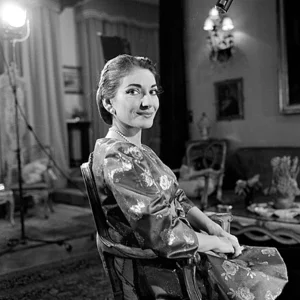
Un style visuel entre glamour opératique des années 1950 — velours bordeaux, ors et marbres — et photographie expressionniste en clair-obscur, reflet d'une personnalité à la fois souveraine et profondément mélancolique.
Sound Ambience
Un mélange de grandeur lyrique — l'acoustique d'un opéra, l'orchestre qui s'accorde, la foule qui retient son souffle — et d'intimité méditerranéenne, la mer grecque et les répétitions au piano dans une loge parisienne.