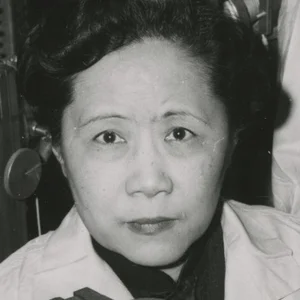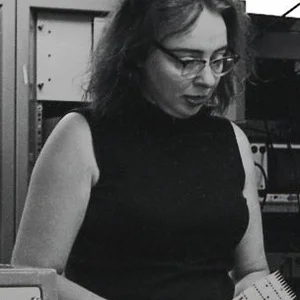

Marie Tharp was an American geologist and cartographer who produced the first scientific maps of the ocean floor. By mapping the Mid-Atlantic Ridge, she provided decisive visual proof of the theory of continental drift — long overlooked because of her status as a woman.
Marie Tharp(1920 — 2006)
Marie Tharp
États-Unis
8 min read
Frequently asked questions
Key Facts
- 1948: Joins the Lamont Geological Observatory at Columbia University, where she begins mapping the ocean floor
- 1952: Discovers the Rift Valley at the center of the Mid-Atlantic Ridge, a key piece of evidence for plate tectonics
- 1977: Publishes with Bruce Heezen the panoramic world map of the ocean floors, released by National Geographic
- 2001: Named by the Library of Congress as one of the four greatest cartographers of the 20th century
- Long excluded from ocean voyages because women were considered “bad luck” aboard research vessels
Works & Achievements
First detailed scientific map of the Mid-Atlantic Ridge, revealing the central rift valley. This work provided the decisive cartographic evidence for continental drift.
Major publication in the Special Papers of the Geological Society of America, describing for the first time the complete structure of mid-ocean ridges and their geodynamic significance.
Extension of the cartographic work to the third major oceanic basin in the world, confirming the universality of the mid-ocean ridge system.
Mapping of the world's largest ocean, completing alongside the Atlantic and Indian a global vision of Earth's submarine relief.
Cartographic masterpiece depicting the entirety of the world's ocean floors. Distributed by the National Geographic Society, this map became one of the most reproduced scientific images of the 20th century.
Anecdotes
When Marie Tharp presented Bruce Heezen with her first maps revealing a rift valley at the center of the Mid-Atlantic Ridge, he dismissed her work with a wave of his hand, declaring it was 'girl talk'. It took two years and additional seismic data before he admitted she was right and that the discovery confirmed continental drift.
Marie Tharp was not allowed to board Columbia University's research vessels in the 1950s, as superstitious maritime tradition held that the presence of women on board was a bad omen. She therefore worked on land, turning the sounding data brought back by her male colleagues into maps, reconstructing underwater landscapes she would never see with her own eyes.
Her monumental map of the ocean floor, published in 1977 with Bruce Heezen and edited by the National Geographic Society, was so accurate and aesthetically striking that it was hung in millions of classrooms around the world. Painter Heinrich Berann gave it a unique artistic dimension, but the scientific data came entirely from Marie Tharp.
In 1952, while methodically plotting bathymetric profiles of the North Atlantic, Marie Tharp noticed that the ocean floor displayed a repeated V-shaped structure, identical to a volcanic rift valley. This observation, drawn from miles of sonar data, would provide the missing geographical evidence for the theory of plate tectonics, long dismissed by the scientific community.
It was not until 1998, nearly fifty years after her landmark discovery, that Marie Tharp received official recognition: the Library of Congress named her one of the four most important cartographers of the 20th century. She had spent decades in the shadow of her male colleagues before her foundational role was fully acknowledged.
Primary Sources
This panoramic map of the ocean floor, produced by Marie Tharp and Bruce Heezen with illustrator Heinrich Berann, depicts for the first time the entire global submarine relief with scientific precision. It reveals the mid-ocean ridge system extending over 65,000 km.
"I just had to do the work. Draw the profiles, over and over, until the truth appeared in the data. The ocean floors don't lie."
Marie Tharp describes the process of compiling bathymetric data and emphasizes the need for a representation that is both scientifically rigorous and visually accessible to the general educational public.
The authors describe the mid-ocean ridge system and the central rift valley as a continuous, dynamic structure, consistent with a model of seafloor spreading.
Key Places
Laboratory where Marie Tharp worked from 1948 to 1982. It is here that she drew her revolutionary maps of the ocean floors, based on data collected by Bruce Heezen's ships.
Underwater mountain range extending from north to south across the Atlantic, whose central rift valley Marie Tharp discovered — decisive proof of seafloor spreading.
Marie Tharp's hometown, where she was born on July 30, 1920. Her father, a soil cartographer, passed on to her from childhood a love of maps and the representation of territory.
Town where Marie Tharp spent her final years and where she passed away in 2006. She kept her cartographic archives there until their donation to the Library of Congress.
Institution that holds Marie Tharp's cartographic archives and which, in 1998, officially named her one of the four most important cartographers of the 20th century.
Typical Objects
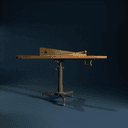
Marie Tharp worked at a large drafting table, using rulers, compasses and precision instruments to manually plot thousands of bathymetric profiles from columns of figures obtained from sonar soundings.
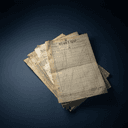
Rolls and bundles of raw numerical data, collected by research vessels, formed the raw material of Tharp's work. She converted them into visual representations of the underwater terrain.
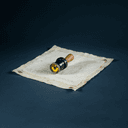
Her maps were drawn in ink on tracing paper, allowing for successive overlays and corrections in an entirely manual and hand-crafted cartographic process.
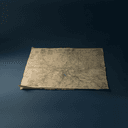
Tharp drew on techniques for representing terrestrial relief to invent a cartographic symbology suited to the ocean floor, a domain with no established conventions at the time.
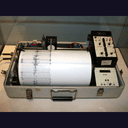
Unable to board the research vessels herself, Tharp used seismic data from underwater earthquakes to corroborate her maps and locate active rift zones.
📷 Wikimedia · Wikimedia Commons ↗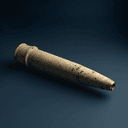
These samples from the ocean floor, brought back by expeditions, allowed Tharp to validate her cartographic interpretations and clarify the geological nature of the relief features depicted.
School Curriculum
Vocabulary & Tags
Key Vocabulary
Tags
Daily Life
Morning
Marie Tharp arrived early at her office at the Lamont Observatory, often before her colleagues. She would begin by unrolling the new columns of bathymetric data received by mail from research vessels onto her large drafting table. She had a black coffee while organizing her spreadsheets before starting to plot.
Afternoon
Afternoons were devoted to the meticulous plotting of ocean floor profiles, line by line, column of figures after column of figures. She compared her plots with already completed profiles, looking for recurring patterns, anomalies, and coherent structures that gradually emerged from the apparent chaos of the raw data.
Evening
In the evenings, Marie Tharp would compare her day's plots against available terrestrial geological maps and seismic data. She annotated her observations, drafted notes for Bruce Heezen, and prepared questions to raise at team meetings. She often went home late, continuing to think about underwater structures on her commute.
Food
Like many scientists of the era, Marie Tharp led a simple, functional life. Meals at the laboratory cafeteria or sandwiches eaten at her desk were common during periods of intensive work. She appreciated convivial dinners with colleagues to discuss scientific developments.
Clothing
In the laboratory, Marie Tharp wore the plain professional attire typical of women scientists in the 1950s: midi skirts or tailored trousers, collared blouses, and sometimes a white lab coat. Practical and unconcerned with ostentation, she favored comfort for the long hours spent bent over her drafting table.
Housing
Marie Tharp lived in the New York area, first in Manhattan and then in the vicinity of the Lamont Observatory in the Hudson Valley. Her apartment or home reflected the environment of a passionate scientist: books, maps, and research documents occupied a prominent place in her personal space.
Historical Timeline
Period Vocabulary
Visual Style
L'univers visuel de Marie Tharp est celui des cartes bathymétriques en camaïeux de bleus profonds et de bruns ocre, alliant rigueur scientifique et puissance évocatrice des paysages sous-marins révélés pour la première fois.
Sound Ambience
L'univers sonore de Marie Tharp mêlait le silence concentré d'un laboratoire de cartographie des années 1950, le bruissement des grandes feuilles de papier calque et le bruit lointain du fleuve Hudson longeant les falaises de Palisades.
Liens externes & ressources
Références
Œuvres
Carte de la dorsale médio-atlantique
1957
The Floors of the Oceans (avec Bruce Heezen et Maurice Ewing)
1959
Carte du fond de l'océan Indien
1964
Carte du fond de l'océan Pacifique
1969
World Ocean Floor Panorama (avec Bruce Heezen et Heinrich Berann)
1977