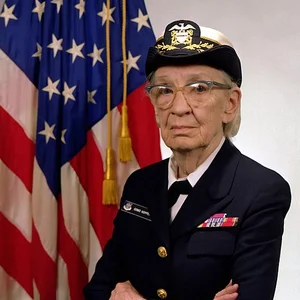

Grace Hopper, American mathematician and rear admiral, is one of the pioneers of computer science. She developed one of the first compilers and contributed to the creation of the COBOL programming language, revolutionizing programming. She popularized the term "bug" in computing after finding a real insect inside a computer.
Grace Hopper(1906 — 1992)
Grace Hopper
États-Unis
8 min read
Frequently asked questions
Famous Quotes
« It's easier to ask forgiveness than it is to get permission.»
« The most dangerous phrase in the language is 'we've always done it this way'.»
Key Facts
- 1934: Earns a PhD in mathematics from Yale University
- 1944: Joins the U.S. Navy and programs one of the first computers, the Mark I at Harvard
- 1952: Develops the first compiler, the A-0, translating code into machine instructions
- 1959: Makes a decisive contribution to the creation of COBOL, the first standardized commercial programming language
- 1983: Promoted to rear admiral, becoming one of the first women to hold that rank in the U.S. Navy
Works & Achievements
The first compiler in history, capable of translating symbolic code into machine instructions. Hopper demonstrated for the first time that a computer could process a language close to human language.
The first programming language using full English words, designed for business applications. It was the direct precursor to COBOL and proved the viability of a language 'readable' by non-specialists.
Standard programming language for business applications, of which Hopper was the principal intellectual architect. Still used today in banking and administrative systems worldwide.
A 500-page technical reference document for one of the first large-scale calculators. This manual stands as one of the earliest examples of structured computer documentation in history.
Hopper actively campaigned for the international standardization of COBOL, enabling interoperability between manufacturers. This initiative laid the groundwork for the modern concept of open computing standards.
For more than fifteen years, Hopper gave hundreds of lectures at universities, companies, and military institutions to democratize the understanding of computers. Her pedagogical talent made her an ambassador for computer science.
Anecdotes
Grace Hopper is the origin of the expression 'computer bug': in 1947, her team discovered an actual moth trapped in a relay of the Harvard Mark II computer, causing a malfunction. She taped it into the logbook with the note 'First actual case of bug being found'. This anecdote gave the word 'bug' its modern meaning.
Hopper was convinced that computers should be programmable in plain English, not just in binary code or assembly language. Her colleagues would tell her that 'computers don't understand English'. She proved them wrong by developing the first compiler, A-0, in 1952.
Nicknamed 'Amazing Grace', she liked to explain the concept of a nanosecond in concrete terms: she would hand out pieces of copper wire about 30 cm long — the distance traveled by light in one nanosecond — to help her students visualize the physical limits of data processing speed.
Enlisted in the US Navy at 37 despite an initial rejection due to her age and insufficient weight, Hopper obtained a waiver and served until age 79, rising to the rank of rear admiral. She was the oldest active-duty officer in the US Navy at her retirement in 1986.
Hopper was one of the first women to earn a doctorate in mathematics from Yale in 1934. During World War II, she worked on the Harvard Mark I, one of the first electromechanical computers, and wrote its 500-page operations manual, a foundational technical document of modern computing.
Primary Sources
15:45 — Relay #70 Panel F (moth) in relay. First actual case of bug being found.
I had a running compiler and nobody would touch it. They told me computers could only do arithmetic.
We're all too focused on short-term results. We need to think about the future of computing and make it accessible to everyone.
A ship in port is safe, but that's not what ships are built for. Go out and do things, make waves.
The Mark I is a fully automatic, general-purpose, electromechanical computer that can perform sequences of arithmetic and logical operations.
Key Places
Grace Hopper was born on December 9, 1906 in New York City. The city, an intellectual and economic hub of the United States, shaped her ambition and open-mindedness.
Hopper earned her bachelor's degree there in 1928, then taught mathematics. This prestigious women's college provided a stimulating environment at a time when women's access to the sciences was very limited.
Hopper earned her doctorate in mathematics there in 1934, becoming one of the few women to reach that level in the field. Yale represents the academic excellence that grounded her scientific rigor.
This is where Hopper worked on the Mark I and Mark II between 1944 and 1949. The laboratory was the birthplace of her foundational discoveries, including the famous anecdote of the first computer 'bug'.
Hopper joined the Eckert-Mauchly company (later Remington Rand) in 1949, where she developed the first A-0 compiler and laid the groundwork for COBOL. Philadelphia was the industrial heart of her innovations.
Hopper has been interred there with full military honors since 1992. Her grave reflects her dual identity: pioneer of computer science and officer in the United States Navy.
Typical Objects

Hopper distributed pieces of copper wire to her students representing the distance traveled by light in one nanosecond. This simple teaching tool allowed her to concretely illustrate the physical constraints of processors.

Massive electromechanical calculator, 15 meters long, on which Hopper worked starting in 1944. She wrote its operating manual, pushing the limits of what was thought possible with the machines of the era.

Hopper wore the naval uniform for more than forty years. Becoming a rear admiral at a time when women were nearly absent from high military ranks symbolizes her exceptional career path.

The COBOL language, whose design Hopper oversaw, was codified in thick technical manuals. This human-readable English-based language allowed millions of non-mathematician programmers to access professional computing.

The universal programming medium of the 1940s–1970s, the punched card was the primary interface between the programmer and the machine. Hopper and her teams used them daily to submit programs to the earliest computers.

The logbook page from the Mark II with the taped insect is preserved at the Smithsonian Institution. It has become one of the most famous artifacts in the history of computing.
School Curriculum
Vocabulary & Tags
Key Vocabulary
Tags
Daily Life
Morning
Hopper rose early, a habit acquired in the Navy. She began her day by reading technical reports and mail, then walked or took transit to the laboratory or naval base. She often arrived among the first, preferring to work in the quiet of the morning.
Afternoon
Afternoons were devoted to programming, team meetings, and machine testing. She supervised her engineers, resolved compilation issues, and wrote documentation. She placed great importance on teaching and spent time explaining her concepts to junior colleagues.
Evening
Hopper frequently worked late into the evening, taking advantage of the silence to make progress on complex problems. She enjoyed dinners in good company, particularly with other scientists or officers, where she could debate ideas. She read extensively — mathematics, history, and detective novels — before falling asleep.
Food
Typical American middle-class diet of the era: abundant black coffee throughout the day, sandwiches or meals taken at the base or laboratory cafeteria. During travel or conferences, she appreciated quality restaurants. Her demanding lifestyle left little room for elaborate cooking.
Clothing
On duty, Hopper wore the regulation uniform of the United States Navy — first that of a lieutenant, then, following her promotion, that of a rear admiral with her gold stripes. Off duty, she dressed soberly and functionally, in keeping with the dress codes of an academic and researcher of the 1950s–1980s.
Housing
Hopper lived primarily in apartments or staff quarters tied to her academic and military positions, in Cambridge, Philadelphia, and Washington D.C. Her living space reflected her priorities: a well-stocked library and a work desk. She placed little importance on material comfort in the decorative sense.
Historical Timeline
Period Vocabulary
Visual Style
Esthétique documentaire des années 1940-1980, entre laboratoire scientifique austère, bureau gouvernemental et salle de mainframes : uniformes marins, métal gris, lumière froide et écrans phosphorescents verts.
Sound Ambience
L'environnement sonore de Grace Hopper mêle le claquement mécanique des premiers calculateurs Harvard aux bruits de perforation des cartes IBM et au bourdonnement des salles de mainframes climatisées des années 1950-1980.
Liens externes & ressources
Références
Œuvres
Compilateur A-0 (Arithmetic Language version 0)
1952
FLOW-MATIC (B-0)
1955-1959
COBOL (Common Business-Oriented Language)
1959-1960
Manuel d'opération du Harvard Mark I (co-auteure)
1944
Conférences 'nanoseconde' et vulgarisation informatique
1970-1986