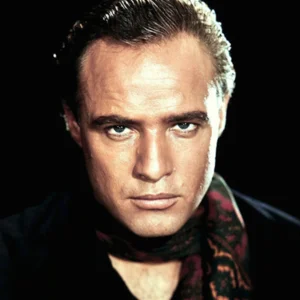

Marlon Brando (1924-2004) was an American actor and director regarded as one of the most influential figures in twentieth-century cinema. A leading exponent of the Actors Studio's “Method,” he revolutionized acting through his naturalism and intensity.
Marlon Brando(1924 — 2004)
Marlon Brando
États-Unis
6 min read
Frequently asked questions
Key Facts
- Born on April 3, 1924, in Omaha, Nebraska, and died on July 1, 2004, in Los Angeles
- Came to prominence in 1951 as Stanley Kowalski in Elia Kazan's “A Streetcar Named Desire”
- Academy Award for Best Actor in 1955 for “On the Waterfront”
- A second Oscar in 1973 for Coppola's “The Godfather,” which he refused as a protest against Hollywood's treatment of Native Americans
- Iconic portrayal of Colonel Kurtz in “Apocalypse Now” (1979)
Works & Achievements
As Stanley Kowalski, Brando brings a raw, instinctive style of acting that revolutionizes American theater and then cinema.
Brando plays a motorcycle gang leader and becomes an icon of 1950s teenage rebellion.
Elia Kazan's film about New York dockworkers earns Brando his first Academy Award for Best Actor.
A sweeping epic filmed partly in Tahiti; this shoot marks the beginning of Brando's lifelong attachment to Polynesia.
As the mafia patriarch Vito Corleone, Brando delivers a legendary performance and wins (but declines) a second Oscar.
Brando plays the menacing Colonel Kurtz in this landmark New Hollywood film about the Vietnam War.
Anecdotes
At the 1973 Academy Awards ceremony, Marlon Brando won the Oscar for Best Actor for *The Godfather*, but he refused to come and collect it. In his place, he sent Sacheen Littlefeather, a Native American activist, who declined the award on stage to protest the way Hollywood treated Indigenous peoples. It is one of the most famous political gestures in the history of cinema.
To play the elderly mafia godfather Vito Corleone when he was only 47, Brando stuffed cotton into his cheeks during the screen test (and later wore a dental prosthesis during filming) to give himself a drooping bulldog face and a hushed, muffled voice. Director **Francis Ford Coppola** had to insist with the studio, which did not want Brando, considering him too difficult.
In *On the Waterfront* (1954), Brando improvised one of the most quoted lines in American cinema: “I coulda been a contender,” spoken in a taxi facing his brother. This scene, played with restraint and contained emotion, became the symbol of the new “naturalistic” acting style that he embodied.
Fascinated by Polynesia after filming *Mutiny on the Bounty* in Tahiti (1962), Brando bought the atoll of Tetiaroa, off the coast of Tahiti, in 1966. He dreamed of turning it into a protected, ecological place, and stayed there regularly, far from Hollywood.
Deeply committed, Brando took part in the 1963 March on Washington for civil rights alongside **Martin Luther King**, then actively supported Native American struggles. He even risked his star image to defend political causes, which was rare for an actor of his level of fame.
Primary Sources
“I coulda had class. I coulda been a contender. I coulda been somebody, instead of a bum, which is what I am.”
In it, Brando recounts his difficult childhood in Nebraska, his alcoholic mother who was passionate about theater, and his discovery of acting in New York.
She announced that Brando “very regretfully cannot accept this very generous award” because of the treatment of Native Americans by the film industry.
The anguished cry of “Stella!” shouted by Stanley at the foot of the stairs became one of the most imitated scenes in American theater and film.
Key Places
Marlon Brando's birthplace, in the heart of the American plains, where he spent a childhood marked by family difficulties.
The legendary place where Brando trained in the acting “Method.” It was here that the naturalistic style that would make him famous took shape.
New York's theater district where Brando triumphed in 1947 in “A Streetcar Named Desire,” revealing his immense talent.
The world capital of cinema where Brando shot his greatest films and became a legend of the big screen.
A small atoll off the coast of Tahiti that Brando bought in 1966, captivated by Polynesia. He made it his refuge far from fame.
Typical Objects

Worn by Brando in “A Streetcar Named Desire,” this plain undershirt became a fashionable garment and a symbol of raw virility and rebellious youth.

In “The Wild One” (1953), Brando wears a black leather jacket while astride his motorcycle. The image turned the leather jacket into the uniform of teenage rebellion.

A play text or screenplay covered in personal notes, the working tool of “Method” actors who sought to inhabit their characters from within.

A central tool of the Hollywood studios and of New Hollywood, it immortalized Brando's performances. The close-up revealed every nuance of his naturalistic acting.

The supreme award of American cinema, won twice by Brando. His refusal of the 1973 Oscar turned this object into a powerful political symbol.

To age his face in “The Godfather,” Brando first slipped cotton and then a prosthesis into his cheeks to give himself the drooping jaw of Vito Corleone.
School Curriculum
Vocabulary & Tags
Key Vocabulary
Tags
Daily Life
Morning
During his training years in New York, Brando would wake up in a small, modest apartment and spend his mornings reading plays and working on his roles. At the Actors Studio, concentration and improvisation exercises took up a good part of the day.
Afternoon
The afternoon was devoted to rehearsals, screen tests, or long hours of shooting on set. Brando, known for being demanding, constantly reworked his scenes and talked at length with directors.
Evening
In the evening, he took to the Broadway stage in his early days, then mingled with artists and friends. Though a sought-after star, he shunned social gatherings and often preferred solitude or passionate conversations.
Food
Brando loved food, and his weight varied greatly depending on the period and the role. He enjoyed hearty American cooking, but also took pleasure in discovering fruit, fish, and Polynesian cuisine during his stays in Tahiti.
Clothing
Off-screen, Brando favored simple, casual outfits: t-shirt, jeans, comfortable jackets, far from the stiff suits of other stars. On screen, his clothes — an undershirt, a leather jacket — became symbols in their own right.
Housing
Brando lived in New York apartments during his youth, then in houses in Los Angeles at the height of his fame. His most unusual home remained his atoll of Tetiaroa, in Polynesia, where he stayed in simple structures by the edge of the lagoon.
Historical Timeline
Period Vocabulary
Liens externes & ressources
Références
Œuvres
L'Équipée sauvage (The Wild One)
1953
Les Révoltés du Bounty (Mutiny on the Bounty)
1962
Le Parrain (The Godfather)
1972