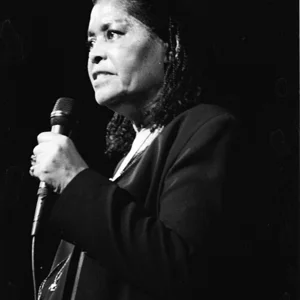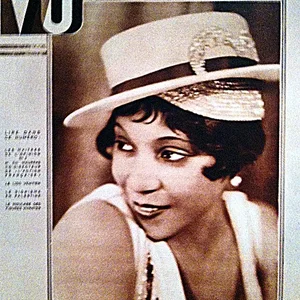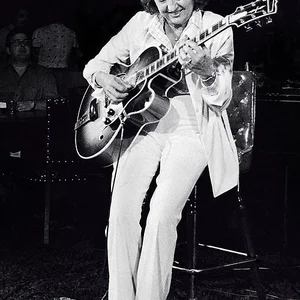

Mary Osborne (1921-1992) was an American jazz guitarist, one of the few women instrumentalists to make a name for herself in the swing and bebop eras. Inspired after hearing Charlie Christian, she became a much-sought-after studio musician in New York.
Mary Osborne(1921 — 1992)
Mary Osborne
États-Unis
5 min read
Frequently asked questions
Key Facts
- Born on July 17, 1921, in Minot, North Dakota (United States)
- Discovered the electric guitar around 1938-1939 after hearing Charlie Christian play, who became her main influence
- Active as a studio and stage guitarist in New York during the 1940s and 1950s, accompanying figures such as Coleman Hawkins and Mary Lou Williams
- Led her own group and recorded under her own name starting in the 1940s-1950s
- Died on March 4, 1992, in Bakersfield, California
Works & Achievements
She led her own group, a rare feat for a female instrumentalist in the age of swing and bebop.
She recorded alongside the great tenor saxophonist, proof of her recognition by the jazz elite.
Her collaboration with the celebrated pianist and arranger was among the rare pairings of leading female instrumentalists.
A long radio residency that made her one of the most widely heard guitarists in America.
A recording that attests to the maturity of her playing, blending the swing heritage with a modern sensibility.
With her husband, she designed and built guitars and amplifiers in Bakersfield, extending her passion into the craft of instrument-making.
Anecdotes
As a teenager in 1930s North Dakota, Mary Osborne was already performing on local radio and had mastered several instruments — guitar, violin, and banjo. This early versatility foreshadowed an extraordinary career for a young girl of that era.
Around 1938, in a club in Bismarck, Mary heard an electric guitar for the first time, played by the young Charlie Christian. Convinced she was hearing a tenor saxophone, she was stunned to discover that this warm, powerful sound was coming from an amplified guitar. This revelation shaped her entire career: she immediately got herself the same kind of instrument.
Settled in New York, she became one of the very few female instrumentalists sought after as a studio musician. She recorded alongside major jazz figures such as saxophonist Coleman Hawkins and pianist Mary Lou Williams.
For more than ten years, throughout the 1950s and 1960s, she was the regular guitarist on Jack Sterling's morning show on CBS radio in New York, playing live for millions of listeners.
In the late 1960s, Mary and her husband, trumpeter Ralph Scaffidi, settled in Bakersfield, California, where they founded a guitar and amplifier manufacturing company. The musician thus became an entrepreneur of the very instrument she had spent her life playing.
Primary Sources
I had never heard an electric guitar before. At first I thought it was a tenor saxophone — until I realized the sound was coming from a guitar.
After hearing Charlie Christian, I got myself an electric guitar and an amplifier: I was absolutely determined to get that sound.
Key Places
Mary Osborne's hometown, where she grew up and learned music in a music-loving family.
It was in a club in this city that she first heard Charlie Christian and the electric guitar, the formative shock that sparked her calling.
The jazz capital where she established herself as a studio and radio musician, playing in the clubs and notably on 52nd Street.
The city where she settled in the late 1960s, founding a guitar-making workshop there, and where she died in 1992.
Typical Objects

Mary Osborne played electrified Gibson archtop guitars, in the tradition of the instrument that had fascinated her in Charlie Christian's hands.

Amplification made the guitar audible within big bands; Mary later built her own with her husband in Bakersfield.

Mounted on the guitar's body, this device turned the vibrations of the strings into an electrical signal: the heart of the jazz guitar revolution.

A small triangle held between the fingers, it allowed her to strike the strings with the precision and speed that swing and bebop demanded.

For CBS live broadcasts, her guitar was picked up by the microphones of New York studios in front of a large audience.

A much-in-demand studio musician, she had to sight-read the arrangements and standards of the jazz repertoire.
School Curriculum
Vocabulary & Tags
Key Vocabulary
Tags
Daily Life
Morning
When she was the guitarist on Jack Sterling's show, Mary would rise before dawn to head to the CBS studios in Manhattan. The morning broadcasts were performed live, with no room for error, which demanded great discipline.
Afternoon
Afternoons were devoted to recording sessions and rehearsals in the New York studios. A highly sought-after musician, she went from one session to the next for various orchestras, singers, and record labels.
Evening
In the evening, she performed in jazz clubs, especially those on the famous 52nd Street, often leading her own trio. These stages were the beating heart of New York's musical life.
Food
Like many musicians torn between studios and clubs, she often ate on the go, between two engagements, in the diners and cafés of Manhattan. Coffee fueled the long days and the late nights.
Clothing
On stage, she wore elegant, polished dresses, asserting her presence as a woman in a very male-dominated world. In the studio and during rehearsals, her attire became simpler and more practical.
Housing
For many years she lived in a New York apartment, as close as possible to the studios and clubs. In the late 1960s, she settled into a house in Bakersfield, California, near her guitar factory.