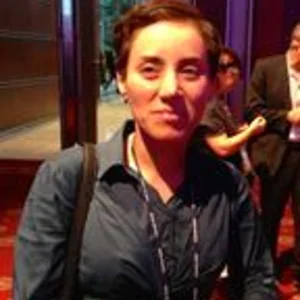

Maryam Mirzakhani is the first woman to win the Fields Medal in 2014, the highest honor in mathematics. Born in Iran, she revolutionized the understanding of Riemann surfaces and hyperbolic geometry. A professor at Stanford, she passed away from cancer at just 40 years old, leaving behind a landmark body of mathematical work.
Maryam Mirzakhani(1977 — 2017)
Maryam Mirzakhani
États-Unis, Iran
7 min read
Frequently asked questions
Famous Quotes
« The beauty of mathematics only shows itself to more patient followers.»
« I don't have any particular recipe. It is the reason why doing research is challenging as well as attractive.»
Key Facts
- Born in Tehran in 1977, she won two gold medals at the International Mathematical Olympiad (1994, 1995)
- In 2004, she earned her doctorate from Harvard under the supervision of Curtis McMullen, himself a Fields Medal laureate
- In 2008, she was appointed full professor at Stanford University
- In 2014, she became the first woman and the first Iranian to receive the Fields Medal, for her work on the dynamics and geometry of Riemann surfaces
- She passed away from breast cancer on July 14, 2017, at the age of 40
Works & Achievements
Her thesis revolutionizes the understanding of simple geodesics on hyperbolic surfaces and establishes a formula for Weil-Petersson volumes. It was published as three articles in major journals.
Article published in Inventiones Mathematicae, derived from her thesis, considered one of her foundational works. It gives a recursive formula of great elegance.
Work on the earthquake flow on Teichmüller spaces, deepening the understanding of Riemann surfaces in connection with Hamiltonian mechanics.
In collaboration with Alex Eskin, this work counts closed geodesics in moduli spaces, a long-standing open problem in geometry.
Nicknamed the "magic wand theorem" by the mathematical community, this spectacular result describes the orbits of the SL(2,R) group on moduli spaces, with deep applications in dynamics.
Anecdotes
As a child, Maryam Mirzakhani dreamed of becoming a writer, not a mathematician. It was only after discovering, in middle school, that she was capable of solving difficult problems with a simple sheet of paper that she changed course. She liked to say that mathematics was for her like telling stories.
In 1994 and 1995, Maryam won two gold medals at the International Mathematical Olympiad, achieving a perfect score on her second participation. She was the first Iranian woman to accomplish this feat, paving the way for many young girls from her country.
Her working method was distinctive: she would cover large rolls of paper laid on the floor with colorful drawings and doodles. Her daughter called her 'the mom who makes paintings'. For Maryam, mathematics had an almost artistic and visual dimension.
In 2014, at the ceremony of the International Congress of Mathematicians in Seoul, Maryam Mirzakhani received the Fields Medal — the highest distinction in mathematics. She remains to this day the only woman and the first Iranian to have received this prize, sometimes nicknamed the 'Nobel of mathematics'.
Diagnosed with breast cancer in 2013, Maryam Mirzakhani continued working until the end of her life. She passed away on July 14, 2017, at the age of 40, leaving behind a considerable body of work and a grieving global mathematical community. The Iranian government, despite its strict rules, published her photo without a veil as a tribute to her.
Primary Sources
« The more I spent time on maths, the more excited I became. I think I'm quite lucky that I fell in love with it, but it was not by design. »
Foundational article from her doctoral thesis at Harvard, in which Mirzakhani establishes a recursive formula for computing the Weil-Petersson volumes of moduli spaces of Riemann surfaces with boundaries.
« I don't have any particular recipe. It is the reason why doing research is challenging as well as attractive. It is like being lost in a jungle and trying to use all the knowledge that you can gather to come up with some new tricks. »
« Maryam was a brilliant mathematical genius who also turned out to be an inspiring role model for countless young people around the world who aspired to follow in her footsteps. »
Key Places
Maryam Mirzakhani's hometown, where she grew up, attended Farzanegan High School (a school for gifted students), and discovered her passion for mathematics.
Where Maryam earned her bachelor's degree in mathematics. This university trains Iran's scientific elite and opened the doors to leading American universities for her.
Maryam completed her doctoral thesis here under the supervision of Curtis McMullen. Her thesis on Weil-Petersson volumes was recognized as a major breakthrough.
Where Maryam was a professor from 2008 until her death in 2017. It is here that she accomplished her most important work on the dynamics of surfaces.
The city where the International Congress of Mathematicians was held in 2014, during which Maryam received the Fields Medal before the global mathematical community.
Typical Objects

Maryam worked by spreading long rolls of paper on the floor, covered in geometric drawings and equations. This visual and spatial working method was her trademark.

She used colors to annotate her Riemann surface diagrams, turning her working sheets into almost artistic creations.

An iconic tool of the mathematician, the blackboard allowed her to present her proofs during seminars at Harvard and later Stanford.

Mirzakhani's work focuses on the geometry of complex curved surfaces. Hyperbolic geometry textbooks were her daily companions since high school.

Awarded every four years to mathematicians under 40, this medal is the highest distinction in mathematics. Mirzakhani is the first woman to receive it.

To visualize moduli spaces and Riemann surfaces, she used computational simulation tools, indispensable complements to her paper-based work.
School Curriculum
Vocabulary & Tags
Key Vocabulary
Tags
Daily Life
Morning
Maryam started her day early, often after dropping her daughter Anahita off at school. She would settle into her Stanford office or at home, spreading her large rolls of paper across the floor to pick up where she had left off with her diagrams the day before. Coffee and a light breakfast accompanied this quiet morning ritual.
Afternoon
Afternoons were devoted to seminars, exchanges with her doctoral students and collaborators — notably Alex Eskin in Chicago — and intensive calculation sessions. She wrote everything by hand before formalizing it at the keyboard, always preferring visual thinking over pure abstraction.
Evening
In the evenings, she rejoined her husband Jan Vondrák and their daughter Anahita. She enjoyed cooking traditional Iranian dishes and reading novels. Even at night, a mathematical idea could arise: she always kept a notebook within reach so as not to forget anything.
Food
Maryam had grown up with Iranian cuisine: saffron rice (chelow), herb stews (ghormeh sabzi), dried fruits and nuts. In the United States, she maintained these Mediterranean and Middle Eastern eating habits, appreciating meals shared with family.
Clothing
In daily life at Stanford, Maryam wore simple, casual Western attire — jeans, sweaters, light jackets — in keeping with her Californian academic environment. When she traveled to Iran to visit her family, she adopted the headscarf required by Iranian law.
Housing
Maryam lived with her family in a house in the Palo Alto neighborhood, near the Stanford campus. The interior combined American simplicity with touches of Iranian culture: traditional rugs, books in Farsi and English, and the inevitable large sheets of paper covering part of the floor of her workspace.
Historical Timeline
Period Vocabulary
Visual Style
Esthétique qui mêle la tradition géométrique persane — arabesques et carrelages — à la visualisation moderne de surfaces mathématiques complexes, avec une palette chaude et élégante.
Sound Ambience
Ambiance studieuse et feutrée d'un bureau de mathématicienne : froissement de papier, feutres sur grandes feuilles, murmures académiques en persan et en anglais.
Liens externes & ressources
Références
Œuvres
Thèse de doctorat — Simple geodesics on hyperbolic surfaces
2004
Simple geodesics and Weil-Petersson volumes of moduli spaces of bordered Riemann surfaces
2007
Ergodic theory of the earthquake flow on quadratic differentials
2008
Counting closed geodesics in moduli space (avec Alex Eskin)
2011
Isolation, equidistribution, and orbit closures for the SL(2,R) action on moduli space (avec Alex Eskin et Amir Mohammadi)
2015