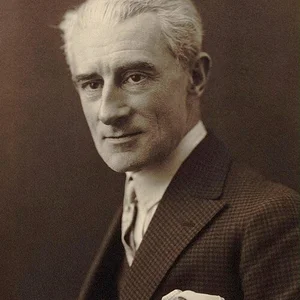

Maurice Ravel was a French composer and one of the great figures of early 20th-century music. A master of orchestration, he is famous for the Boléro and associated with the impressionist movement alongside Claude Debussy.
Maurice Ravel(1875 — 1937)
Maurice Ravel
France
6 min read
Frequently asked questions
Key Facts
- Born in 1875 in Ciboure (Basque Country), died in 1937 in Paris
- Composed the Boléro in 1928, his most famous work
- Wrote Daphnis et Chloé (1912), a ballet for Diaghilev's Ballets Russes
- Created the 1922 orchestration of Mussorgsky's Pictures at an Exhibition
- Composed Ma mère l'Oye, Gaspard de la nuit, and the Piano Concerto for the Left Hand
Works & Achievements
Piano piece that revolutionized piano writing with its shimmering, liquid sonorities, heralding musical Impressionism.
Fearsomely difficult piano triptych, regarded as one of the pinnacles of virtuosity in the repertoire.
Vast ballet created for the Ballets Russes, a symphonic masterpiece famous for its orchestral sunrise.
Suite for piano, later orchestrated, paying tribute to 18th-century French music and to friends who fell during the Great War.
Choreographic poem for orchestra, at once a tribute to and a tragic, dizzying vision of the Viennese waltz swept away by chaos.
Fantasy opera on a libretto by Colette, in which the objects and animals of a house come to life to teach a child a lesson.
Orchestral crescendo built on a single melody repeated over an unrelenting rhythm; Ravel's most performed and most popular work.
Concerto written for the pianist Paul Wittgenstein, who had lost his right arm in the war, blending jazz influences with virtuosity.
Anecdotes
*Boléro*, first performed in 1928, is Ravel's most famous work — yet he considered it of little musical interest, calling it a mere exercise in orchestration: a single melody repeated for a quarter of an hour over a relentless rhythm. At the premiere, a woman in the audience reportedly shouted “He's mad!”, which led Ravel to remark that she had understood it perfectly.
Ravel failed five times to win the prestigious **Prix de Rome** and was eliminated in **1905**, even though he was already recognized as a gifted composer. The scandal, nicknamed “the Ravel affair”, caused such outrage that it forced the resignation of the director of the Paris Conservatoire, **Théodore Dubois**.
Fascinated by mechanisms and automata, Ravel filled his house in **Montfort-l'Amaury** with a multitude of trinkets, mechanical birds, and miniature objects. This love of meticulous detail is found again in his watchmaker's music, chiseled like fine goldsmith's work.
In **1928**, Ravel made a triumphant four-month tour of the United States and met **George Gershwin**. When Gershwin asked him for lessons, Ravel reportedly declined, saying that he should not become “a bad Ravel instead of a good Gershwin”.
Ravel's final years were darkened by a neurological illness that gradually prevented him from writing and playing, even as music kept resounding in his head. He died in **1937** following a brain operation attempted as a last resort.
Primary Sources
It is an experiment in a very special and limited direction... a piece lasting seventeen minutes and consisting wholly of orchestral tissue without music.
From Chabrier, certainly, proceeds the general aesthetic of my work... To Erik Satie, I acknowledge a debt of another kind.
I do not claim to set myself up as a victim... but it is curious that a jury should eliminate a candidate on written exercises when that candidate has already proven himself.
The audience gave a triumphant welcome to this strange and haunting work, in which a single phrase returns again and again, carried by a relentless crescendo.
Key Places
Ravel's birthplace, on the Basque coast facing Saint-Jean-de-Luz. His Basque and Spanish roots deeply marked his work, from the Boléro to the Rapsodie espagnole.
Ravel studied composition here, notably with Gabriel Fauré. This is where the scandal of the “Ravel affair” over the Prix de Rome unfolded in 1905.
Ravel's home from 1921 onward, where he composed the Boléro and his concertos. Now a museum, it preserves his collection of miniature objects and his piano.
Site of the triumphant premiere of the Boléro in November 1928, danced by Ida Rubinstein. Several of his ballets were staged here.
A major stop on his triumphant 1928 American tour, where he was acclaimed and met George Gershwin. America and jazz influenced his concertos.
The town where Ravel died on 28 December 1937 in a clinic, following brain surgery. He is buried in the town's cemetery.
Typical Objects

The instrument at the heart of Ravel's creative work, on which he composed and refined his most virtuosic pieces such as Gaspard de la nuit. He played it with the precision of a watchmaker.

Ravel himself conducted the premieres of several of his works, including the Boléro. An undisputed master of orchestration, he thought of his music in terms of instrumental colours.

Ravel collected a multitude of mechanical objects, miniatures, and trinkets in his house. This fascination with mechanisms fed his taste for musical precision.

Ravel notated his works with extremely careful and refined musical handwriting. His final illness gradually robbed him of the ability to write down the notes he could still hear.

During the First World War, Ravel served as a truck driver (he nicknamed his vehicle "Adélaïde") transporting ammunition and soldiers near the Verdun front.

Ravel was a dandy who paid close attention to his appearance, always dressed with great care. His sartorial elegance reflected the refinement of his music.
School Curriculum
Vocabulary & Tags
Key Vocabulary
Daily Life
Morning
A night owl and late riser, Ravel often started his day slowly, meticulously attending to his grooming and appearance. Mornings could be devoted to walks or to correspondence before the work of composing began.
Afternoon
The afternoon was the time for relentless work at the piano in his house in Montfort-l'Amaury. Ravel composed with extreme slowness, chiseling each measure like a goldsmith, sometimes working on a single piece for months.
Evening
Evenings would readily take him to Paris, to the salons, cafés, and cabarets where he loved the nightlife and the company of his artist friends. He also enjoyed the jazz he discovered in the clubs.
Food
A refined gourmet, Ravel relished fine cuisine and delicate dishes, just as he loved precious objects. A great lover of tobacco, he smoked heavily, especially Caporal-brand cigarettes.
Clothing
A true dandy, Ravel placed extreme importance on his elegance: impeccable suits, carefully chosen ties, well-kept shoes. His polished appearance reflected the refinement of his art.
Housing
From 1921 onward, he lived at Le Belvédère, a small villa in Montfort-l'Amaury that he decorated with meticulous taste. The house overflowed with trinkets, automatons, Japanese objects, and miniatures that fascinated him.