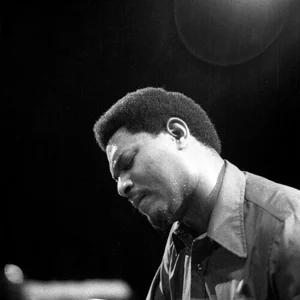

American jazz pianist, one of the most influential of the post-war era. A member of John Coltrane's historic quartet, he developed a recognizable piano style built on quartal chords and a powerful left-hand technique.
McCoy Tyner(1938 — 2020)
McCoy Tyner
États-Unis
6 min read
Frequently asked questions
Key Facts
- Born in 1938 in Philadelphia, died in 2020 in New Jersey
- Member of the John Coltrane Quartet from 1960 to 1965, contributing to major albums including A Love Supreme (1965)
- Prolific solo career beginning in 1965, with the landmark album The Real McCoy (1967)
- Style characterized by quartal chords and a powerful left-hand technique, a model for generations of pianists
- Honored with several Grammy Awards over the course of his career
Works & Achievements
Hypnotic jazz reworking of a musical-theater song; Tyner's piano solo on it has remained famous.
Spiritual suite regarded as one of the peaks of jazz; Tyner plays piano in the legendary quartet.
Tyner's first major album as a leader, on Blue Note, where his quartal style fully comes into its own.
A defining album of his solo career on Milestone, where he also plays the koto and percussion.
Concert recorded at the Montreux Festival, a testament to the energy of his quartet on stage.
A tribute to his former mentor that won a Grammy Award.
Big-band album crowned with a Grammy, showcasing his talent as an arranger and bandleader.
Anecdotes
As a child, McCoy Tyner grew up in a Philadelphia neighborhood that was home to the great bebop pianist **Bud Powell**, whom he admired enormously. His mother, a hairdresser, installed a piano in her beauty salon so the boy could practice: he played in the middle of the customers. By his teenage years, he had already decided to become a professional musician.
As a teenager, he met the saxophonist **John Coltrane**, who was also from the Philadelphia area, and the two men promised to play together one day. In **1960**, Coltrane kept his word and invited him to join his new quartet: Tyner was only 21 at the time. He stayed for five years, alongside bassist **Jimmy Garrison** and drummer **Elvin Jones**.
Around the age of 17, McCoy Tyner converted to Islam and took the name **Sulaiman Saud**, in connection with the Ahmadiyya community. He nevertheless continued to perform and record under his birth name throughout his career.
In **1960**, Coltrane's quartet transformed “My Favorite Things,” a song from the musical *The Sound of Music*, into a long, almost hypnotic jazz piece. Against all odds, the record became a hit and brought the group to the attention of the general public.
Tyner developed a very personal way of playing: he stacked notes in intervals of a fourth rather than a third, which gave his piano an open, wide sound. His left hand pounded the low notes with such power that countless jazz pianists later sought to imitate him.
Primary Sources
“Towards the end, I didn't feel I was contributing anything musically. All I could hear was a lot of noise. I had no feeling for the music, and when I don't have feeling, I don't play.” — McCoy Tyner explaining why he left Coltrane's group in 1965.
Sleeve credits: “John Coltrane – tenor saxophone; McCoy Tyner – piano; Jimmy Garrison – double bass; Elvin Jones – drums.” The album also features a devotional poem written by Coltrane.
Credits: “McCoy Tyner – piano; Joe Henderson – tenor saxophone; Ron Carter – double bass; Elvin Jones – drums.” Tyner's first major album as a leader, made up entirely of his own compositions.
Key Places
Tyner's hometown, where he learned the piano and mixed with young musicians destined for great careers. It was there that he met John Coltrane.
The capital of jazz, where Tyner settled and worked, playing in the major clubs and recording for the leading labels. He spent most of his career there.
The legendary studio where A Love Supreme and many Impulse! and Blue Note records were cut. Tyner recorded several of his masterpieces there.
The famous Manhattan jazz club where Coltrane's quartet performed and was recorded live. A landmark of avant-garde jazz in the 1960s.
The town where McCoy Tyner died in 2020. He spent his final years in the New York area.
Typical Objects

The instrument of his entire life, on which he developed his quartal chords and his powerful left hand. He often played a Steinway in concert and in the studio.

A Japanese zither that Tyner played on the album Sahara (1972), proof of his curiosity for the sounds of the world. He also added flute and percussion to it.

The albums of Coltrane's quartet were released on the Impulse! label, recognizable by its orange and black sleeve. These LPs spread Tyner's playing all around the world.

A sheet noting the melody and chords of a tune, the basic support for jazz improvisation. This is how Tyner composed many of his own themes.

A trophy of the American music industry that Tyner won several times from the 1980s onward. It rewarded his work as a pianist and big-band leader.

A neat suit and jacket, the usual attire of jazz musicians of his era in clubs and concerts. Sartorial elegance was part of the job.
School Curriculum
Vocabulary & Tags
Key Vocabulary
Tags
Daily Life
Morning
Like most jazz musicians who played late into the night, Tyner often got up in the late morning. Once awake, he liked to practice his instrument: scales, chords in fourths, and ideas for new compositions.
Afternoon
Afternoons were devoted to rehearsals, writing pieces, or recording sessions, sometimes at Rudy Van Gelder's studio in New Jersey. While on tour, this time was mostly spent traveling from one city to the next.
Evening
When evening came, it was time for the stage: in clubs like the Village Vanguard, bands often played two or three sets well into the night. That was where the rapport between musicians was forged, in the heat of improvisation.
Food
On the road, musicians' meals were irregular, grabbed between concerts. Having converted to Islam in his youth, Tyner avoided pork and alcohol, which shaped his dietary choices.
Clothing
On stage, he wore the elegant suit typical of the jazzmen of his time: a dark suit, a shirt, and a tie. This well-groomed attire was part of the respect owed to the audience and to the music.
Housing
Born in a row house in a working-class neighborhood of Philadelphia, Tyner later lived mostly in the New York area. Touring kept him in hotels for long weeks at a time, following the rhythm of the concerts.