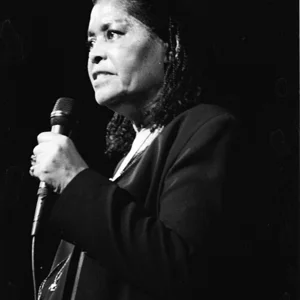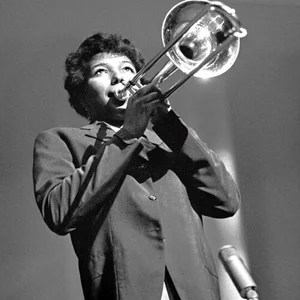

Melba Liston (1926-1999) was an American jazz trombonist, composer, and arranger. A pioneer as a woman instrumentalist in the big bands of the bebop era, she collaborated with Dizzy Gillespie, Count Basie, and above all the pianist Randy Weston.
Melba Liston(1926 — 1999)
Melba Liston
États-Unis
6 min read
Frequently asked questions
Key Facts
- Born January 13, 1926, in Kansas City, Missouri; died April 23, 1999, in Los Angeles
- Joined Gerald Wilson's orchestra in the late 1940s, then toured with Dizzy Gillespie
- Accompanied Billie Holiday and played in the orchestras of Count Basie and Quincy Jones
- Became one of the few recognized women trombonists and arrangers of the bebop era
- Long artistic collaboration with the pianist Randy Weston beginning in the 1950s
Works & Achievements
Her only album as a bandleader, showcasing the trombone section and her own arrangements.
The first major project of her collaboration with pianist Randy Weston, for which she wrote the refined arrangements.
An ambitious suite celebrating African independence movements, set to texts by Langston Hughes and arranged entirely by Liston.
An album blending jazz with West African music, where her arrangements bridge the two musical worlds.
Another collaboration with Weston, extending their exploration of the links between jazz and African heritage.
A late, monumental work composed with Weston, regarded as a high point of their partnership.
Demanding scores written for the State Department's international tour, which cemented her reputation as an arranger.
Anecdotes
Melba Liston received her first trombone around the age of seven. Too shy to play in front of others, she taught herself almost entirely by ear, working the slide of an instrument bigger than she was. A few years later, she was already able to hold her own in adult orchestras.
In 1949, still very young, Melba went on tour through the American South with singer Billie Holiday. Faced with racial segregation, hostile audiences, and miserable pay, she became so discouraged that she left the music world for a time to take an office job.
When she joined Dizzy Gillespie's big band in 1956, several musicians grumbled at the idea of a woman joining the brass section. Gillespie then handed them the very difficult charts she had arranged herself. Unable to sight-read them on the first try, the men quickly realized who they were dealing with and respected her from then on.
In the 1970s, Melba Liston moved to Jamaica to teach at the Kingston music school. There she trained young musicians and passed on her skills as an arranger, proving that her talent reached far beyond the American stage.
After suffering a severe stroke in 1985, she lost the use of part of her body and could barely play the trombone anymore. Refusing to give up, she learned to compose and arrange with the help of a computer, continuing to create music until the end of her life.
Primary Sources
Gillespie recounts hiring Melba Liston as a trombonist and arranger, and describes how his male colleagues, skeptical at first, had to acknowledge the difficulty and quality of her arrangements.
The pianist Randy Weston, her lifelong artistic partner, presents Melba Liston as one of the greatest arrangers and composers in jazz, highlighting their long collaboration from Little Niles to The Spirits of Our Ancestors.
The only album recorded by Melba Liston as a bandleader, showcasing the trombone section and her own arrangements.
Key Places
Melba Liston's birthplace, an important hub for jazz and swing in the 1920s and 1930s.
The city of her teenage years and musical training, where she got her start in big bands and where she died in 1999.
The jazz capital where she played and arranged alongside Dizzy Gillespie and Randy Weston.
The city where she taught music in the 1970s and trained young musicians.
Typical Objects

Her instrument of choice, a rare sight in the hands of a woman in the big bands of the 1940s and 1950s. She mastered the slide for long, deep melodies as well as for the fast passages of bebop.

A small accessory placed in the bell of the instrument to muffle its sound. Liston used it to vary the tonal colors favored by the jazz of the era.

Sheets covered in notes on which she distributed the melody among all the sections of the orchestra. Her demanding arrangements earned her a reputation with Gillespie, Basie, and Randy Weston.

The arranger's basic tools for writing out each instrumental line before rehearsals. She spent long hours of solitary work with them.

After her stroke in 1985, she learned to compose and arrange with the help of a computer, working around her disability to keep creating.

The elegant outfit she wore on stage, contrasting with the dark suits of her male colleagues. Her mere presence in a gown amid the brass section left a lasting impression.
School Curriculum
Vocabulary & Tags
Key Vocabulary
Tags
Daily Life
Morning
A jazz arranger's morning is often spent in quiet, leaning over sheet music. Melba Liston wrote out, line by line, each instrument's part before rehearsals. This writing work, invisible to the audience, took up a large part of her days.
Afternoon
The afternoon was devoted to rehearsals with the orchestra, in a hall or a studio. She conducted the musicians, fixed the tricky passages and adjusted her arrangements as she listened to the result. As a trombonist, she also practiced her slide work and breathing.
Evening
Evenings were the time for concerts, in clubs, theaters or ballrooms. The orchestra often played late, before an audience that had come to dance or to listen. After the show, jam sessions among the musicians might spring up.
Food
On tour, the musicians' meals depended on the towns they passed through and, in the segregated South, on the few places where Black Americans were allowed. Quick meals, sandwiches and food eaten on the road set the rhythm of the long journeys by bus or train.
Clothing
On stage, Melba Liston wore elegant dresses, in sharp contrast with the dark suits of her male colleagues. Off stage, she favored the polished outfits of the jazz musicians of her time.
Housing
Her life led her to live in several places: Kansas City as a child, then Los Angeles, New York as engagements came and went, and finally Kingston in Jamaica. The life of a musician meant frequent changes of home and long stretches on tour far from her own.