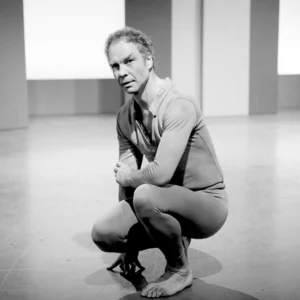

Merce Cunningham (1919-2009) was an American dancer and choreographer, a major figure in modern and contemporary dance. A pioneer of abstract dance, he revolutionized choreography by detaching it from music and narrative.
Merce Cunningham(1919 — 2009)
Merce Cunningham
États-Unis
6 min read
Frequently asked questions
Famous Quotes
« You have to love dancing to stick to it. It gives you nothing back, no manuscripts to store away, no paintings to show, nothing but that single fleeting moment when you feel alive.»
Key Facts
- Born in 1919 in Centralia (Washington State), died in 2009 in New York
- Solo dancer in Martha Graham's company from 1939 to 1945
- Founded the Merce Cunningham Dance Company in 1953 at Black Mountain College
- A lifelong artistic and personal collaboration with composer John Cage (beginning in 1942), introducing chance and indeterminacy into the creative process
- Pioneer of computer-assisted dance (LifeForms / DanceForms software) starting in the 1990s
Works & Achievements
The first choreography composed entirely through chance operations, set to electronic music by Christian Wolff. A manifesto for Cunningham's new method.
A “pointillist” ballet with speckled sets and costumes by Robert Rauschenberg, in which the dancers seem to blend into the space around them.
A piece famous for Andy Warhol's floating silver pillows and the music of David Tudor, a perfect example of collaboration between dance, art, and sound.
Sets by Jasper Johns inspired by Marcel Duchamp's “Large Glass,” a tribute to modern art on stage.
A virtuosic, high-energy group piece set to a saturated electronic score by David Tudor.
A monumental work conceived with John Cage: the dancers move in a circle, surrounded by one hundred and twelve musicians.
A pioneering show blending dance, motion capture, and digital projections, set to music by Gavin Bryars.
A book in which Cunningham lays out his method of composition by chance and his relationship to movement.
Anecdotes
To compose his choreographies, Merce Cunningham tossed coins or consulted the I Ching, the ancient Chinese Book of Changes. Chance then decided the order of the movements, their direction, or their duration. Cunningham accepted these results even when they seemed impossible or baffling, in order to free dance from its habits.
With his partner, the composer John Cage, Cunningham invented a radical rule: music and dance were created separately and shared only their duration. The dancers often rehearsed in silence and heard the score only on opening night, discovering at the same time as the audience how the two worlds met.
In 1968, for the ballet “RainForest,” Andy Warhol set up his “Silver Clouds” on stage: silver, helium-filled pillows that floated freely. The dancers had to move among these unpredictable clouds, which drifted on the air currents, some threatening to float off toward the spotlights or into the audience.
At nearly 70, Cunningham took up choreographing on a computer using the software LifeForms (later DanceForms). On it he invented sequences of movements sometimes so strange that no human body would ever have imagined them, then challenged his dancers to take on the task of performing them.
Cunningham danced and choreographed until his death at 90, in 2009. Weakened by arthritis, he kept on creating while seated. He had arranged in advance, in a “Legacy Plan,” that his company would set off on a worldwide farewell tour before disbanding, a rare decision in the world of dance.
Primary Sources
You have to love dancing to stick to it. It gives you nothing back, no manuscripts to store away, no paintings to show on walls and maybe hang in museums, no poems to be printed and sold, nothing but that single fleeting moment when you feel alive.
Dance provides something — an amplification of energy — that nothing else provides. Choreographing is less about ordering steps than about staying open to what arises.
With John Cage, we decided that music and dance could be independent of each other while occupying the same span of time. Each exists on its own, and they simply coincide in duration.
Key Places
Town in the northwestern United States where Merce Cunningham was born in 1919. There he took his first dance lessons from a local teacher.
Art school in Seattle where Cunningham trained in dance and theater in the late 1930s. There he met John Cage, then an accompanist.
Experimental college for artists where Cunningham founded his company in 1953 and took part in the first “happening.” A hotbed of the American avant-garde.
A former industrial complex converted into housing and artists' studios, where the Merce Cunningham Dance Company set up its studio starting in 1971.
Artistic capital where Cunningham lived and created most of his work, and where he died in 2009.
Typical Objects

The Chinese Book of Changes and a few simple coins were used to draw the order, direction or duration of movements by chance. Randomness thus became a compositional tool.

Cunningham recorded his choreographies through notes, diagrams and symbols, as in his book “Changes.” Notation fixes on paper a dance that is by nature fleeting.

Software that animates a virtual figure to invent sequences. Cunningham used it from the 1990s onward to explore unprecedented movements.

Supple bodysuits (unitards) hugging the body, often designed by artists such as Rauschenberg or Jasper Johns. They revealed every line of the movement.

Silver Mylar pillows filled with helium that floated across the stage in “RainForest” (1968). A mobile, unpredictable set with which the dancers interacted.

Magnetic tapes, loudspeakers and electronic instruments used by John Cage and David Tudor to accompany the ballets. The sound was often noise-based and independent of the dance.
School Curriculum
Vocabulary & Tags
Key Vocabulary
Tags
Daily Life
Morning
The day began with the technique class: foot, back, and balance exercises that Cunningham had developed himself. Dancers and choreographer thus maintained a body capable of shifting instantly from stillness to the swiftest movement.
Afternoon
The afternoon was devoted to rehearsals in the studio, often in silence since the music remained independent. Cunningham taught the dancers sequences that were sometimes dictated by chance procedures or, later, designed on a computer.
Evening
Evenings brought the performances, where dance, music, and set design sometimes met for the very first time in front of the audience. Cunningham danced in them himself for a long time, a magnetic presence at the center of his own creations.
Food
Like any dancer, he had to sustain intense physical effort through regular, balanced meals. The life of a New York artist, often financially modest in his early days, called for simple food.
Clothing
At work, he wore loose rehearsal clothes. On stage, the close-fitting costumes designed by artist friends hugged the body to make every line of the gesture visible.
Housing
Cunningham lived in New York, for a long time in modest artist's lodgings shared with John Cage. From 1971, his company settled into the studios of the Westbeth Artists Community, in Greenwich Village.
Historical Timeline
Period Vocabulary
Liens externes & ressources
Références
Œuvres
Summerspace
1958
RainForest
1968
Walkaround Time
1968
Sounddance
1975