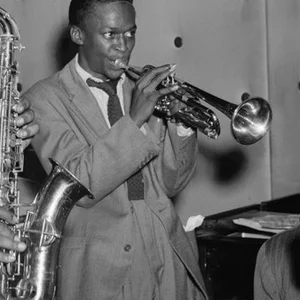

Miles Davis (1926-1991) was an American jazz trumpeter, composer, and bandleader. A major figure of the musical 20th century, he relentlessly reinvented jazz, from cool jazz to modal jazz and on to electric fusion.
Miles Davis(1926 — 1991)
Miles Davis
États-Unis
6 min read
Frequently asked questions
Famous Quotes
« Don't play what's there, play what's not there.»
« Jazz is the big brother of revolution. Revolution follows it.»
Key Facts
- Born in 1926 in Alton, Illinois, he moved to New York in 1944, where he played alongside Charlie Parker, a leading figure of bebop.
- In 1949-1950, his recordings gathered under the title Birth of the Cool launched the cool jazz movement.
- In 1959, the album Kind of Blue established modal jazz and became one of the best-selling jazz records in history.
- In 1970, the album Bitches Brew paved the way for jazz-rock fusion by bringing together electric instruments and amplification.
- He died in 1991 in Santa Monica, California, after a career spanning nearly fifty years marked by constant reinvention.
Works & Achievements
With a nonet and arranger Gil Evans, Davis laid the foundations of cool jazz, softer and more spacious than bebop.
An almost entirely improvised soundtrack for Louis Malle's film, a famous example of the meeting between jazz and cinema.
A masterpiece of modal jazz and the best-selling jazz record in history, recorded almost without rehearsal.
An orchestral album made with Gil Evans, inspired by Spanish music (including the Concierto de Aranjuez).
A founding double album of jazz-rock fusion, blending electric instruments, rock and funk.
A landmark album of his later period, modern and electronic, awarded a Grammy Award.
Anecdotes
In 1944, Miles Davis arrived in New York at age 18, officially to study at the prestigious Juilliard School. But every evening he skipped class to comb the clubs of 52nd Street in search of his idols Charlie Parker and Dizzy Gillespie. He eventually dropped out of Juilliard to learn jazz directly on stage, at their side.
To record Kind of Blue in 1959, Davis handed out almost no sheet music to his musicians: he gave them only a few scales and some notes scribbled down just before playing. Most of the tracks were nailed on the very first take. The album would go on to become the best-selling jazz record of all time.
Around 1955, after a throat operation meant to remove nodules, doctors forbade Davis from speaking for a few days. But he lost his temper and raised his voice too soon, permanently damaging his vocal cords. That is how he kept that famous raspy whisper for the rest of his life.
In August 1959, outside the Birdland club where he had just played, Davis was walking a woman to a taxi. A police officer ordered him to move along; the confrontation escalated and the musician, already famous as he was, was struck on the head and then arrested. The affair caused a scandal and illustrated the racism endured even by the most celebrated Black artists.
On stage, Davis often played with his back to the audience, which many took for arrogance. He explained that he was simply directing his musicians with his eyes and his gestures, entirely focused on the music rather than on the show.
Primary Sources
Listen. The greatest feeling I ever had in my life — with my clothes on — was when I first heard Diz and Bird together in St. Louis, Missouri, back in 1944.
There is a Japanese visual art in which the artist is forced to be spontaneous. He must paint on a thin stretched parchment with a special brush and black water paint in such a way that an unnatural or interrupted stroke will destroy the line.
It's not the notes you play, it's the notes you don't play.
Key Places
Midwestern town where Miles Davis was born on May 26, 1926, on the banks of the Mississippi.
Town where Davis grew up in a well-off family; his dentist father gave him his first trumpet around age 13.
Jazz capital where Davis enrolled at Juilliard before learning everything in the clubs alongside Charlie Parker, then building his career there.
A city he loved, where in 1957 he improvised the score for Louis Malle's film “Elevator to the Gallows,” playing live in front of the projected images.
City where Miles Davis died on September 28, 1991, at the age of 65.
Typical Objects

The trumpet was an extension of Miles Davis himself. He loved the warm sound of the Martin Committee models and popularized a restrained style of playing, favoring sparse notes and silences.

Davis would remove the central tube of this small metal mute and place it right next to the microphone. This gave him that muffled, intimate, almost whispered sound that became his signature, especially on ballads.

Often seen wearing elegant dark glasses, Davis cultivated a mysterious, “cool” look. This accessory became inseparable from his image as a jazz icon.

In the 1950s and 1960s, Davis wore impeccably cut Italian suits and set trends. Elegant down to his fingertips, he was regarded as one of the most stylish men of his time.

A lover of fine machines, Davis owned luxury sports cars such as Ferraris. Speed and style were part of his way of life.

Boxing was Davis's great passion outside of music. He trained regularly at the gym and compared the boxer's art — dodging, rhythm, precise punches — to that of the jazz musician.

In the last years of his life, Davis devoted himself to painting, covering his canvases with colorful, abstract shapes. Several of his works were exhibited.
School Curriculum
Vocabulary & Tags
Key Vocabulary
Tags
Daily Life
Morning
A night-owl musician, Davis rarely got up early. When he did, his mornings were quiet: coffee, listening to records, and his first trumpet exercises in his New York home.
Afternoon
The afternoon was devoted to working on music: rehearsals with his band, fine-tuning arrangements with his friend Gil Evans, or recording sessions in the studio. He also trained in boxing at the gym.
Evening
In the evening, life truly began. Davis played in New York's great jazz clubs, such as Birdland or the Village Vanguard, performing one set after another late into the night before a passionate audience.
Food
Keen to stay in a boxer's shape, Davis watched his diet and loved cooking for his friends. But his health was long undermined by alcohol and drugs, which he had to fight hard to break free from.
Clothing
A true fashion icon, Davis wore very elegant tailor-made suits in his youth, then flamboyant, colorful stage outfits in the 1980s, almost always paired with dark sunglasses.
Housing
Starting in 1959, Davis lived in an elegant brownstone townhouse at 312 West 77th Street, in the Upper West Side neighborhood of Manhattan, where he welcomed musicians and friends.