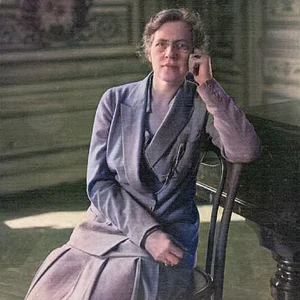

French pedagogue, pianist, organist, choral conductor, orchestral conductor, and composer
Nadia Boulanger(1887 — 1979)
Nadia Boulanger
France
8 min read
Frequently asked questions
Key Facts
- Nadia Boulanger (1887-1979) est la première femme à diriger les grands orchestres symphoniques américains et britanniques, notamment le Boston Symphony Orchestra en 1938.
- Elle enseigne la composition et l'harmonie à l'École normale de musique de Paris et au Conservatoire américain de Fontainebleau pendant plus de soixante ans, formant des générations de compositeurs du monde entier.
- Parmi ses élèves figurent des musiciens majeurs du XXe siècle : Aaron Copland, Philip Glass, Astor Piazzolla, Quincy Jones et Daniel Barenboïm.
- Elle se consacre à la pédagogie après la mort prématurée de sa sœur Lili Boulanger en 1918, première femme à remporter le Grand Prix de Rome de composition musicale.
- Nommée professeure au Conservatoire national supérieur de musique de Paris en 1949, elle est la première femme à y occuper un poste de titulaire.
Works & Achievements
One of her last compositions before she gave up creating; these lyrical pieces demonstrate a genuine talent for chamber music in the French post-Romantic tradition.
For sixty years, Nadia devoted a large part of her energy to making her sister Lili's music known, recorded, and disseminated — Lili having died at age 24; this selfless commitment is itself considered a life's work.
Her pedagogical method, grounded in the analysis of Bach and the classical masters, trained hundreds of internationally renowned composers and stands as her most enduring legacy.
She led a vocal ensemble specializing in Renaissance and Baroque music, helping to reintroduce Monteverdi and early polyphonists to the broader European public.
The historic first concert by a woman leading a major American orchestra, this performance broke a professional taboo and paved the way for women conductors.
This documentary, made two years before her death, captures her thoughts on music, pedagogy, and her students; it has become a reference document on her musical thinking.
Anecdotes
In 1938, Nadia Boulanger became the first woman to conduct a full concert with the Boston Symphony Orchestra, one of the most prestigious orchestras in the world. This historic performance broke a glass ceiling in a musical world that was then overwhelmingly male, and she did so with an authority and precision that silenced all skeptics.
Among her students was Astor Piazzolla, the great master of Argentine tango. Having come to Paris in 1954 to learn 'real' classical music and ashamed of his tango, he played Boulanger some of his compositions. It was she who revealed to him that his genius lay precisely in tango: 'It's magnificent, it's you — never abandon it!' In doing so, she restored his musical identity.
Nadia Boulanger slept only four hours a night and devoted her entire days to teaching, sometimes giving up to sixteen hours of lessons per day. She read scores with astonishing speed and could identify any chord or counterpoint at a glance, which both fascinated and intimidated her students from around the world.
After the premature death of her younger sister Lili Boulanger in 1918, Nadia decided to permanently give up composition in order to dedicate herself entirely to teaching and to promoting Lili's work. She spent more than sixty years championing her sister's music, believing that Lili's talent surpassed her own.
Her Parisian apartment at 36 rue Ballu was a gathering place for the greatest figures of the musical world: Stravinsky, Copland, Milhaud, Les Six, Bernstein... There she held legendary 'Wednesdays' where students and established composers debated music around the piano, in an atmosphere that was at once rigorous and warm.
Primary Sources
I ask you to work on the melodic line with greater austerity. Simplicity is the last thing one acquires and the most difficult to maintain.
The point is not to play correctly — the point is to understand why you play, what you play, and for whom. Without that, technique is nothing but organized noise.
Music is the silence between the notes as much as the notes themselves. Learn first to listen to what you are not playing.
Your Symphony of Psalms is a revelation. I wept reading it — not from sorrow, but from a joy I did not know was possible in contemporary music.
I have never taught composition. I have taught how to listen, to think, to feel. Composition comes from within; my role is to open doors, not to walk through them in the student's place.
Key Places
Nadia Boulanger's Parisian apartment, home to her legendary 'musical Wednesdays' that brought together composers, performers, and students from around the world for over fifty years.
Founded in 1921, this conservatory was the main setting for her international teaching; hundreds of Americans came there to train under her direction, making Fontainebleau the world capital of music pedagogy.
It was here that Nadia Boulanger trained and won her first prizes, and where she later taught, perpetuating a French academic tradition of musical excellence.
Nadia Boulanger served as titular organist there and gave numerous concerts; this religious venue nurtured her attachment to sacred repertoire and the music of Bach.
Boulanger stayed there after winning her Second Grand Prix de Rome in 1908; this place symbolizes the pinnacle of official recognition for musical composition in France.
Typical Objects

The piano was the center of all her classes: she would sit at it to correct harmonies, demonstrate counterpoint, or illustrate an analysis. The Pleyel piano, rooted in French tradition, was the instrument around which her famous musical 'Wednesdays' took place.

Boulanger corrected her students' work with a red pencil and surgical precision, marking every counterpoint error and every harmonic imbalance. These annotated scores became precious pedagogical documents preserved by her former students.

Nadia Boulanger was an accomplished organist, titular organist of the grand organ at La Madeleine in Paris. The organ allowed her to explore Baroque counterpoint and the repertoire of Bach, whom she considered the indispensable foundation of any serious musical training.

A symbol of the rhythmic rigor she demanded from all her students, the metronome sat enthroned on her piano. She insisted on the inner pulse as the foundation of any authentic musical interpretation.

Boulanger taught up to sixteen hours of lessons per day, and her diary was a legendary object among her students, filled from morning to night with appointments. She simultaneously managed students from America, Europe, and Asia, all drawn by her unique reputation.

In addition to teaching, Boulanger regularly conducted vocal and orchestral ensembles; her baton symbolizes her ability to convey music not only theoretically but also by bringing it to life in sound.
School Curriculum
Vocabulary & Tags
Key Vocabulary
Daily Life
Morning
Nadia Boulanger rose very early, at five in the morning, after only four hours of sleep. She read scores, analyzed students' work, and prepared her lessons in the silence of dawn. She sometimes attended morning Mass at the Madeleine, her Catholic faith being deeply woven into her musical life.
Afternoon
Her afternoons were devoted to an uninterrupted succession of private lessons, receiving her students one by one in her apartment at 36 rue Ballu. She corrected fugues and harmonies with relentless precision, demanding that every mistake be understood rather than simply fixed.
Evening
On Wednesday evenings, her living room transformed into a musical salon where established composers and students gathered to play, listen, and debate. On other evenings, she prepared the next day's lessons or attended concerts, mentally analyzing every performance.
Food
Boulanger had a simple and frugal diet, little concerned with the pleasures of the table, which she regarded as a secondary distraction. She ate quickly, often alone or while continuing to work, preferring to devote as much time as possible to music.
Clothing
She wore dark and austere outfits, often black or grey, reflecting a personal asceticism consistent with her devotion to music. Her dress was always neat and dignified, suited to her role as a respected master in the highest musical circles.
Housing
Her Parisian apartment on rue Ballu was at once her home, her teaching studio, and her cultural salon. Overflowing with scores, music books, and mementos of her sister Lili, it reflected a life entirely dedicated to art and its transmission.
Historical Timeline
Period Vocabulary
Visual Style
Esthétique sobre et élégante du Paris académique de la première moitié du XXe siècle : tons sombres, intérieurs bourgeois chargés de partitions, lumière classique et gravité intellectuelle.
Sound Ambience
L'univers sonore de Nadia Boulanger mêle les exercices de contrepoint au piano, la pulsation régulière du métronome, les voix d'élèves travaillant Bach, et la résonance de l'orgue d'église.