
Daughter of pharaoh Hatshepsut and Thutmose II, Neferure was raised at the Egyptian court in the 18th century BC. Educated by the renowned royal steward Senenmut, she held the title of God's Wife of Amun.
Neferure(1500 av. J.-C. — 1500 av. J.-C.)
Neferure
Égypte antique
8 min read
Frequently asked questions
Key Facts
- Daughter of Hatshepsut and Thutmose II, born around 1490 BC
- Raised and educated by Senenmut, a highly influential royal steward
- Holder of the title God's Wife of Amun, a major religious and political office
- Her likeness appears on several royal monuments alongside her mother
- She likely died before her mother, around 1470 BC, leaving no known descendants
Works & Achievements
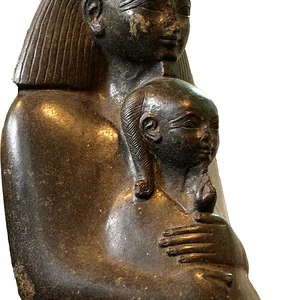
A set of more than twenty statues depicting the steward Senenmut holding the swaddled princess Neferoure, an iconographic type without precedent in Egyptian art. These works illustrate both the role of the royal tutor and the importance placed on the princess's education.
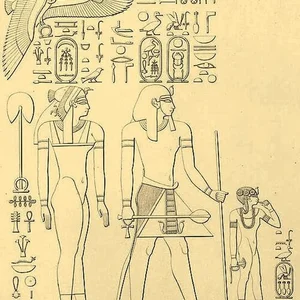
Scenes carved and painted on the walls of Hatshepsut's temple showing Neferoure taking part in religious ceremonies with her royal attributes. These reliefs are the most valuable and best-preserved representations of the princess.
A stele carved in the turquoise mines of the Sinai, mentioning Neferoure with the titles of "Lady of the Two Lands" and "Divine Wife of Amun." A foundational document for understanding the princess's exceptional status.
A commemorative monument found in Nubia, attesting to the presence of Neferoure's name and titles as far as the southern borders of the Egyptian empire and bearing witness to how widely her rank was recognized.
Anecdotes
Neferure was the beloved child of one of the rare female pharaohs in history. Her mother Hatshepsut had her image carved on the walls of the great temple of Deir el-Bahri, depicting her with the youth lock worn by royal children and the uraeus, the sacred cobra symbolizing royal power. This double attribute made it clear that she was both a child and a princess destined for a high religious office.
The steward Senenmut, one of the most powerful men at Hatshepsut's court, was entrusted with Neferure's education. He had himself depicted in some twenty statues showing him holding the swaddled young girl close against him — something extremely rare for a non-royal figure. These statues, found in several temples, testify to the particular affection he held for his pupil and to the importance placed on the princess's upbringing.
The title of “Divine Wife of Amun” that Neferure held was not merely honorific: it conferred upon her a central priestly role in the cult of the principal god of Thebes. By performing the rituals reserved for this title, the princess represented on earth the mystical wife of the god Amun, thereby reinforcing her mother's divine legitimacy on the throne of Egypt.
An inscription carved in the Sinai Peninsula, at Serabit el-Khadim, refers to Neferure as “Lady of the Two Lands” — a title normally reserved for queens. Dated to her mother's reign, this inscription suggests that Neferure was already carrying out near-royal functions while still a teenager, perhaps foreshadowing a succession that her premature death prevented her from assuming.
The disappearance of Neferure remains one of the enigmas of ancient Egypt: her name ceases to appear in monuments around the eleventh or twelfth year of her mother's reign, roughly 1490 BCE. Egyptologists still debate whether she died young or possibly married Thutmose III, her half-brother, which may have erased her trace from the royal records.
Primary Sources
Some twenty statues show the steward Senenmut kneeling or seated, holding the swaddled princess Neferure with only her face visible. The inscriptions identify both figures and describe Senenmut as the “great steward” and “tutor” of the royal princess.
A rock stela carved in the turquoise mines of the Sinai mentions Neferure with the title of “Lady of the Two Lands” (nbt-t3wy) and “Divine Wife of Amun,” attesting to her near-royal status during the reign of Hatshepsut.
The walls of Hatshepsut's mortuary temple at Deir el-Bahari depict Neferure wearing the sidelock of youth and the royal uraeus, taking part in religious ceremonies alongside her mother and Senenmut.
A commemorative monument found at Buhen (present-day Sudan) mentions Neferure with her titles and confirms her place in the royal protocol of Hatshepsut's court, testifying to the reach of her name to the farthest borders of the empire.
The annals carved at Karnak provide the chronological framework for Hatshepsut's reign and allow Neferure's life to be placed within the Eighteenth Dynasty, in particular the years when her name disappears from the historical record.
Key Places
Hatshepsut's mortuary temple on the west bank of Thebes, where Neferure is depicted in several reliefs and inscriptions bearing her royal attributes. It is the most important monument for understanding her life.
The great religious complex dedicated to the god Amun, center of the cult of which Neferure was the Divine Wife. It was here that she performed the sacred rituals reserved for this supreme title in the most powerful temple of Thebes.
A turquoise mining site where a rock inscription mentions Neferure with the title of "Lady of the Two Lands," a testament to her near-royal status during the reign of her mother.
The royal residence on the west bank of the Nile where Hatshepsut's court lived, and the setting of Neferure's childhood and education under Senenmut.
A Nubian fortress and administrative site where a stele mentioning Neferure was discovered, attesting to the spread of her name to the southernmost reaches of the Egyptian empire.
Typical Objects

A golden frontal ornament shaped like a rearing cobra, reserved for members of the royal family. Neferoure is regularly depicted wearing the uraeus on her forehead, marking her rank as a royal princess and her connection to divine power.

A braid worn on the side of a shaved head by children of the Egyptian elite until they came of age. It is clearly visible in depictions of the young Neferoure in the relief carvings of her mother's temple at Deir el-Bahari.

A metal-framed musical instrument producing a rattling sound, used during rituals honoring the gods. As God's Wife of Amun, Neferoure played the sistrum during the religious ceremonies she presided over in the temples of Thebes.

A lavish necklace of blue faience, gold, and semi-precious stones, covering the chest down to the shoulders. Depictions of Neferoure show her adorned with this ornament, characteristic of Egyptian royalty and the high nobility.

A hieroglyphic oval enclosing the name of the ruler, a symbol of eternal protection. The fact that the name "Neferoure" appears within cartouches on several monuments is exceptional for someone who was not a pharaoh, revealing her extraordinary status.

An object symbolizing the elite education Neferoure received under the tutelage of Senenmut. Children of the court were taught to read and write hieroglyphs, the sacred language essential to the practice of religious rituals.

A sculptural type unique in Egyptian art: the steward Senenmut is shown holding the swaddled princess, with only her face emerging. More than twenty examples have been found across different sites, attesting to the significance of this exceptional pedagogical bond.
School Curriculum
Vocabulary & Tags
Key Vocabulary
Tags
Daily Life
Morning
Néférourê rose at dawn in the royal palace of Thebes. She took part in the morning rituals of opening the sanctuary of Amun alongside the priestesses, a role that fell to her as Divine Wife. Her handmaidens dressed her in fine white linen and adorned her with her ritual jewels — a usekh collar, gold bracelets, and the frontal uraeus.
Afternoon
In the afternoon, Néférourê received her lessons from Senenmut: reading and writing hieroglyphs, knowledge of religious texts, royal protocol, and the history of Egypt. She sometimes observed the architectural works commissioned by her mother, accompanied by her retinue of servants and nurses.
Evening
In the evening, Néférourê attended royal banquets where musicians and dancers performed before the court. She took part in ritual libations and offerings to the gods. The evenings ended with readings of sacred texts in the royal apartments, by the light of castor oil lamps.
Food
Néférourê's table was that of a royal princess: white wheat bread, roasted poultry (goose, Nile duck), grilled fish, vegetables (onions, lentils, cucumbers), fruits (figs, dates, pomegranates, grapes), and quality beer or red wine from the royal estates of the Delta.
Clothing
Néférourê wore tunics of very fine white linen, sometimes pleated or decorated with colorful embroidery. Her ceremonial outfits included carefully styled black wigs, a frontal diadem with the uraeus, and a broad pectoral collar in gold and blue faience. The braided sidelock of youth worn on one side still marked her status as a royal child in her early years.
Housing
Néférourê lived in the royal palace of Thebes, in apartments with floors and columns painted with geometric and floral motifs. The rooms were ventilated by wooden latticed screens, furnished with plastered wooden beds, ebony chests, and chairs with lion-paw feet. Blue faience basins and interior gardens provided coolness and comfort.
Historical Timeline
Period Vocabulary
Visual Style
Style des reliefs polychromes du Nouvel Empire égyptien, avec la palette chaude et les contours hiératiques caractéristiques des monuments de la XVIIIe dynastie — ocre d'or, bleu lapis-lazuli et blanc lin.
Sound Ambience
Ambiance sonore des temples thébains du XVe siècle avant J.-C., mêlant chants liturgiques, sistres rituels, musique de cour et rumeur quotidienne du palais royal d'Hatchepsout.
Liens externes & ressources
Références
Œuvres
Statues de groupe Senenmout-Néférourê
vers 1490-1482 av. J.-C.
Reliefs de Deir el-Bahari
vers 1495-1482 av. J.-C.
Inscription rupestre de Serabit el-Khadim
vers 1490 av. J.-C.
Stèle de Bouhen
vers 1490 av. J.-C.