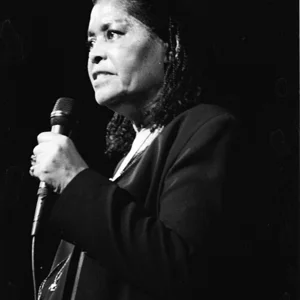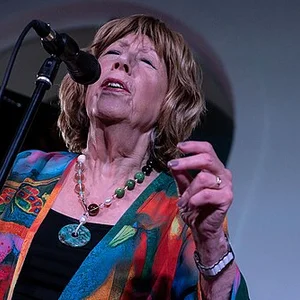

Norma Winstone is a British jazz singer born in 1941, a major figure in European vocal jazz. Famous for her wordless vocalises and her art of writing lyrics for instrumental themes, she has profoundly shaped contemporary jazz.
Norma Winstone(1941 — ?)
Norma Winstone
Royaume-Uni
5 min read
Frequently asked questions
Key Facts
- Born on 23 September 1941 in London (United Kingdom).
- Emerged on the British jazz scene in the 1960s, collaborating with Michael Garrick and Kenny Wheeler.
- Co-founded the trio Azimuth in 1977 with pianist John Taylor and trumpeter Kenny Wheeler.
- Recorded several acclaimed albums for the German label ECM, a pioneer of stripped-down vocal jazz.
- Appointed MBE (Member of the Order of the British Empire) in 2007 for her contribution to music.
Works & Achievements
First album as a leader, showcasing her wordless vocals and the new British jazz scene.
First record by the Azimuth trio (with John Taylor and Kenny Wheeler) on ECM, one of the most acclaimed European groups.
ECM trio album with John Taylor and Tony Coe, which became a classic of European vocal jazz.
Lyrics written to pianist Jimmy Rowles's melody: an emblematic example of her artistry as a lyricist for instrumental themes.
ECM trio album with Klaus Gesing and Glauco Venier, nominated for a Grammy Award.
A continuation of the collaboration with her Italian-German trio on the ECM label.
A new album by the trio, blending original compositions and reimagined covers.
Anecdotes
Norma Winstone is famous for singing without words: she uses her voice as a fully-fledged instrument, holding long vowels or improvising melodies amid the brass and piano. In her trio Azimuth, she isn't content to be the spotlighted “singer”: she blends into the group, on equal footing with the instrumentalists.
Her rarest talent is writing lyrics for purely instrumental themes. For instance, she set words to *The Peacocks*, a melody by the American pianist Jimmy Rowles, which became the song *A Timeless Place*. Turning wordless music into a song requires sensing the emotion hidden within the notes.
In 1977, she founded the trio Azimuth with pianist **John Taylor** — then her husband — and trumpeter **Kenny Wheeler**. This voice-piano-trumpet trio, with its hushed, floating atmosphere, became one of the most admired European ensembles and recorded for the prestigious German label ECM.
In 2007, Queen **Elizabeth II** appointed her MBE (Member of the Order of the British Empire) for services to music: a rare honor for a jazz artist. Her influence reaches beyond Europe, as her album *Distances* went on to be nominated for a Grammy Award in the United States.
Before becoming a singer, Norma Winstone first trained on piano and organ. This knowledge of harmony explains her remarkable precision: she can follow the most complex harmonies of modern jazz and improvise accurately, just like an instrumentalist.
Primary Sources
Norma Winstone, Jazz Singer. For services to Music.
Azimuth: Norma Winstone — vocals; John Taylor — piano, organ; Kenny Wheeler — trumpet, flugelhorn.
Norma Winstone — vocals; John Taylor — piano; Tony Coe — tenor saxophone, clarinet.
Norma Winstone — vocals; Glauco Venier — piano; Klaus Gesing — bass clarinet, soprano saxophone.
Key Places
A working-class neighbourhood in London's East End where Norma Winstone was born in 1941.
A legendary London jazz club where great musicians cross paths and where she performs.
The city where she lives and builds her career, at the heart of the British jazz scene.
The Norwegian capital where ECM recorded many albums with their distinctive sound.
Home of the ECM label, founded by Manfred Eicher, which accompanies much of her career.
Typical Objects

Her voice, often whispered and intimate, relies on the microphone to create a hushed atmosphere and subtle shades of timbre.

Norma Winstone wrote lyrics for existing instrumental melodies; the notebook symbolizes this rare art of “putting words” to jazz.

Several of her major albums (Azimuth, Distances) were released on ECM, a label recognizable by its minimalist sleeve designs and its reverberant sound.

In 2007 she received the medal of Member of the Order of the British Empire for services to music.

Before singing, she trained on piano and organ, which nurtures her keen understanding of harmony.

The instrumental themes she sets lyrics to (such as “The Peacocks” by Jimmy Rowles) first reach her in the form of sheet music.
School Curriculum
Vocabulary & Tags
Key Vocabulary
Tags
Daily Life
Morning
A jazz singer like Norma Winstone protects her voice: waking up without overdoing it, gentle vocal warm-ups, honey herbal tea. Mornings are often spent writing lyrics over instrumental melodies, a patient effort to bring words and music into harmony.
Afternoon
The afternoon is devoted to rehearsals with her partners (piano, trumpet, saxophone), to listening to recordings, and to fine-tuning the arrangements. On tour, you also have to travel from one city to the next and test the acoustics of each venue.
Evening
In the evening, it's time for the concert, often in intimate clubs like Ronnie Scott's or at European festivals. On stage, her voice converses with the instruments, sometimes without words, in a hushed and contemplative atmosphere.
Food
To protect their voices, singers avoid iced drinks, too much alcohol, and overly spicy dishes before singing. Herbal teas, room-temperature water, and light meals are preferred on concert nights.
Clothing
On stage, she favors understated elegance, nothing flashy, in keeping with the spare aesthetic of the ECM label. For rehearsals and touring, comfortable outfits take over.
Housing
Based in London, she later divides her life between England and continental Europe according to her collaborations, alternating between home and hotels during long international tours.