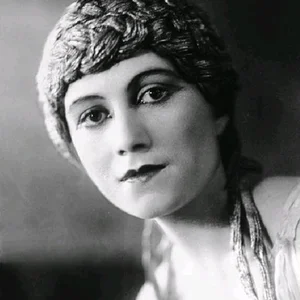

Olga Khokhlova was a Ukrainian dancer with Serge Diaghilev's Ballets Russes. She met Pablo Picasso during the creation of the ballet Parade in 1917 and became his first wife in 1918.
Olga Khokhlova(1891 — 1955)
Olga Khokhlova
France, Empire russe
5 min read
Frequently asked questions
Key Facts
- Born in 1891 in Nizhyn (Russian Empire, present-day Ukraine)
- Joined Diaghilev's Ballets Russes in the 1910s
- Met Pablo Picasso in 1917 during the creation of the ballet Parade in Rome
- Married Picasso on 12 July 1918; she was the mother of their son Paulo (born in 1921)
- Died in 1955 in Cannes
Works & Achievements
Avant-garde ballet in which Olga dances; its creation marks her meeting with Picasso and a turning point in the collaboration between painters and dance.
Olga performs roles in the productions of Diaghilev's company, the showcase of modern dance in Europe.
By posing for Picasso, Olga inspires one of the emblematic canvases of his figurative and classical period.
Her presence accompanies Picasso's return to a figurative painting inspired by antiquity and ceremonial portraits.
Olga takes part in the tours across Europe and South America that spread Russian choreographic art throughout the world.
Anecdotes
Olga Khokhlova joined Diaghilev's Ballets Russes around 1912; like many of the company's dancers, she was a solid artist but remained in the corps de ballet, never becoming a prima ballerina.
It was during the 1917 Italian tour, while preparing the ballet Parade in Rome, that Picasso (who was designing the sets and costumes) fell in love with her. The story goes that Diaghilev warned the painter that one does not marry a Russian dancer: you have to do it for real.
On 12 July 1918, Olga and Picasso were married in Paris at the Russian Orthodox church on rue Daru, according to the Orthodox rite. Their witnesses included prestigious friends such as Jean Cocteau, Max Jacob and Guillaume Apollinaire.
Picasso made numerous portraits of Olga between 1917 and 1920, in a figurative, classical style very different from Cubism: seated in an armchair, wearing a Spanish mantilla, or lost in thought. These canvases reflect Olga's taste for bourgeois elegance.
The couple separated in 1935, but since French law did not allow divorce without dividing their assets, Olga legally remained Picasso's wife until her death in 1955. She never stopped signing her letters “Madame Picasso.”
Primary Sources
Wedding celebrated according to the Orthodox rite at the Saint-Alexandre-Nevsky Church on rue Daru in Paris.
Letters in Russian and French addressed to Picasso during their affair and then their marriage, preserved in the Picasso collection.
Production based on a scenario by Jean Cocteau, music by Erik Satie, with curtain, sets and costumes by Pablo Picasso and choreography by Léonide Massine.
Oil on canvas depicting Olga seated, in a dark dress, holding a fan, in a figurative style based on a photograph.
Key Places
Town in the Russian Empire, in Ukraine, where Olga Khokhlova was born in 1891.
Parisian theatre where the ballet Parade premiered in 1917, the occasion of the meeting between Olga and Picasso.
Russian Orthodox church in Paris where Olga and Picasso married on 12 July 1918.
City where the company prepared Parade in 1917 and where Picasso, there to work on the sets, fell in love with Olga.
Town on the French Riviera where Olga Khokhlova died in 1955.
Typical Objects

Reinforced-toe ballet shoes that allow the ballerina to dance on pointe. An everyday tool for Olga during her years with the Ballets Russes.

A classical dancer's costume designed for the ballets; some of the company's costumes were created by avant-garde painters.

A lace veil worn over the head and shoulders, which Olga wears in several portraits painted by Picasso around 1917-1918.

A handheld fashion accessory that appears in some of Olga's portraits, a symbol of the bourgeois elegance of the era.

Correspondence written in Russian and French that Olga exchanged with Picasso and her family back in Russia.

Photographic portraits that sometimes served as models for Picasso's figurative paintings of Olga.
School Curriculum
Vocabulary & Tags
Key Vocabulary
Daily Life
Morning
During her years as a dancer, Olga's morning began with the daily class: barre exercises, stretches, and rehearsals under the demanding eye of the ballet masters. Bodily discipline was the absolute rule in Diaghilev's company.
Afternoon
The afternoon was devoted to ballet rehearsals, costume fittings, and preparing for performances. While on tour, there were also the long train journeys from one European city to another to manage.
Evening
Evening brought the performance, a moment of tension and exhilaration before a fashionable audience. After her marriage, her evenings became those of the Parisian bourgeoisie: dinners, theatres, and receptions for which she insisted that Picasso appear elegant.
Food
A dancer's diet was carefully watched and frugal to maintain lightness. Married to Picasso, Olga shared the table of fashionable Parisian society and enjoyed stays on the French Riviera, more generous in refined meals.
Clothing
Olga loved elegance: dresses in the fashion of the 1920s, lace mantillas, furs, and carefully chosen accessories. This taste for bourgeois attire contrasted with the bohemian world of the artists her husband mixed with.
Housing
After her marriage, the couple settled into a large Parisian apartment on rue La Boétie, then frequented villas and houses on the French Riviera. Olga insisted on a tidy, respectable home, far from the disorder of the studio.
Historical Timeline
Period Vocabulary
Liens externes & ressources
Références
Œuvres
Parade (Ballets russes)
1917
Participation au répertoire des Ballets russes
1912-1918
Modèle de Portrait d'Olga dans un fauteuil
1918
Muse de la période « classique » de Picasso
1917-1924
Tournées internationales des Ballets russes
1912-1917