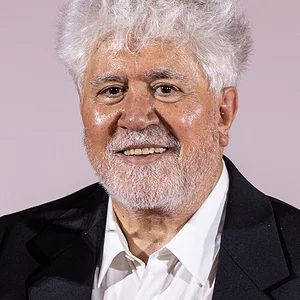

Spanish filmmaker, screenwriter and producer born in 1949, a major figure of contemporary European cinema. Brought to prominence by the “Movida madrileña” following Franco's death, he established himself as the author of a flamboyant cinema blending melodrama, humor and desire.
Pedro Almodóvar(1949 — ?)
Pedro Almodóvar
Espagne
6 min read
Frequently asked questions
Key Facts
- Born in 1949 in Calzada de Calatrava (Castilla-La Mancha), Spain
- Emerges in the late 1970s within the “Movida madrileña,” a cultural liberation movement following Franco's death (1975)
- Founds the production company El Deseo in 1986 with his brother Agustín
- Wins the Academy Award for Best Foreign Language Film for “All About My Mother” (2000), then for Best Original Screenplay for “Talk to Her” (2003)
- Receives an honorary Palme d'Or and numerous international awards for his body of work
Works & Achievements
His first feature film, low-budget and provocative, becomes a manifesto of the Madrid Movida.
A colorful comedy that brings him worldwide success and a nomination for the Academy Award for Best Foreign Language Film.
A devastating melodrama about motherhood and grief, awarded the Academy Award for Best Foreign Language Film.
A delicate and daring film that earns him the Academy Award for Best Original Screenplay.
A work partly inspired by his childhood among the clergy, exploring memory and abuse.
A tribute to the women of La Mancha and to his own mother, carried by Penélope Cruz.
An unsettling thriller that reveals the darkest and most inventive side of his cinema.
A partly autobiographical story of an aging filmmaker, hailed as one of his most personal films.
Anecdotes
As a teenager, Pedro Almodóvar left his native La Mancha for Madrid with the dream of making films. But Franco had just shut down the Official Film School: so the young man would be entirely self-taught, learning his craft alone, camera in hand.
To earn a living, he worked for twelve years as a clerk at the national telephone company (Telefónica). By day, he filed administrative paperwork; at night and on weekends, he shot short films on Super 8 stock with his friends, with no budget and no permission.
At the heart of the *Movida madrileña*, the artistic explosion that followed Franco's death in 1975, Almodóvar didn't just film: he took to the stage! With his friend Fabio McNamara, he formed a wild, provocative musical duo that embodied the newfound freedom of Spanish youth.
In 1985, he founded his own production company with his brother Agustín: El Deseo (“The Desire”). This independence allowed him to make exactly the films he wanted, without giving in to pressure, and made him one of the few filmmakers to have complete control over his work.
Almodóvar has won two Oscars: in 2000 for *All About My Mother* (Best Foreign Language Film), then in 2003 for the screenplay of *Talk to Her*. At the 2000 ceremony, his overflowing emotion and his halting English became famous.
Primary Sources
To Bette Davis, Gena Rowlands, Romy Schneider… To all the actresses who have played actresses, to all the women who act, to the men who act and become women, to all the people who want to be mothers. To my mother.
In them Almodóvar invents a heroine full of humor and insolence, who freely recounts Madrid's nightlife during the Movida; these pieces would later be gathered into a single volume.
In it Almodóvar blends childhood memories of La Mancha, his relationship with cinema, and the evocation of his mother's death, offering an intimate self-portrait of the writer hidden behind the filmmaker.
Almodóvar has often recalled that he taught himself everything by filming, and that the ferment of Madrid after Franco gave him the feeling that everything was possible and nothing was forbidden.
Key Places
Village in La Mancha where Almodóvar was born in 1949. This rural, working-class Spain would remain a source of inspiration, notably in *Volver*.
Region where his family settled and where he studied under religious teachers. These boarding-school years would leave a lasting mark on his imagination.
Capital where Almodóvar settled in the late 1960s, became a filmmaker and founded El Deseo. At the heart of the Movida, the city is the central backdrop of his cinema.
City where the Oscars are held, which Almodóvar won twice. It symbolizes his international recognition.
Home of the international film festival, where Almodóvar regularly presents his work and has received several prestigious honors.
Typical Objects

Cheap amateur camera with which Almodóvar shot his first films on no budget. It symbolizes the free, do-it-yourself cinema of his early days.

Written text in which Almodóvar imagines dialogue, characters and situations before shooting. A complete author, he writes most of his films himself.

Tool of the trade Almodóvar worked at for twelve years before making a living from cinema. There he observed the daily lives of employees and conversations that would later feed his characters.

Award presented in Hollywood, which Almodóvar received twice. It marks the worldwide recognition of a deeply Spanish cinema.

Almodóvar's visual signature, present everywhere in his sets, costumes and posters. It conveys the passion, desire and melodrama that run through his work.

Pop, punk and flamenco music that set the rhythm of Madrid's nights in the 1980s. Almodóvar took part in it and steeped his films' soundtracks in it.
School Curriculum
Vocabulary & Tags
Key Vocabulary
Daily Life
Morning
Known for his discipline, Almodóvar often devotes his mornings to writing, alone and in quiet, tirelessly reworking his screenplays. As an auteur-filmmaker, he builds each story word by word before any shooting begins.
Afternoon
The afternoon is dedicated to preparing his films: choosing the sets, the colors, the costumes, scouting locations, and long audition sessions with the actors. Almodóvar personally controls the smallest visual detail.
Evening
In the evening, he feeds his imagination through culture: cinema, reading, music, and friendships in the artistic world. In the 1980s, his nights blended into the non-stop revelry of Madrid's *Movida*.
Food
Attached to his roots, Almodóvar enjoys the popular cooking of La Mancha and Madrid: stews, slow-cooked dishes, and traditional pastries. Food, moreover, holds a tender and symbolic place in several of his films.
Clothing
He cultivates a personal, colorful, and recognizable style, mixing bright shirts, bold jackets, and striking accessories. This eccentric elegance extends the flamboyant aesthetic of his cinema.
Housing
Almodóvar lives and works in Madrid, in a domestic world saturated with colors, contemporary art, and design objects. His apartment reflects the taste for beauty and visual abundance that characterizes his films.
Historical Timeline
Period Vocabulary
Liens externes & ressources
Références
Œuvres
Pepi, Luci, Bom et autres filles du quartier
1980
La Mauvaise Éducation
2004