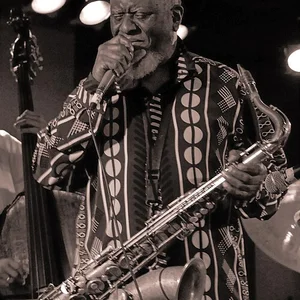

American jazz saxophonist (1940-2022), a major figure of free jazz and spiritual jazz. A collaborator of John Coltrane in the 1960s, he developed an intense style blending powerful breath, ecstatic sonorities, and African and Eastern inspirations.
Pharoah Sanders(1940 — 2022)
Pharoah Sanders
États-Unis
6 min read
Frequently asked questions
Key Facts
- Born in 1940 in Little Rock (Arkansas) as Farrell Sanders, died in 2022 in Los Angeles
- Joined John Coltrane's group in 1965 and took part in major albums such as “Ascension” and “Meditations”
- Released the album “Karma” in 1969, along with its sprawling track “The Creator Has a Master Plan,” an emblem of spiritual jazz
- Recorded a series of landmark albums for the Impulse! label in the late 1960s and early 1970s
- Returned to success in 2021 with the album “Promises,” in collaboration with electronic musician Floating Points and the London Symphony Orchestra
Works & Achievements
His very first album as a leader, recorded for the independent label ESP-Disk.
His saxophone playing leaves its mark on these founding free jazz records through its sheer intensity.
His first major solo album on Impulse!, a manifesto of his spiritual jazz with Eastern and African colors.
His most famous work, featuring the more-than-thirty-minute track “The Creator Has a Master Plan.”
A radiant album in which he explores soaring textures and percussion, much loved by fans of spiritual jazz.
A single composition of about thirty-seven minutes, an anthem of unity blending collective fervor with African influences.
A late and acclaimed collaboration with Floating Points and the London Symphony Orchestra, which earned him newfound fame.
Anecdotes
Pharoah Sanders was born Ferrell Sanders. In the early 1960s, while playing in New York with the eccentric pianist Sun Ra, Sun Ra started calling him “Pharoah”, a play on his first name Farrell. The nickname stayed with him for the rest of his life.
When he arrived in New York in 1962, the young saxophonist lived in dire poverty: he sometimes slept in the subway, pawned his saxophone, and sold his blood to survive. Sun Ra took him in and fed him, which helped him hold on.
In 1965, jazz giant John Coltrane invited Sanders, then barely 24 years old, to play in his band. On records like “Ascension” and “Meditations”, their two saxophones answer each other in dialogues of blazing intensity.
In 1969, his album “Karma” contained a track more than thirty minutes long, “The Creator Has a Master Plan”, carried by the singing and vocalizing (a surprising yodel) of Leon Thomas. The track became an emblem of spiritual jazz.
In 2021, at over 80 years old, Sanders recorded “Promises” with the electronic musician Floating Points and the London Symphony Orchestra. Hailed as one of the finest records of the year, it introduced the veteran saxophonist to a whole new generation.
Primary Sources
Pharoah is a man of large spiritual reservoir. He's always trying to reach out to truth. He's trying to allow his spiritual self to be his guide.
The creator has a master plan, peace and happiness for every man.
The National Endowment for the Arts names Pharoah Sanders a 2016 NEA Jazz Master, the highest honor the United States bestows in the field of jazz.
Key Places
Pharoah Sanders's hometown, in the segregated American South, where he grew up and learned music.
The city where he settled after high school to study music and cut his teeth in the jazz clubs.
The heart of avant-garde jazz, where he met Sun Ra and then John Coltrane and forged his style; here he lived through years of bohemian struggle and glory.
The city where he spent his final years and where he died in September 2022.
Typical Objects

His instrument of choice, from which he drew a powerful breath, cries, and ecstatic sonorities characteristic of free jazz and spiritual jazz.

A small strip of cane fixed to the saxophone's mouthpiece that vibrates to produce the sound; Sanders pushed it to its limits to obtain his famous shrieking, torn high notes.

The part where the breath enters the instrument; by blowing very hard, Sanders made multiphonics emerge there — several sounds at once.

Little bells, rattles, and small percussion instruments that punctuated his concerts and records, echoing his African and spiritual inspirations.

The famous orange-and-black sleeve of the Impulse! label, on which he released his major albums such as “Tauhid” and “Karma”.

A colorful West African–inspired garment, worn by many spiritual jazz musicians to assert African pride and heritage.
School Curriculum
Vocabulary & Tags
Key Vocabulary
Tags
Daily Life
Morning
On tour as at home, his days revolved around the instrument: long sessions working on his breathing and scales to maintain his extraordinary stamina. Mornings were also a time to rehearse new pieces with his musicians.
Afternoon
The afternoon might be devoted to group rehearsals, studio recording sessions, or travel from one city to the next. Like many jazzmen of his era, his life was paced by ceaseless touring.
Evening
The evening was concert time, often in clubs or halls, where his performances could stretch into long, fiery improvisations. The sets sometimes ended late into the night.
Food
Precise details about his diet are scarce, but many musicians close to the spiritual jazz of the 1960s and 1970s, drawn to Eastern spiritualities, adopted a simple and sometimes vegetarian diet. Touring life often meant quick meals between two concerts.
Clothing
On stage, Sanders frequently sported outfits of African inspiration — colorful tunics, headdresses — asserting a Black heritage and pride in keeping with his spiritual jazz. In the studio, he stayed more understated.
Housing
In his early New York years, he lived in great hardship, housed for a time by Sun Ra. With success, he led the life of a professional musician, split between urban dwellings and hotel rooms as the tours dictated.