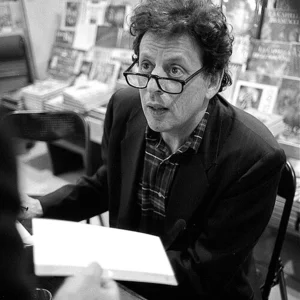

Philip Glass is an American composer born in 1937, a major figure of minimalist music. He made his name with operas and film scores built on repetitive, hypnotic structures.
Philip Glass(1937 — ?)
Philip Glass
États-Unis
6 min read
Frequently asked questions
Key Facts
- Born on January 31, 1937, in Baltimore, Maryland, in the United States
- Studied with Nadia Boulanger in Paris in the early 1960s
- Created the opera Einstein on the Beach in 1976, a founding work of minimalism in opera
- Composed the trilogy of portrait operas with Satyagraha (1980) and Akhnaten (1983)
- Wrote numerous film scores, including The Hours (2002), nominated for an Oscar
Works & Achievements
A vast cycle for ensemble that sums up his thinking on repetitive structures; a true compendium of minimalism.
A sprawling, plotless opera created with Robert Wilson, regarded as a groundbreaking work of the 20th century.
An opera about Gandhi's early years, sung in Sanskrit, the first installment of a trilogy of portraits.
The score for Godfrey Reggio's experimental film, which revealed his gift for cinema to a wide audience.
An opera about the sun-worshipping Egyptian pharaoh, the third installment of his trilogy of portrait operas.
A poignant, Oscar-nominated soundtrack that gave his style worldwide popularity in the world of film.
A work for string orchestra showing that Glass extends his repetitive language into the classical symphonic form.
Anecdotes
To pay his bills before becoming famous, Philip Glass worked for a long time as a plumber and as a taxi driver in New York. The story goes that one day, while repairing a dishwasher at the home of art critic Robert Hughes, the latter recognized him and asked, astonished: “But you're Philip Glass, the composer!” Glass replied that he was just finishing the repair.
As a young man, Glass went to study in Paris with the legendary teacher Nadia Boulanger, who trained composers with iron-fisted rigor. But it was above all his encounter with the Indian sitar player Ravi Shankar, whose music he was transcribing for a film, that transformed the way he thought about rhythm and repetition.
His opera “Einstein on the Beach” (1976) lasts nearly five hours without an intermission, and there is no real plot. The audience was allowed to enter and leave the hall freely during the performance, which was a revolution for the opera of the time.
Glass disliked having his music labeled “minimalist.” He preferred the phrase “music with repetitive structures,” feeling that the term minimalist had been invented by critics and did not really describe what he was doing.
He composed the music for a great many films, including “The Hours” (2002), nominated for an Oscar. His repetitive, hypnotic music became so recognizable that it influenced generations of film composers and even rock bands.
Primary Sources
I didn't think in terms of melody or harmony in the traditional sense, but in terms of rhythmic structures that transform slowly, like a process you listen to as it unfolds.
In New York, I drove a taxi and installed plumbing by day, and I composed at night. I didn't see it as a failure, but as the normal life of an artist searching for his voice.
We wanted an opera without a story, where time itself became the subject. The audience could stay for four hours or leave, and the work carried on its way.
Key Places
Philip Glass's birthplace, where his father ran a record store that sparked his musical curiosity at a very young age.
Glass studied here in the early 1960s under Nadia Boulanger and met Ravi Shankar while working on a film transcription project.
The heart of his career: he founded the Philip Glass Ensemble here in 1967 and composed his major works while working odd jobs.
Glass enrolled here at age 15 to study mathematics and philosophy, training that would shape his structured approach to music.
The prestigious conservatory where Glass deepened his training as a composer before breaking with academic conventions.
Pivotal travels that strengthened his attraction to cyclical rhythms, spirituality, and the Eastern philosophies present in his operas.
Typical Objects

A portable electronic instrument with a distinctive sound, a sonic pillar of the Philip Glass Ensemble in the 1970s. Its vibrant, sustained tone was perfectly suited to repetitive structures.

A written document in which short musical cells repeat while slowly transforming. Glass's notation relies on the gradual addition and subtraction of notes.

An Indian stringed instrument discovered through Ravi Shankar, whose cyclical rhythmic structures inspired Glass's musical thinking. He did not play it, but transcribed its logic.

The medium of the films Glass scored, from “Koyaanisqatsi” to “The Hours.” Film music became an essential part of his body of work.

Before fame, Glass earned his living as a taxi driver in New York. This vehicle symbolizes the precarious years of an artist searching for his voice.

Glass also worked as a plumber and installer to make ends meet. His tools embody the dual daily life of the New York artist of the 1960s and 70s.
School Curriculum
Vocabulary & Tags
Key Vocabulary
Tags
Daily Life
Morning
Glass long led a double life: in the mornings, during the 1960s and 70s, he might drive a taxi or install plumbing across New York. Once he gained recognition, he devoted his mornings to composing, with the discipline of a clockmaker.
Afternoon
Afternoons were often dedicated to rehearsals with the Philip Glass Ensemble, the group he had founded to perform his own music. He tirelessly worked through the repetitive motifs until they reached perfect precision.
Evening
Evenings were the time for concerts, premieres, and collaborations with theatre directors, choreographers, and filmmakers. Glass loved the artistic buzz of the New York of that era.
Food
Shaped by Eastern philosophies and yoga, Glass adopted a simple lifestyle and was a vegetarian for many years. His diet reflected his interest in Indian and Tibetan spirituality.
Clothing
He was most often seen in plain, casual attire — a dark shirt, a simple jacket — far from any showiness, in keeping with the image of the understated New York artist despite his fame.
Housing
Glass lived mainly in New York, in the East Village neighborhood and later in housing connected to the art world. His composition studio was a space of intense work, blending keyboards and scores.