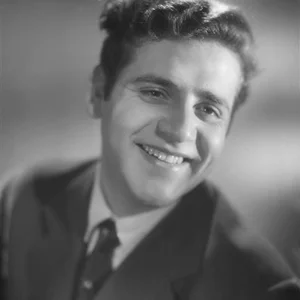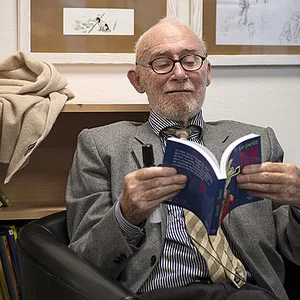

Pierre Étaix (1928-2016) was a French clown, filmmaker, actor and illustrator. A collaborator of Jacques Tati, in the 1960s he directed slapstick comedies such as “The Suitor” and “Yoyo,” in the tradition of visual comic cinema.
Pierre Étaix(1928 — 2016)
Pierre Étaix
France
6 min read
Frequently asked questions
Key Facts
- Born on 23 November 1928 in Roanne
- Collaborated with Jacques Tati on “Mon Oncle” in the late 1950s
- Won the Academy Award for Best Short Film in 1963 for “Happy Anniversary”
- Directed “The Suitor” (1963) and “Yoyo” (1965), classics of French slapstick
- Died on 14 October 2016 in Paris
Works & Achievements
Short film co-written with Jean-Claude Carrière, awarded the Oscar for Best Live Action Short Film. A masterpiece of visual comedy without dialogue.
Étaix's first feature film, a slapstick comedy about a shy young man searching for love. It reveals his elegant, deadpan style.
His most famous film, a tribute to the circus and silent cinema, blending black and white with a slapstick aesthetic. Regarded as his masterpiece.
A sketch film satirizing modern life, noise and advertising. It extends his gentle critique of consumer society.
Étaix's first comedy in color, about the daydreams of a married man. It poetically explores imagination and desire.
A satirical documentary on the holidays and mass leisure of the French. A clear-eyed and sometimes biting look at society.
One of his first short films, a pure exercise in visual comedy built around a breakup letter. It heralds his entire slapstick world.
Anecdotes
Before cinema, Pierre Étaix was a circus clown and worked as an illustrator and graphic designer. He even created posters and visual gags, and this dual training as an artist of the drawing board and the ring would nourish all of his slapstick cinema.
In the late 1950s, Étaix became the assistant of Jacques Tati on *Mon Oncle* (1958). He contributed to the gags and the shot breakdown, learning from the master the art of visual comedy and the precise timing that would become his signature.
In 1962, his short film *Heureux Anniversaire*, co-written with Jean-Claude Carrière, won the Oscar for Best Short Film. This nearly dialogue-free film shows a husband stuck in Parisian traffic while his anniversary dinner goes cold.
For decades, his films became invisible because of a long legal dispute over the rights. It was only in 2010, after a court battle backed by many filmmakers, that his work was restored and screened again, revealing Étaix to a new generation.
Étaix never stopped being a man of the ring: with his wife Annie Fratellini he founded the *École nationale du cirque* (National Circus School) in 1974, passing on the art of clowning and acrobatics to young performers.
Primary Sources
With Tati, I learned that laughter is born from precise observation of reality, not from pulling faces. A gag must be constructed like a musical phrase.
I have always believed that visual comedy was a universal language, one that needs no translation to reach a viewer.
These films nearly disappeared. Seeing them again on the big screen is like recovering a part of your own life that you thought was lost.
Key Places
Town in the Loire where Pierre Étaix was born in 1928. It was there that he spent his childhood before moving to Paris.
Capital where Étaix settled in the 1950s and where most of his career as a clown, filmmaker, and illustrator unfolded. He died there in 2016.
Institution he founded in 1974 with Annie Fratellini to pass on the circus arts. There he trained young clowns and acrobats.
Places where he directed his slapstick comedies of the 1960s such as “The Suitor” and “Yoyo.” There he displayed his art of the meticulous visual gag.
Typical Objects

The central tool of his craft as a director, with which he composed visual gags of clockwork precision. Étaix conceived each shot the way an illustrator conceives a line.

A symbol of his original identity as a circus-ring performer and clown. He embodied the tradition of the white-faced clown and the auguste inherited from the circus.

The tools of his training as an illustrator and graphic artist, which he used throughout his life to design posters and storyboards. His feel for drawing shaped his framing.

The emblematic accessory of the slapstick character he plays on screen, in the tradition of Buster Keaton and Charlie Chaplin. It contributes to the elegant, deadpan silhouette of his films.

Present in several of his films and shows, it evokes the music hall and the accompaniment of comic numbers. Music gives his gags their rhythm like a musical score.

A recurring source of gags in slapstick cinema, a source of falls and comic chases. Étaix turned it into a visual device in his shorts and feature films.
School Curriculum
Vocabulary & Tags
Key Vocabulary
Daily Life
Morning
A man of discipline, Étaix often began his day by drawing, sketching gags and framing ideas in his notebooks. The morning was a time for conception, when the filmmaker rejoined the illustrator.
Afternoon
The afternoon was devoted to ring work, to rehearsing clown routines or to filming. The precision of the slapstick gesture required an almost acrobatic training.
Evening
Evenings might be spent at a show or in the music hall, the world he came from. Later, he shared these evenings with Annie Fratellini and the world of the circus.
Food
Étaix lived in post-war France and then during the Trente Glorieuses, an era marked by traditional cooking and the rise of consumer culture. Shared meals were, as in his films, scenes of social life.
Clothing
In town, he wore the plain, elegant suit of a twentieth-century artist. On screen and in the ring, he donned a bowler hat, a red nose and the costumes of silent slapstick.
Housing
He lived in Paris, among artists, cinema and the circus. His surroundings blended drawing studios, film sets and performance venues.
Historical Timeline
Period Vocabulary
Liens externes & ressources
Références
Œuvres
Heureux Anniversaire (court métrage)
1962
Le Soupirant
1962
Le Grand Amour
1968
Pays de Cocagne
1970
Rupture (court métrage)
1961