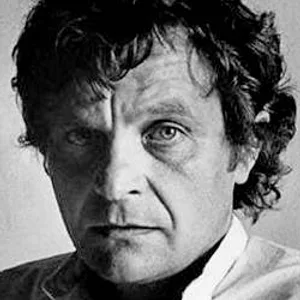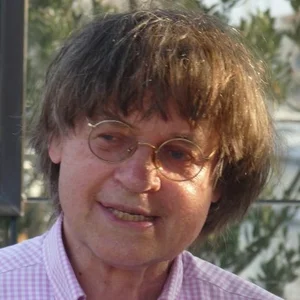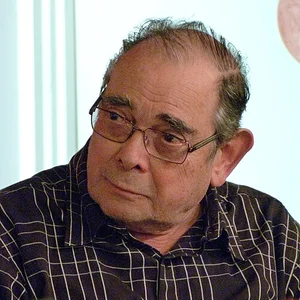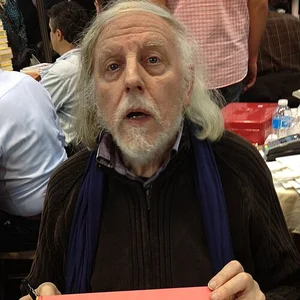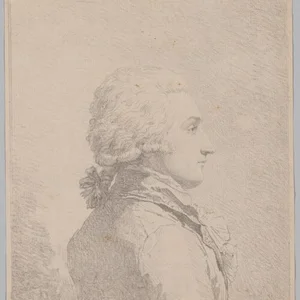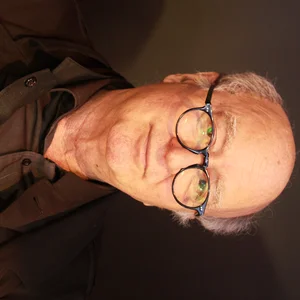

French press cartoonist and comic-book author of Tunisian-Italian origin, a leading figure of the libertarian spirit and satire from the 1960s to the 2000s. He left his mark on Hara-Kiri, Charlie Hebdo and L'Humanité before being murdered in the attack of 7 January 2015.
Georges Wolinski
Georges David Wolinski
5 min read
Frequently asked questions
Famous Quotes
« Humor is the politeness of despair.»
Key Facts
- Born on 28 June 1934 in Tunis, to a Polish father and an Italian mother
- Joined the satirical newspaper Hara-Kiri in the early 1960s, then Charlie Hebdo
- A leading figure of the protest press around May 1968 (Charlie Mensuel, L'Humanité)
- Received the Grand Prix de la ville d'Angoulême in 2005 for his life's work
- Murdered on 7 January 2015 in the attack on Charlie Hebdo, at the age of 80
Works & Achievements
His early contributions to the “dumb and nasty newspaper” laid the foundations of his satirical and provocative style. There he worked alongside Cavanna, Choron and Reiser.
A protest newspaper founded with Siné during May 1968, embodying the libertarian spirit of the era. It became a landmark of the politically committed press.
Wolinski was one of the historic figures of the satirical weekly, from its first title to its relaunch in 1992. His drawings of women and politicians are famous.
For several years he illustrated the daily newspaper of the French Communist Party. This collaboration reflected his left-wing and libertarian sympathies.
A satirical and provocative comic strip for adults, featuring a heroine with a free-spirited tone. It exemplifies the boldness of the era.
Wolinski published dozens of albums bringing together his drawings on women, politics, couples and society. His body of work spans more than fifty years.
Anecdotes
Born in Tunis in 1934, Georges Wolinski lost his father, who was murdered, when he was only two years old. His family then settled in France, in Nice, after the Second World War.
In 1968, at the height of the May '68 upheaval, Wolinski co-founded the newspaper 'L'Enragé' with Siné, which displayed the protest slogans of the moment. Editorial cartooning then became a true political weapon.
Wolinski liked to say that, for him, humor was a way of surviving anxiety. He said he drew women, politics, and death with the same slightly disillusioned tenderness.
In 2005, he received the Legion of Honor, a distinction that amused this libertarian cartoonist who had long been close to anarchist and communist ideas. Yet he continued to sketch the powerful without indulgence.
On 7 January 2015, Wolinski was murdered on the premises of Charlie Hebdo during the terrorist attack, at the age of 80. His death, together with that of his colleagues, sparked immense emotion and marches gathering millions of people.
Primary Sources
Humor is an elegant way of saying desperate things.
I draw because I don't know how to do anything else, and because it lets me say what I think.
On the last page of his notebook, he had drawn and written a few words, a testament to his work right up to the end.
Key Places
Birthplace of Georges Wolinski, born in 1934 into a Jewish family of Tunisian-Italian origin. He spent his early childhood here before going into exile in France.
City where his family settled after the Second World War and where he grew up. He studied here before moving up to Paris.
Capital where Wolinski built his entire career as a press cartoonist, at the heart of the editorial offices of Hara-Kiri, Charlie Hebdo and L'Humanité.
Site of the terrorist attack on 7 January 2015 where Wolinski was murdered along with several of the newspaper's contributors.
Typical Objects

A slanted work surface on which Wolinski made his press cartoons and comic strips. A central tool in his daily life as a cartoonist.

Black ink and a metal pen nib allowed the sharp, expressive line characteristic of press cartooning. Wolinski favoured a spontaneous, nervous style.

Titles such as Hara-Kiri and Charlie Hebdo brought his cartoons to a wide audience. The printed newspaper was the main vehicle for press satire.

Wolinski jotted down ideas and sketches day after day in notebooks. One of them, found after his death, became a moving testimony.

Having become a symbol of freedom of expression after the 2015 attack (“Je suis Charlie”), the pencil embodies the power of drawing in the face of violence.
School Curriculum
Vocabulary & Tags
Key Vocabulary
Daily Life
Morning
Wolinski often began his day by reading the newspapers and following political and social current events. That was where he drew inspiration for his cartoons of the day, reacting on the spot to unfolding events.
Afternoon
The afternoon was devoted to work at the drawing table, pen and ink in hand. He turned out sketches, ideas, and captions one after another, often under the pressure of newspaper deadlines.
Evening
In the evening, he happily reunited with his fellow cartoonists and the world of the Parisian press. The conversations, often cheerful and irreverent, nourished his outlook on the world.
Food
A man of twentieth-century Parisian life, he shared the culture of cafés and convivial meals among journalists. Nothing in particular set his diet apart from that of his era.
Clothing
Wolinski adopted the casual attire of an intellectual and artist of the second half of the twentieth century. Far from strict suits, he embodied a free style that mirrored his spirit.
Housing
He lived in Paris, at the heart of the capital's editorial and artistic life. His daily routine was shaped by his closeness to the newsrooms and the world of the press.
Historical Timeline
Period Vocabulary
Liens externes & ressources
Références
Œuvres
Dessins pour Hara-Kiri
à partir de 1960
L'Enragé
1968
Collaboration à Charlie Hebdo
1970-2015
Dessins pour L'Humanité
années 1980
Paulette (bande dessinée, avec Georges Pichard)
années 1970
Nombreux albums de dessins et recueils
1960-2015