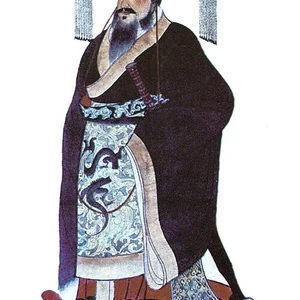

Qin Shi Huang (258–210 BC) unified the Chinese kingdoms for the first time in 221 BC, founding the Qin dynasty. As China's first emperor, he standardized writing, weights and measures, and initiated construction of the Great Wall.
Qin Shi Huang(258 av. J.-C. — 209 av. J.-C.)
Qin Shi Huang
dynastie Qin, Qin
10 min read
Frequently asked questions
Key Facts
- 258 BC: born in the kingdom of Qin
- 221 BC: unification of the seven Chinese kingdoms and proclamation of the title Huangdi (Son of Heaven)
- 221 BC: standardization of writing, currency, weights and measures throughout the empire
- 214 BC: beginning of the major Great Wall construction works to repel nomadic invasions
- 210 BC: death of the emperor; his tomb guarded by the Terracotta Army of Xi'an (approximately 8,000 soldiers)
Works & Achievements
By subjugating the six rival kingdoms over ten years (230–221 BC), Qin Shi Huang created the first unified Chinese state. This political precedent remains the foundation of Chinese national identity to this day.
The imposition of a unified writing system (xiao zhuan, small seal script), standardized weights and measures, and the Ban Liang coin enabled communication and trade across the empire. This administrative reform is regarded as one of the founding acts of Chinese civilization.
General Meng Tian connected and extended the defensive walls of the former kingdoms to form a continuous northern frontier stretching over 5,000 km. Later dynasties would rebuild and greatly expand upon this colossal undertaking.
Qin Shi Huang ordered the construction of a network of major roads, 50 meters wide, radiating from Xianyang to every corner of the empire, facilitating military movement and administrative control. This network is often compared to the Roman road system.
A hydraulic engineering feat connecting the Xiang River to the Li River, enabling inland water transport between northern and southern China. It is considered one of the oldest canal locks in the world and remains partially operational today.
A monumental funerary complex covering 56 km², of which the Terracotta Army — some 8,000 life-size figures — is the visible portion. The central tomb, still unexcavated, is described by ancient sources as a miniature reproduction of the entire universe.
The extension across the entire empire of the Legalist laws developed by Shang Yang, establishing a written, uniform, and merit-based penal system to replace the patchwork of feudal customs. Bamboo tablets discovered at Shuihudi in 1975 preserve these laws in remarkable detail.
Anecdotes
When conquering Qi, the last rival kingdom, in 221 BC, Qin Shi Huang gathered his advisors to choose a new title. Rejecting traditional titles like king or sovereign, he coined the word "huangdi" (皇帝), combining terms from the legendary Three Sovereigns and Five Emperors, to convey a greatness unprecedented in Chinese history.
Haunted by a fear of death, Qin Shi Huang sent several sea expeditions — most notably that of Xu Fu around 219 BC — in search of a legendary island inhabited by immortals said to possess the elixir of eternal life. The thousands of sailors and young people who set out never returned, and some historians believe they may have reached Japan.
After surviving three assassination attempts, including the famous attack by the hired killer Jing Ke in 227 BC, the emperor became deeply paranoid. He maintained multiple secret bedchambers, moving to a different room each night, and anyone who revealed his whereabouts faced execution. It is said he had hundreds of people put to death on suspicion of disclosing his movements.
In 213 BC, on the advice of his minister Li Si, the emperor ordered the destruction of nearly all classical books — sparing only technical works on agriculture, medicine, and divination — and had 460 Confucian scholars buried alive. This episode, known as the "Burning of Books and Burying of Scholars," remains one of the most radical acts of censorship in history.
Construction of his mausoleum began the moment he ascended the throne at age 13, and kept more than 700,000 workers occupied for 36 years. According to the historian Sima Qian, the tomb reproduced the empire in miniature, with rivers of liquid mercury flowing through it by mechanical means. Modern soil analyses have indeed detected abnormally high levels of mercury around the burial mound.
Primary Sources
"In the twenty-sixth year [221 BCE], the six kingdoms were united, and there was nothing on earth that was not subject to him. The Emperor adopted the title of Huangdi… he decreed that his proclamations should be called 'imperial edicts' and his commands 'imperial orders.'"
"The great Emperor has united and pacified the four corners of the earth. He has applied benevolent and impartial laws; the statutes and regulations are exemplary. The ten thousand nations tremble and bow before him."
"Li Si memorialized the Emperor: scholars who study the past to criticize the present sow disorder among the people. If Your Majesty does not put an end to this, your power will decline above and factions will form below."
"The Emperor has unified the empire; all measures of length, weight, and volume are henceforth identical throughout the territory, so that men shall no longer be deceived."
"The Epang Palace was begun: the audience hall could hold ten thousand people, with room for banners of five feet. All around, covered roadways rose from the throne room to Mount Li."
Key Places
Capital of the Qin Empire, situated in the heart of the Wei River plain (present-day Shaanxi), where the massive Epang Palace was built. It was here that the emperor centralized his administration and received nobles from the conquered kingdoms, who were forced to relocate there.
A 76-meter-high burial mound containing the emperor's still-unexcavated tomb, surrounded by the Terracotta Army. A UNESCO World Heritage Site, it remains one of the most significant archaeological sites in the world.
Sacred mountain where Qin Shi Huang performed the feng shan ritual in 219 BCE — a ceremony reserved for rulers recognized as legitimate Sons of Heaven — to proclaim his universal dominion. Commemorative steles were erected there.
Under the command of General Meng Tian, the old walls of the northern kingdoms were connected and extended to form a defensive frontier against Xiongnu incursions. This massive project mobilized hundreds of thousands of convicts and peasants.
A 150-kilometer irrigation canal dug around 246 BCE on the orders of Qin, transforming the Guanzhong plain into a breadbasket and funding military conquests through vastly increased crop yields.
Typical Objects

Approximately 8,000 life-size clay soldiers, each with individualized features, buried to protect the emperor in the afterlife. Discovered in 1974 near Xi'an, they represent one of the most significant archaeological finds of the 20th century.

A round bronze coin with a square hole, standardized across the entire empire in 221 BC. Its shape embodies the Chinese cosmological concept of a round sky and a square earth, and it served as the model for Chinese coinage for two millennia.

The official writing medium for imperial decrees and administrative records of the Qin chancellery. The imperial seal, carved in jade, was affixed to authenticate edicts.

Carved from precious jade and inscribed with the words "By the mandate of Heaven, may the reign be long and prosperous," this seal was the supreme symbol of imperial legitimacy. Its loss in the 3rd century AD was experienced as a dynastic catastrophe.

Two half-scale bronze chariots discovered in 1980 in the burial pit, complete with horses and charioteers, recreating the imperial procession. Their technical refinement speaks to the exceptional level of Qin metallurgy.

The standardized weapon of the Qin armies, mass-produced with interchangeable parts — a major military innovation revealed through the terracotta warriors. Its range and power ensured the battlefield superiority of Qin Shi Huang's legions.
School Curriculum
Vocabulary & Tags
Key Vocabulary
Tags
Daily Life
Morning
The Emperor rose before dawn and began his day with purification rituals and offerings to his ancestors. His eunuchs and physicians presented him with preparations made from cinnabar and herbs believed to extend his life. He then consulted diviners and astrologers about the day's auspices before receiving the first administrative reports.
Afternoon
The afternoon was devoted to audiences: ministers, generals, and commandery governors came one after another to report. Li Si, his Prime Minister, presented official memorials — Qin Shi Huang was said to set himself the daily task of reading the equivalent of 30 kg of bamboo tablets. He also oversaw construction projects through traveling inspectors.
Evening
In the evening, the Emperor withdrew to his private quarters, whose location changed each night for security reasons. He might listen to court music (qin zither, xiao flutes), watch acrobats or wrestlers perform, and consult texts on immortality. Imperial banquets brought together the administrative elite over rare delicacies and millet wine.
Food
The imperial table was lavish: millet, rice, meats (pork, duck, game), fish from the Yellow River, lacto-fermented vegetables, tofu, and a wide variety of sauces (jiang). The Emperor regularly consumed alchemical preparations — mercury pills, herbal infusions — recommended by the fangshi (masters of the longevity arts), which likely contributed to his gradual poisoning.
Clothing
The Emperor wore long robes of black silk, a color chosen because the Five Elements theory associated the Qin with water, whose color is black. His ceremonial crown (miàn) was adorned with twelve strings of jade beads hanging in front of and behind his face to set him apart from ordinary men. Jade, gold, and bronze decorated his belts, sandals, and ritual accessories.
Housing
The Emperor resided in the Epang Palace, a pharaonic construction project whose first hall alone measured 500 meters in length. According to sources, he owned 270 secondary residences connected by covered galleries so that his movements could remain secret. The interior decor combined lacquerware, bronze, embroidered silk, and maps of the empire painted on the walls.
Historical Timeline
Period Vocabulary
Visual Style
Le style visuel Qin allie la rigueur géométrique légiste — noir, vermillon, bronze — à la monumentalité impériale, avec des contrastes forts entre ombre et lumière dans des espaces architecturaux écrasants.
Sound Ambience
L'ambiance sonore mêle la solennité des carillons de bronze de la cour impériale aux bruits de chantier titanesques et aux pas cadencés des légions qui sillonnent les routes impériales.
Liens externes & ressources
Références
Œuvres
Unification politique de la Chine
221 av. J.-C.
Standardisation de l'écriture, des mesures et de la monnaie
221 av. J.-C.
Construction de la Grande Muraille (premiers tronçons)
215-210 av. J.-C.
Réseau de routes impériales (chidao)
220 av. J.-C.
Canal Lingqu (Guangxi)
214 av. J.-C.
Mausolée de l'Empereur (mont Li)
246-210 av. J.-C.
Code légiste (lois Qin)
221 av. J.-C.