
Indian sitarist and composer
Ravi Shankar(1920 — 2012)
Ravi Shankar
Raj britannique, Inde
8 min read
Frequently asked questions
Key Facts
Works & Achievements
One of the most celebrated ragas performed by Shankar, it perfectly illustrates the ornamental richness and improvisatory depth of Hindustani music. His recordings of this raga are considered definitive references in the genre.
A pioneering work bringing together sitar and Western orchestra, seeking to create a genuine dialogue between two musical traditions without reducing either to the other. It paved the way for many intercultural collaborations.
A documentary tracing the life and musical philosophy of Ravi Shankar, produced with the support of George Harrison. The film allowed millions of Western viewers to understand the spiritual foundations of Indian classical music.
A landmark collaboration between violinist Yehudi Menuhin and Ravi Shankar, awarded a Grammy Award. The album symbolizes a respectful dialogue between two great musical traditions of the world.
An album produced by George Harrison bringing together Vedic hymns and mantras set to music by Ravi Shankar. A work of musical spirituality, it expresses the sacred dimension at the heart of his entire artistic vision.
The last album recorded by Ravi Shankar just months before his death, in an intimate setting. It stands as his musical testament, playing ragas in their purest and most stripped-back form.
Anecdotes
In 1966, Ravi Shankar met George Harrison of the Beatles at a concert in London. Harrison, fascinated by the sitar sound he had already used on 'Norwegian Wood', asked Shankar to teach him the instrument. This meeting helped spark a genuine craze for Indian music in the West.
At the Monterey Pop Festival in 1967, Ravi Shankar was one of the few artists to receive a standing ovation from the American audience. He was astonished to see spectators lighting lighters and rising to their feet — a rock custom he was encountering for the first time, and one that moved him deeply.
In 1971, Ravi Shankar organized the Concert for Bangladesh with George Harrison, one of the first major humanitarian concerts in rock history. Before 40,000 people at Madison Square Garden in New York, he opened the show with a raga, demanding absolute silence from the audience — and receiving it.
Ravi Shankar was appointed a member of the Indian Parliament (Rajya Sabha) in 1986, an exceptional honor for a musician. He viewed music as a spiritual act as much as an artistic one, saying that playing the sitar was for him a form of daily prayer offered to God.
His daughter Norah Jones, born in 1979 from his relationship with American pianist Sue Jones, was long unaware of her father's identity. She did not truly meet him until her teenage years. She would go on to become a globally acclaimed jazz singer, embodying the intercultural transmission of musical art.
Primary Sources
Since my earliest childhood, music has been my life. It is my religion, my love, my breath. The sitar is not just an instrument to me — it is the voice of my soul.
I was born in Varanasi, the holy city, and it is there that I understood music to be inseparable from the sacred. Each raga corresponds to a time of day, a season, an emotion of the human soul.
Classical Indian music is a heritage spanning several millennia. My only wish is to be its faithful messenger to all the nations of the world.
The West discovered our music as an exotic curiosity in the 1960s, but today there is a genuine dialogue. That is what I sought my entire life: not a superficial fusion, but a deep and respectful exchange.
Key Places
Ravi Shankar's birthplace, one of the oldest cities in the world and a major center of Hindu spirituality. This holy city on the banks of the Ganges profoundly shaped his vision of music as a spiritual practice.
The city where Ravi Shankar underwent his intensive seven-year apprenticeship under the master Allauddin Khan. It was here, between 1938 and 1944, that he developed his technique and musical sensibility.
The institution where Ravi Shankar served as music director from 1949 to 1956, enabling him to broadcast classical Indian music across the entire country and compose for numerous national productions.
Venue of the Concert for Bangladesh in August 1971, organized by Ravi Shankar and George Harrison to raise funds for Bangladeshi refugees. It was one of the most significant humanitarian concerts in history.
A cultural center founded by Ravi Shankar in 2002 to promote the classical arts of India, hosting concerts, training programs, and intercultural exchanges. It remains a living venue for the transmission of his legacy.
Typical Objects

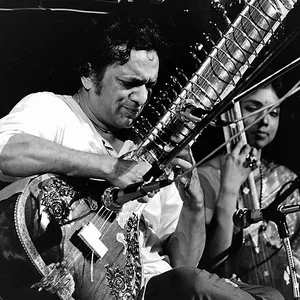
A plucked string instrument originating from North India, with 18 to 21 strings including sympathetic strings that resonate through vibration. Ravi Shankar was considered the greatest sitar player of the 20th century and helped bring this instrument to audiences around the world.

A drone string instrument that provides the continuous tonal background during Indian classical music concerts. At every performance by Ravi Shankar, a tambura player was present on stage to maintain this essential harmonic foundation.

A pair of small drums used as rhythmic accompaniment in Hindustani music. Ravi Shankar regularly performed alongside celebrated tabla players, most notably Alla Rakha, his preferred accompanist for decades.

A small metal plectrum worn on the tip of the right index finger by the sitar player to pluck the strings. Ravi Shankar used this tool with a precision and expressiveness that became legendary, enabling the ornaments and slides characteristic of the Maihar style.

The traditional Indian attire worn by Ravi Shankar in concert, consisting of a long white draped cloth (dhoti) and a long tunic (kurta). He always sat cross-legged on a low platform covered with a white cloth, upholding the tradition of Indian classical music performance.

Although Indian classical music is largely improvised, Ravi Shankar would notate the basic structures of his ragas and compositions. He worked to adapt Western notation in order to transcribe and pass on the Hindustani musical repertoire.
School Curriculum
Daily Life
Morning
Ravi Shankar rose early, before dawn, to practice his musical sadhana — a solitary, meditative sitar practice session. He regarded this daily ritual as a form of prayer. In the guru-shishya tradition, he also passed on teachings to his students in the early morning hours.
Afternoon
Afternoons were devoted to rehearsals with his accompanists (tabla player, tanpura player) and to new compositions. During his most creative periods, he would sketch out raga structures and plan upcoming concert programs, often while traveling from city to city.
Evening
Classical Indian music concerts traditionally begin in the evening and can last several hours. Ravi Shankar performed his most significant ragas at night, in keeping with the rules governing nocturnal ragas. After a concert, he enjoyed sharing a simple meal with his fellow musicians.
Food
Ravi Shankar followed a vegetarian diet, in keeping with the Brahmin Hindu tradition in which he was raised. He was fond of Bengali and North Indian cuisine, particularly spiced vegetables (sabzi), dal, and rice. He avoided alcohol but enjoyed masala chai.
Clothing
For concerts, he invariably wore traditional North Indian attire: a pleated white dhoti, a long white or cream kurta, and sometimes a light shawl. In everyday life, he sometimes dressed in Western clothing during his many travels to Europe and the United States.
Housing
Ravi Shankar divided his time between several homes: Delhi, his Indian base, and Los Angeles, his American base from the 1970s onward. He lived in modest but refined apartments where musical instruments and books held pride of place. Small Hindu deity figurines adorned his workspace.
Historical Timeline
Period Vocabulary
Visual Style
Palette chaude et spirituelle mêlant les dorés de Bénarès, les blancs de la tenue traditionnelle et les reflets profonds de l'instrument en bois précieux, avec une touche d'influence psychédélique des années 1960.
Sound Ambience
Ambiance sonore mêlant la quiétude spirituelle d'un ashram de Bénarès et l'énergie d'un grand concert international, dominée par le bourdon méditatif du tanpura et les arabesques du sitar.