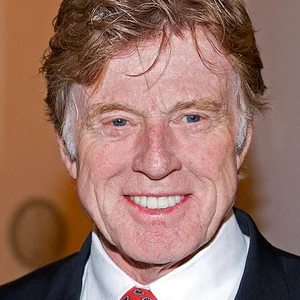

Robert Redford was an American actor, director, and producer, a major figure in 1960s–1970s Hollywood cinema. In 1981 he founded the Sundance Film Festival, which became the world's leading showcase for independent film.
Robert Redford(1936 — 2025)
Robert Redford
États-Unis
6 min read
Frequently asked questions
Key Facts
- Born in 1936 in Santa Monica, California; died in 2025
- Rose to fame with “Butch Cassidy and the Sundance Kid” (1969), then “The Sting” (1973) alongside Paul Newman
- Academy Award for Best Director for “Ordinary People” (1980)
- Founded the Sundance Film Festival in 1981, a global benchmark for independent cinema
- Honorary Academy Award for his lifetime achievement in 2002
Works & Achievements
Western that brought him to wide public attention alongside Paul Newman and earned him the nickname that would follow him for the rest of his life.
Con-artist comedy that won seven Oscars, reuniting him with Paul Newman and cementing his star status.
Spy thriller emblematic of the disillusioned post-Watergate cinema.
A re-creation of the Watergate investigation, which he produced and starred in, and which became a touchstone for investigative journalism.
His first film as a director, crowned with the Oscars for Best Picture and Best Director.
Creation of the organization that would support thousands of independent filmmakers and give its name to the Sundance Film Festival.
A sweeping, novelistic epic opposite Meryl Streep, showered with Oscars.
A film he directed, celebrated for its formal beauty and for introducing a young Brad Pitt.
Anecdotes
The nickname "Sundance" comes from the Kid he plays opposite Paul Newman in "Butch Cassidy and the Sundance Kid" (1969). The role stuck with him so closely that he named his Utah ski resort "Sundance," then the institute and the festival he founded there. That festival has become the world's largest showcase for independent cinema.
The famous cliff-jump scene in "Butch Cassidy" is a movie trick. Redford and Newman don't actually leap from the top of the precipice: the jump was filmed from a platform set up at a low height, and the fall into the river was shot separately using stunt performers and dummies.
Director Mike Nichols considered Redford for the role of Benjamin in "The Graduate" (1967). He gave up on the idea, judging the actor too handsome to be believable as a young man unlucky in love; the role went to Dustin Hoffman, who turned it into a triumph.
For his very first film as a director, "Ordinary People" (1980), Redford won the Oscar for Best Director, and the film won Best Picture. Pulling off such a feat on a first attempt behind the camera is exceedingly rare in Hollywood.
Fascinated by the Watergate scandal, Redford bought the rights to the book by journalists Bob Woodward and Carl Bernstein even before its release, then produced and starred in "All the President's Men" (1976). The film helped etch the role of investigative journalism into the collective imagination.
Primary Sources
Storytellers broaden our minds: they engage us, provoke us, inspire us, and ultimately, connect us to one another.
— I can't swim! — Are you crazy? The fall will probably kill you!
Never say never, but I pretty much concluded that this would be it for me in terms of acting.
Key Places
Coastal city near Los Angeles where Robert Redford was born in 1936 and spent his childhood.
Mountain estate he acquired in 1969 and where he established his institute. He would live there and die there in 2025.
He trained here at the American Academy of Dramatic Arts and made his Broadway debut in the early 1960s.
Mountain resort that hosts the Sundance Film Festival every winter, the leading showcase for independent cinema.
World capital of cinema where Redford filmed his major hits from the 1960s to the 1980s.
Typical Objects

Central tool of the director's craft, which Redford took up in 1980. It records the images later projected in theaters.

Golden trophy awarded by the Academy of Motion Picture Arts and Sciences. Redford received one as a director (1980) and later an Honorary Oscar (2002).

The hat, vest, and revolver of the outlaw he played in 1969. This western costume became the iconic image attached to his name.

A text describing dialogue and scenes, which the actor and the director cover with notes to prepare for the shoot.

In 1969, Redford bought a mountain estate in Utah that he named Sundance. A ski destination, it also became the birthplace of his institute and his festival.

A slate with a clapping arm that marks the start of each take and synchronizes picture and sound.
School Curriculum
Vocabulary & Tags
Key Vocabulary
Tags
Daily Life
Morning
Settled on his Sundance estate in Utah, Redford liked to start the day early, in the quiet of the Wasatch Mountains. A nature lover, he often devoted his mornings to walking, horseback riding, or skiing depending on the season.
Afternoon
His afternoons were shaped by the work of cinema: reading screenplays, scouting locations, editing, or meeting young directors who came to his institute. He was also deeply committed to defending the environment.
Evening
Evenings were given over to film screenings, writing, or family life. During festival season, he moved from one debate, presentation, and meeting with filmmakers to the next.
Food
Living in the mountains, Redford favored simple, healthy food, often made from local products. Mindful of ecology, he championed a cuisine respectful of nature.
Clothing
On screen, his name remains tied to the hat and cowboy outfit of the Sundance Kid. In everyday life, he cultivated an understated, casual style, with shirts and jackets suited to outdoor living.
Housing
He lived on his Sundance estate, a vast wooded property in Utah that he had bought in 1969 and protected from developers, far from the ostentatious luxury of Hollywood.
Historical Timeline
Period Vocabulary
Liens externes & ressources
Références
Œuvres
Butch Cassidy et le Kid (Butch Cassidy and the Sundance Kid)
1969
L'Arnaque (The Sting)
1973
Les Hommes du président (All the President's Men)
1976
Fondation du Sundance Institute
1981
Out of Africa (Souvenirs d'Afrique)
1985