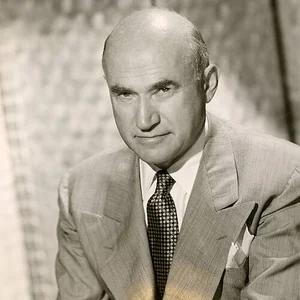

A Polish-born Hollywood producer, Samuel Goldwyn was one of the founders of the American film industry. He co-founded several major studios and produced hundreds of films that shaped the golden age of Hollywood.
Samuel Goldwyn(1879 — 1974)
Samuel Goldwyn
États-Unis, Empire russe
9 min read
Frequently asked questions
Famous Quotes
« Include me out.»
« A verbal contract isn't worth the paper it's written on.»
Key Facts
- Born Schmuel Gelbfisz in 1879 in Warsaw (then part of the Russian Empire), he emigrated to the United States around 1898.
- In 1916, he co-founded Goldwyn Pictures Corporation, whose name was later adopted by Metro-Goldwyn-Mayer (MGM) in 1924.
- In 1923, he founded Samuel Goldwyn Productions, an independent studio he ran until his retirement.
- He produced classics such as 'Wuthering Heights' (1939), 'Splendor in the Grass', and 'Guys and Dolls' (1955).
- He received the Thalberg Memorial Award (1947) and the Presidential Medal of Freedom (1971).
Works & Achievements
One of the first feature films shot in Hollywood, co-produced with Jesse Lasky and Cecil B. DeMille. A landmark film that established Los Angeles as the capital of American cinema and launched Goldwyn's career as a producer.
A melodrama about maternal sacrifice, adapted from the novel by Olive Higgins Prouty. A major commercial success that revealed Goldwyn's talent for popular stories with strong emotional impact.
An adaptation of Emily Brontë's novel, directed by William Wyler with Laurence Olivier and Merle Oberon. Nominated for eight Academy Awards, this film illustrates Goldwyn's commitment to bringing great works of literature to the screen.
A social drama about the reintegration of World War II veterans, directed by William Wyler. Winner of seven Academy Awards including Best Picture, it is unanimously regarded as the absolute masterpiece of Goldwyn's career.
A musical comedy with Danny Kaye in the role of the famous Danish storyteller. A major popular and family success that showcases Goldwyn's talent for large-scale productions aimed at a broad audience.
An adaptation of the Broadway musical starring Marlon Brando and Frank Sinatra. A lavishly designed musical film that was one of the biggest commercial successes of the late stage of Goldwyn's career.
A film adaptation of George Gershwin's opera, directed by Otto Preminger. Goldwyn's final major project — ambitious and controversial — marking the conclusion of a career spanning nearly fifty years.
Anecdotes
Samuel Goldwyn was born Samuel Gelbfisz in Warsaw in 1879, into an impoverished Polish Jewish family. Orphaned at a young age, he fled poverty by emigrating first to England around 1895, then to the United States around 1898, changing his name to Samuel Goldfish before permanently adopting "Goldwyn." This immigrant-to-success journey made him a living symbol of the American Dream in the twentieth century.
Before conquering Hollywood, Goldwyn worked as a glove salesman in Gloversville, New York, where he excelled to the point of becoming one of the best salesmen in the country. It was this commercial tenacity that led him to partner with Jesse Lasky and Cecil B. DeMille to produce, in 1914, the first feature film shot in Hollywood: *The Squaw Man*. Made under rudimentary conditions, the film helped establish Los Angeles as the world capital of cinema.
Goldwyn is famous for his "Goldwynisms" — paradoxical, unintentionally humorous turns of phrase such as "Include me out" and "A verbal contract isn't worth the paper it's written on." These absurd aphorisms, whether genuine or embellished by the press, reflect the larger-than-life personality of a self-made man who shook up the conventions of the Hollywood industry.
In 1946, Goldwyn produced *The Best Years of Our Lives*, a film about the difficult homecoming of American soldiers after World War II. The picture won seven Academy Awards, including Best Picture, and was celebrated as a masterpiece of American social cinema. Goldwyn declared it the production he was most proud of, because it had said "something essential about America.
Throughout his career, Goldwyn refused to be absorbed by the major studios and maintained his independence by founding his own production company. Unlike other Hollywood moguls, he did not control a vertically integrated empire encompassing theaters and distribution. This independence allowed him to take remarkable artistic risks — adapting Emily Brontë or recruiting the greatest European directors — but also exposed him to serious financial setbacks.
Primary Sources
"I believe every picture must tell a story worth telling, with actors worth watching. That has been my philosophy for thirty years, and I have never deviated from it."
"I have never produced a picture I was not personally proud of. If I did not believe in a project, I did not make it. It is as simple as that."
Official document from the New York District Court attesting to the naturalization of Samuel Goldfish, born in Warsaw (Poland), declaring his intention to renounce all foreign allegiance and adopt American citizenship.
Agreement stipulating the terms of nationwide theatrical distribution, profit-sharing arrangements, and advertising commitments for the Samuel Goldwyn Productions feature The Best Years of Our Lives.
"I came to America with nothing. No money, no language, no family. But I had one thing no one could take from me: I knew what people wanted to see."
Key Places
Birthplace of Samuel Gelbfisz, born in 1879 in the city's poor Jewish quarter. These humble origins in Eastern Europe profoundly shaped his ambition and determination to succeed in the United States.
The American city where Goldwyn settled upon arriving in the United States, working as a glove salesman. It was here that he developed the early business skills that would serve him throughout his career in the entertainment industry.
The production studio Goldwyn acquired in 1919, where most of his major films were shot. Today known as The Lot, it remains an iconic site in American independent cinema.
The heart of the American film industry that Goldwyn helped build from the 1910s onward. His landmark productions played a key role in establishing Hollywood's worldwide reputation as the capital of dreams.
The prestigious residential neighborhood of Los Angeles where Goldwyn lived for several decades in a grand villa with his wife Frances Howard — a symbol of his extraordinary success.
Typical Objects

The dominant professional camera in Hollywood from the 1920s through the 1960s. Goldwyn demanded the finest equipment for his productions and was one of the first producers to invest heavily in the technical quality of the image.

A legal document binding an actor or actress to a studio for several years, a cornerstone practice of the studio system. Goldwyn signed such contracts with Gary Cooper, Danny Kaye, and Miriam Hopkins to secure his casts.

An iconic accessory of Hollywood moguls, a symbol of power and success in the 1930s–1960s. Goldwyn, like his contemporaries Louis B. Mayer and Jack Warner, was rarely photographed without his cigar.

Goldwyn was known for personally reading every screenplay and marking up the dialogue and plotlines. He intervened directly in the creative process, sometimes to the great frustration of the screenwriters he employed.

A tool used to synchronize sound and image during a shoot. A symbol of the film industry, the clapperboard was a constant presence on the sets of Goldwyn productions.

An indispensable instrument for producers in the 1930s–1950s, allowing Goldwyn to manage his productions from his office while negotiating with distributors, agents, and directors the world over.
School Curriculum
Vocabulary & Tags
Key Vocabulary
Tags
Daily Life
Morning
Goldwyn rose early, around 7 a.m., and began his day by reading the trade papers — Variety and The Hollywood Reporter — to keep up with industry news. He had a light breakfast before driving to his office at the West Hollywood studio, where he arrived around 8:30 a.m. to start his meetings.
Afternoon
Afternoons were devoted to meetings with directors, screenwriters, and agents in his large private office. Goldwyn screened dailies from ongoing productions in his private projection room and had no hesitation in demanding reshoots if the results fell short of his standards, often eating lunch from a tray brought to his desk.
Evening
Goldwyn's evenings blended professional and social life: he frequently entertained Hollywood figures, Europeans, and Washington personalities at his Bel Air home. The premieres of his films at Grauman's Chinese Theatre were grand events to which he attached enormous importance as launchpads for his productions' commercial success.
Food
Goldwyn kept a relatively restrained diet, though business lunches at top Los Angeles restaurants — such as Romanoff's or Chasen's — were a regular occurrence. He favored European cuisine, a legacy of his Central European roots, and avoided the excesses that might have undermined his image as a rigorous executive.
Clothing
Goldwyn was always dressed in a made-to-measure three-piece suit from London or New York tailors, invariably wearing a silk tie. He took great care of his appearance as an ostentatious mark of social success, setting himself apart from his humble origins as a Polish immigrant.
Housing
Goldwyn lived in a grand colonial-style villa in Bel Air with his wife Frances Howard. The home featured a swimming pool, manicured gardens, and a private screening room — an essential amenity for a Hollywood producer who needed to watch films and dailies outside of office hours.
Historical Timeline
Period Vocabulary
Liens externes & ressources
Références
Œuvres
Stella Dallas
1925
Hans Christian Andersen
1952