
Spanish histologist and neuroscientist
Santiago Ramón y Cajal(1852 — 1934)
Santiago Ramón y Cajal
Espagne
7 min read
Frequently asked questions
Key Facts
Works & Achievements
Cajal established that the nervous system is composed of individual cells (neurons) rather than a continuous network, revolutionizing our understanding of the brain. This discovery founded modern neuroscience and earned him the Nobel Prize in Physiology or Medicine in 1906.
A landmark treatise describing the detailed structure of the nervous system, richly illustrated with Cajal's own drawings. This work became the definitive reference in neuroanatomy and nervous system histology.
Cajal produced thousands of exceptionally precise and artistically remarkable drawings of nerve tissue observed under the microscope, combining scientific rigor with artistic talent. These illustrations remain major educational references in neuroscience.
Cajal refined Golgi's staining technique to better visualize individual neurons under the microscope, enabling detailed observation of their structure and connections.
Pioneering research into brain plasticity and the mechanisms of nervous system repair following injury, opening major new avenues in regenerative neurobiology.
An autobiography and collection of philosophical reflections published shortly before his death, in which Cajal shares his scientific experience, working methods, and vision of scientific progress.
Anecdotes
Santiago Ramón y Cajal was not only a scientist but also a talented artist. He drew his own observations of the brain with remarkable precision, using his artistic gifts to create illustrations that revolutionized the understanding of neural structure. These detailed, hand-drawn illustrations became as important as his scientific discoveries.
In 1906, at the age of 54, Cajal received the Nobel Prize in Physiology or Medicine, which he shared with the Italian Camillo Golgi. Although Golgi had developed the staining technique that made the observations possible, Cajal had applied it far more systematically to discover that the brain was made up of individual cells rather than a continuous network.
Born in a rural region of Spain, Cajal was known for his extraordinary perseverance and self-taught determination. He pursued his scientific training despite limited resources and had to work at less prestigious universities before becoming one of the greatest scientific figures of his era.
Cajal established the fundamental principle known as the 'neuron doctrine': the idea that the nervous system is composed of distinct cells called neurons. This landmark discovery, made through his painstaking microscopic observations, laid the foundations of modern neuroscience and continues to influence science to this day.
Primary Sources
The neuron is the fundamental anatomical element of the nervous system. Each neuron constitutes an independent morphological and genetic unit, endowed with nutritive and relational autonomy.
My passion for drawing and microscopic observation led me to discover the intimate structure of the brain. Each neuron is like a tree that communicates with its neighbors through delicate connections.
Neurons are not simply passive cells, but active units endowed with remarkable functional specificity. The neuron doctrine forms the very foundation of our understanding of the nervous system.
Science must be pursued with passion and rigor. My drawings of the brain are not mere illustrations, but attempts to reveal the hidden architecture of human thought.
Key Places
A small village in Aragon where Santiago Ramón y Cajal was born in 1852. This place marks the humble origins of the scientist who would become one of the greatest neurobiologists in the world.
Where Cajal studied medicine and began his first microscopic observations. It was in Aragon that he developed his passion for histology and techniques for staining nervous tissue.
A major research center where Cajal worked and refined his revolutionary microscopic techniques. His work in Catalonia allowed him to describe the structure of neurons with unprecedented precision.
The prestigious institution where Cajal held the chair of histology and continued his fundamental research on the central and peripheral nervous system.
Founded by Cajal himself in 1900, this research institute remains a center of excellence in neuroscience. It preserves Cajal's scientific archives and collections, including his famous drawings of neurons.
Where Cajal received the Nobel Prize in Physiology or Medicine in 1906, shared with Golgi, for his discoveries on the structure of the nervous system and his neuron doctrine.
Typical Objects

A fundamental instrument for observing nervous tissue at high magnification. Cajal revolutionized histology by using advanced microscopes to observe and draw neurons with unprecedented precision.

A chemical process using silver salts to selectively stain nerve cells. Cajal refined this technique, originally developed by his Italian colleague Golgi, making it possible to clearly visualize the structure of neurons.

Notebooks containing Cajal's own meticulous illustrations of neurons and the brain. These remarkable drawings, blending art and science, have become iconic references in neuroanatomy and stand as testament to his extraordinary artistic talent.

Samples of nervous tissue fixed and mounted on microscope slides following the protocols of the time. These preparations were the raw material Cajal worked with daily in his laboratories in Madrid and Barcelona.

A prestigious award received in 1906, shared with Camillo Golgi, recognizing their groundbreaking discoveries on the structure of the nervous system. This prize symbolizes the importance of Cajal's contributions to science worldwide.

19th-century writing and drawing instruments used by Cajal to document his microscopic observations. His pen-and-ink illustrations remain models of scientific art, celebrated for both their precision and artistic beauty.

Models and mock-ups representing the architecture of the brain and neural connections. Cajal contributed greatly to the understanding of the spatial organization of the nervous system, a foundation of modern neuroanatomy.

Works and articles published by Cajal, most notably 'Textura del sistema nervioso del hombre y de los vertebrados'. His illustrated writings provided the first complete and precise descriptions of the microscopic structure of the brain.
School Curriculum
Daily Life
Morning
Ramón y Cajal starts his day early, around 6-7 a.m., after a full night's sleep. He has a light breakfast of bread, coffee, and perhaps some fruit, then prepares to head to his laboratory at the university or hospital where he works.
Afternoon
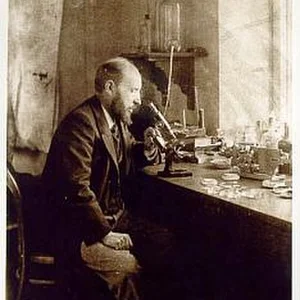
The afternoon is devoted to careful microscopic examination of nerve tissue prepared using the Golgi method. Ramón y Cajal spends several hours bent over his microscope, meticulously drawing neurons and their connections. He takes detailed notes and produces anatomical sketches to document his observations.
Evening
In the evening, after leaving his laboratory around 6-7 p.m., he returns home and has dinner with his family. After the meal, he spends time writing scientific articles, corresponding with other European researchers, or refining his drawings for publication.
Food
As a member of the Spanish intellectual middle class of the 19th century, Ramón y Cajal follows a Mediterranean diet consisting of bread, olive oil, fresh vegetables, fish, and occasional meat. He drinks wine in moderation and coffee, both typical beverages of his era.
Clothing
Ramón y Cajal wears the formal attire typical of a scientist of his standing: a dark suit, waistcoat, tie, and jacket. In the laboratory, he dons a white coat to protect himself from chemicals. His well-groomed hair and beard reflect his status as a professor and respected figure.
Housing
He lives in a respectable urban neighborhood in Madrid or Barcelona, in a bourgeois home of upper-middle standing, typical of Spanish intellectuals of his time. His residence includes a personal study where he can continue his research and read European scientific publications.
Historical Timeline
Period Vocabulary
Visual Style
Un style de dessin scientifique du XIXe siècle mêlant la précision des illustrations anatomiques, l'élégance de l'Art Nouveau et l'atmosphère chaleureuse d'une chambre de savant. Technique de ligne fine à l'encre dorée sur papier ancien, évoquant directement les croquis neurologiques de Cajal lui-même.
Sound Ambience
Une ambiance intime et concentrée du laboratoire de Ramón y Cajal au XIXe siècle, mêlant les bruits minutieux du travail scientifique avec l'atmosphère urbaine de Madrid et l'écho de la vie quotidienne de l'époque, évoquant la rigueur et la passion du pionnier des neurosciences.
Liens externes & ressources
Références
Œuvres
Théorie du neurone
1890-1904
Textura del sistema nervioso del hombre y de los vertebrados
1897-1904
Dessins et illustrations du cerveau
1880-1930
Technique de coloration à l'argent (Méthode de Golgi améliorée)
1890s
Études sur la dégénérescence et régénération du système nerveux
1905-1913
El mundo visto a los ochenta años
1934