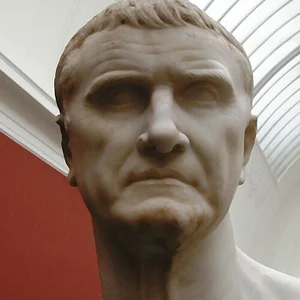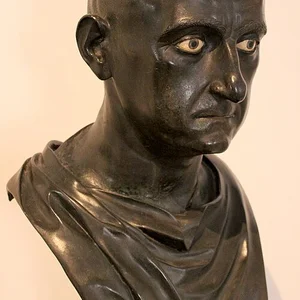

Roman general of the 2nd century BC, victor over Hannibal at the Battle of Zama (202 BC). He brought the Second Punic War to an end and secured Rome's dominance over Carthage.
Scipio Africanus(234 av. J.-C. — 182 av. J.-C.)
Scipio Africanus
Rome antique
9 min read
Frequently asked questions
Famous Quotes
« Nusquam est qui ubique est.»
« Ingrata patria, ne ossa quidem mea habes.»
Key Facts
- 236 BC: born in Rome into the gens Cornelia
- 209 BC: capture of Cartagena (Spain), a turning point in the war
- 204 BC: landing in North Africa
- 202 BC: decisive victory over Hannibal at the Battle of Zama
- 183 BC: death in voluntary exile at Liternum
Works & Achievements
In three years, Scipio drove the Carthaginians out of the entire Iberian Peninsula, cutting Hannibal off from his rear bases and reinforcements. This campaign laid the foundation for lasting Roman presence in Hispania.
A strategic and tactical victory considered one of the most brilliant of Antiquity. Scipio neutralized Hannibal's 80 war elephants, turned the Numidian cavalry against him, and encircled the Carthaginian infantry.
Scipio personally negotiated the peace terms, refusing the destruction of Carthage that others were demanding. This more lenient treaty secured fifty years of peace across the western Mediterranean.
Scipio adopted the *gladius hispaniensis*, perfected the use of the *pilum* in volley fire, and developed the flexible manipular legion, capable of adapting to any terrain. These innovations shaped the Roman army for two centuries.
Although his brother Lucius was officially in command, Scipio accompanied the expedition and his mere presence was enough to impress the Greeks and Antiochus's allies. The victory at Magnesia extended Roman influence into the East.
Anecdotes
At only 17 or 18 years old, at the Battle of the Ticinus (218 BC), Scipio charged alone with a handful of cavalrymen to rescue his wounded father, who was surrounded by Carthaginian troops. This act of bravery earned him a reputation for invincibility among the legionaries.
After the capture of Carthago Nova in 209 BC, his soldiers brought him a young Iberian woman of exceptional beauty, intended for his personal use. Scipio returned her untouched to her fiancé, winning the loyalty of many Iberian chieftains who went on to join the Roman cause.
Before the Battle of Zama (202 BC), Scipio met Hannibal face to face to negotiate peace. According to Polybius, the two generals regarded each other in prolonged silence, each admiring the other's military genius, before the talks broke down and the decisive battle commenced.
Returning in triumph to Rome, Scipio received the cognomen 'Africanus' — a surname drawn from a conquered territory, an exceedingly rare honor in the Roman Republic. He was also the first Roman to have a statue erected in the temple of the gods on the Capitol, a mark of reverence bordering on the divine.
Accused of corruption and of being too deeply enamored of Greek culture, Scipio appeared before the Senate around 187 BC. He publicly tore up the accusation documents and told the crowd: “Today is the anniversary of the Battle of Zama — follow me to give thanks to the gods.” The crowd followed him, leaving the tribunes without an audience.
Primary Sources
Scipio drew up the hastati in the front line, behind them the principes, and in the rear the triarii… Hannibal, seeing that the enemy cavalry was outflanking him, understood that the day was lost.
Then Scipio, after granting peace terms to the Carthaginians, returned to Carthage with his entire army, and was thenceforth called Africanus — a cognomen owed not to the flattery of men but to the glory of his deeds.
From that high vantage point, Africanus showed me Carthage and said: “It is from this city that, from a position of height, you will have to defend the freedom of Rome.”
Scipio advanced his lines in good order, and when the war elephants charged, he opened lanes in his ranks to let them pass without disrupting his troops.
Scipio, pressed by the tribunes to justify himself before the people, said simply: “This is the day I defeated Carthage at Zama. Come with me to give thanks to the immortals.” And the people followed him.
Key Places
The main Carthaginian port and military base in Spain, captured by Scipio in a single day in 209 BC through a surprising amphibious maneuver at low tide. This strategic victory delivered Carthage's war treasury and Iberian hostages into his hands.
Site of the decisive battle of October 19, 202 BC, where Scipio defeated Hannibal and brought the Second Punic War to an end. On this North African plateau, Scipio's tactic of opening his ranks to let the war elephants pass through foiled Hannibal's plan.
The political and religious heart of the Roman Republic, where Scipio gave thanks to the gods after his victories and faced his political accusers. He was the first Roman to have a statue erected in the Capitoline temple.
A coastal town in Campania where Scipio voluntarily retired after his trial, refusing to die in Rome at the hands of his political enemies. He died there in self-imposed exile around 183 BC, reportedly leaving this epitaph: “Ingrate homeland, you shall not even have my bones.”
The site of Rome's catastrophic defeat in 216 BC, which Scipio witnessed as a young officer. Scarred by the annihilation of the Roman army by Hannibal, he drew tactical lessons from it — flank envelopment, use of cavalry — and turned them against Hannibal himself at Zama.
Typical Objects

Heavy Roman javelin with an iron tip, the distinctive weapon of the republican legionary. Scipio improved its tactical use by ordering his soldiers to throw a synchronized volley to break the enemy formation before close combat.

Short double-edged sword that Scipio adopted after observing Iberian warriors during his campaigns in Spain. He equipped his legions with this weapon, more effective than the old Roman sword, permanently transforming Roman armament.

The supreme military honor awarded to victorious commanders during the triumph. Scipio was hailed by his troops and the Roman people, his laurel crown symbolizing his victory over Carthage and the might of Rome.

The everyday writing medium of literate Romans. Scipio, a great admirer of Greek culture, used them for his diplomatic and military correspondence, as well as for the philosophical reflections that earned him renown throughout Rome.

Large curved rectangular shield made of wood and covered with leather, the emblem of the Roman legionary. At the Battle of Zama, the disciplined wall of scutums held by his troops allowed them to withstand the charge of Hannibal's elephants.

A quadriga of white horses carrying the victorious general during his triumphal entry into Rome. Scipio rode along the Via Sacra to the cheers of the Roman people after his victory at Zama — the crowning moment of an exceptional career.
School Curriculum
Vocabulary & Tags
Key Vocabulary
Daily Life
Morning
Scipio rises before dawn, like all Roman generals. He consults the augurs and sacrifices to the gods — Jupiter in particular, whose protégé he claimed to be — before any important decision. He then inspects the lines of his fortified camp, personally checking the sturdiness of the palisades and the condition of his troops.
Afternoon
The morning is devoted to war councils with his legates, to studying scout reports, and to drilling the legions. Scipio insists that his soldiers train daily in the handling of weapons, even in friendly territory. He also receives delegations from Iberian and Numidian allies, whose support he carefully cultivates.
Evening
In the evening, Scipio sets himself apart from his contemporaries by his marked taste for Greek culture. He reads philosophical works, discusses with Greek scholars in his circle, and writes notes on his campaigns. His political enemies reproach him for this Hellenizing “softness,” which he embraces without embarrassment.
Food
Like any general on campaign, Scipio shares the food of his legionnaires: bucellatum (campaign biscuit), pulmentum (spelt or barley porridge), dried legumes, salt pork, and dried meat. In peacetime in Rome, he attends aristocratic banquets featuring watered wine, olive oil, cheeses, fruit, and roasted meats.
Clothing
On campaign, Scipio wears the lorica musculata in cast bronze over the torso, a red wool tunic beneath the armor, the paludamentum (the generals’ scarlet cloak), caligae (hobnailed military sandals), and bronze greaves (ocreae). In Rome in peacetime, he wears the white toga of senators, embroidered with purple on ceremonial occasions.
Housing
On campaign, Scipio lodges in the praetorium, the central command tent of the Roman camp, which was perfectly organized according to a fixed layout. In Rome, he owns a patrician domus on the Palatine with an atrium, tablinum, and peristyle garden. His villa at Liternum, where he would spend his final days in semi-exile, was more modest but surrounded by gardens where, according to Seneca, he would tend certain plants himself.
Historical Timeline
Period Vocabulary
Visual Style
Style peinture académique néoclassique, lumière méditerranéenne intense sur cuirasse de bronze, terres ocres d'Afrique du Nord et ciel ultramarin — évoquant la grandeur austère de la République romaine à son apogée.
Sound Ambience
Les sons du camp militaire romain — cuivres militaires, cliquetis des armures, pas cadencés des légions — mêlés au vent africain et aux bruits de forge, évoquant la machine de guerre que Scipion commandait avec maestria.
Liens externes & ressources
Références
Œuvres
Conquête de l'Espagne carthaginoise (209–206 av. J.-C.)
209–206 av. J.-C.
Bataille de Zama et victoire sur Hannibal (202 av. J.-C.)
202 av. J.-C.
Traité de paix avec Carthage (201 av. J.-C.)
201 av. J.-C.
Réforme tactique de la légion romaine
209–202 av. J.-C.
Campagne d'Asie contre Antiochos III (190 av. J.-C.)
190 av. J.-C.