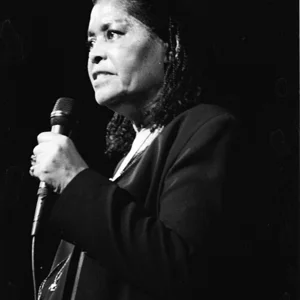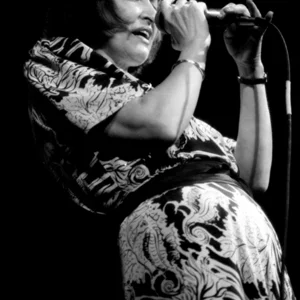

Sheila Jordan, born in 1928 in Detroit, is an American jazz singer. Shaped by bebop and the music of Charlie Parker, she is celebrated for her inventive phrasing and for having popularized the voice-and-double-bass duo.
Sheila Jordan(1928 — 2025)
Sheila Jordan
États-Unis
6 min read
Frequently asked questions
Key Facts
- Born on November 18, 1928, in Detroit (Michigan).
- Recorded the album 'Portrait of Sheila' in 1962, becoming one of the first singers to cut a record under her own name for the Blue Note label.
- A pioneer of the voice-and-double-bass duo format, notably with Harvie Swartz and Steve Swallow.
- Married bebop pianist Duke Jordan, a former accompanist of Charlie Parker.
- Named an NEA Jazz Master in 2012, the highest honor in jazz in the United States.
Works & Achievements
First album under her own name, released by Blue Note. It reveals her original phrasing and her art of instrumental restraint.
A striking reinvention of a popular song on the album *The Outer View*. This track drew the jazz world's attention to her voice.
A comeback album that revived her career as a leader and confirmed her singular musical personality.
An emblematic record of the voice-and-double-bass duo that she helped establish as a format in its own right.
A major album of her maturity, praised for its freedom and its sense of storytelling in every song.
A record entirely devoted to the voice-and-double-bass duo, summing up decades of exploration.
A long-forgotten early recording, released decades later, that bears witness to her precocious talent.
Anecdotes
As a teenager in Detroit, Sheila Jordan was fascinated by bebop and spent hours memorizing Charlie Parker's saxophone solos, which she sang with two friends, adding their own made-up lyrics. According to jazz legend, Parker himself, struck by her musical ear, nicknamed her “the kid with the million-dollar ears.”
For nearly thirty years, Sheila Jordan led a double life: by day, she worked as a typist at a New York advertising agency; by night, she sang in jazz clubs. She was determined to keep this job so she could stay free to sing exactly the music she loved, without depending on the money.
Sheila Jordan dared to try a rare and risky format: singing accompanied by a single double bass, with no piano or drums. This voice-and-bass duo, which she developed notably with bassist Harvie Swartz, gives the voice immense freedom and became one of her signatures.
In 1962, the Blue Note label, best known for its great instrumentalists, recorded “Portrait of Sheila”: she was one of the very first singers to cut a record under her own name for this prestigious house. She was over thirty at the time and still little known to the general public.
A jazz devotee, Sheila Jordan frequented the clubs of Detroit's Black neighborhoods and later married the African American pianist Duke Jordan. In an America still scarred by segregation, this choice brought her hostility and discrimination, which she faced out of her love for the music and its musicians.
Primary Sources
Sheila Jordan's first album as a lead vocalist, featuring renditions of “Dat Dere”, “Baltimore Oriole”, and “If You Could See Me Now”, accompanied by just guitar, double bass, and drums.
A long, reimagined version of a popular song, in which Sheila Jordan's voice, woven into George Russell's orchestra, caused a sensation and revealed her talent to the modern jazz audience.
“The kid with the million-dollar ears.” This phrase attributed to Parker highlights the young singer's exceptional ear.
Key Places
Industrial city where Sheila Jordan was born and where, as a teenager, she discovered bebop in the clubs of the Black neighborhoods.
Mining region where she spent part of her childhood in a poor family, before returning to Detroit.
Jazz capital where she settled in the early 1950s, working by day and singing in the clubs at night.
Starting in the 1970s and 1980s, Sheila Jordan toured across Europe, where jazz audiences welcomed her warmly in concerts and festivals.
Typical Objects

A low-pitched instrument that, with her voice alone, formed the famous voice-and-bass duo so dear to Sheila Jordan. This stripped-down dialogue became her trademark.

An essential tool for the singer in jazz clubs, capturing her inventive phrasing and her voice full of subtle shades. She used it right up close to the audience, in intimate venues.

A 33 rpm LP released by Blue Note in 1962, her first album under her own name. It made her one of the very few singers in the catalogue of this legendary label.

A symbol of her life as a typist by day, in a New York advertising agency. This job allowed her to fund a singing career pursued at night, in complete freedom.

Sheet music for a song from the classic jazz repertoire (a “standard”), which Sheila reinvented with her own personal phrasing. She loved to rework and recompose these well-known melodies.

An iconic vinyl format of post-war American jazz. Sheila Jordan recorded her renditions on these discs distributed all over the world.
School Curriculum
Vocabulary & Tags
Key Vocabulary
Tags
Daily Life
Morning
On weekdays, Sheila Jordan would head to the office of a New York advertising agency, where she worked as a typist. These ordinary salaried mornings contrasted with her life as a nighttime artist.
Afternoon
Afternoons were often spent at work or rehearsing at home, searching for new ways to sing a standard. She loved working on her phrasing and improvisation, alone or with a double bass player.
Evening
The evening belonged to jazz: she sang in the clubs and basement venues of Greenwich Village, sometimes late into the night, before an attentive and close-knit audience. That was where she truly felt she belonged.
Food
Like many New York club musicians, she ate simple, quick meals between work and gigs. Coffee and snacks fueled her long days split between office and stage.
Clothing
On stage, she wore elegant but understated outfits suited to the intimate atmosphere of jazz clubs. During the day, she adopted the discreet attire of an office worker.
Housing
She lived in modest New York apartments, the city where she spent most of her adult life. Her home reflected a life devoted to music rather than to money.