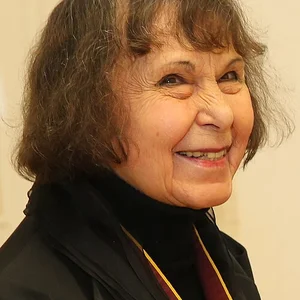

A Russian-Tatar composer born in 1931, Sofia Gubaidulina is one of the leading figures of contemporary music. Her deeply spiritual work blends Eastern and Western influences, and was long marginalized in the USSR.
Sofia Gubaidulina(1931 — 2025)
Sofia Gubaidulina
Russie, Union soviétique
8 min read
Frequently asked questions
Key Facts
- Born on October 24, 1931, in Chistopol, in the Tatar Republic (USSR)
- A graduate of the Moscow Conservatory in 1963, she studied composition with Vissarion Shebalin
- Her work 'Offertorium' for violin and orchestra (1980), premiered by Gidon Kremer, brought her international recognition
- Marginalized in the USSR for her experimental sound research, deemed incompatible with socialist realism
- She settled in Germany in 1992 and has continued composing to this day
Works & Achievements
Violin concerto dedicated to Gidon Kremer, considered her masterpiece. The work progressively transforms a theme drawn from Bach's *Musical Offering* into a spiritual journey symbolizing offering, dissolution, and transfiguration.
For cello and organ (or bayan), this piece embodies the symbol of the cross: the two instruments gradually exchange their registers, "crossing" at the midpoint of the work in a formal gesture of rare symbolic coherence.
For cello, bayan, and strings, inspired by the seven last words of Christ on the cross according to the Gospels. The work demonstrates her mastery of the bayan as an expressive instrument capable of carrying an intense spiritual weight.
A symphony in twelve movements, one of which — placed at the center — is entirely silent: a radical gesture that astonished audiences. The work reflects the tension between creative expression and censorship that Gubaidulina experienced under the Soviet regime.
A large oratorio commissioned to mark the 250th anniversary of Bach's death, in which Gubaidulina unfolds her spiritual vision on a grand scale by weaving together liturgical texts and contemporary musical language. A landmark work of her maturity.
For solo cello, chamber choir, and percussion, inspired by the *Canticle of the Creatures* of Saint Francis of Assisi. Premiered by Yo-Yo Ma, this late work illustrates the composer's creative vitality and spiritual universalism well into her eighties.
Anecdotes
At his diploma defense at the Moscow Conservatory in 1963, Sofia Gubaidulina was terrified that her music would be judged too daring. It was Dmitri Shostakovich himself, a member of the jury, who reassured her with a phrase that has since become famous: “I wish you to continue on your mistaken path.” Far from being a criticism, these words were an encouragement to maintain her artistic singularity in the face of Soviet orthodoxy.
In the 1970s, rejected by the Union of Soviet Composers and denied official commissions, Gubaidulina survived by composing film music for the Mosfilm studios. This bread-and-butter work allowed her to earn a living while secretly pursuing her personal, spiritual music — a double life typical of many artists under the Soviet regime.
In 1975, Gubaidulina co-founded with Viktor Suslin and Vyacheslav Artyomov an improvisation group called “Astreia.” The trio explored rare folk instruments from around the world — Mongolian jaw harp, Armenian duduk, balalaika — to create music on the border between East and West, far removed from the canons imposed by socialist realism.
When violinist Gidon Kremer premiered Offertorium in Vienna in 1980, the work was received in the West as a revelation but remained largely unheard in the USSR for years. It was largely thanks to Kremer that Gubaidulina’s music began to circulate clandestinely on hand-copied cassettes, before triumphing on the world’s great stages after Perestroika.
A devout believer in an officially atheist country, Gubaidulina drew on Orthodox spirituality, Sufism, and other traditions, viewing composition as an act of prayer. In 1992, she settled permanently in Appen, Germany, where she continued to compose until her death on March 12, 2025, at the age of 93.
Primary Sources
“Music is, for me, a form of prayer. I do not compose for an audience or for critics — I compose because it is my way of entering into communication with what lies beyond human reason.”
“In the Soviet Union, spirituality was considered a dangerous deviation. We had to conceal our convictions, yet they showed through in the music nonetheless, for those who knew how to listen.”
“The Passion is the story of a transformation through suffering. I wanted the music to carry simultaneously this pain and this light, just as the cross itself unites the vertical and the horizontal.”
“Offertorium is an offering in the liturgical sense. The main theme is presented, transformed, dismembered, then transfigured — this is the path of all true spiritual life.”
Key Places
Sofia Gubaidulina's birthplace, in central Russia, at the confluence of Russian and Tatar cultures. This dual cultural heritage profoundly shaped her relationship to both Eastern and Western musical traditions.
The first major musical institution Gubaidulina attended, where she received her initial training in composition and piano before moving to Moscow to complete her studies.
Gubaidulina earned her composition degrees here in 1963, studying under Nikolai Peiko and then Vissarion Shebalin. It was here that Shostakovich encouraged her to follow her singular artistic path.
For more than thirty years, Gubaidulina lived and worked in Moscow, composing film music to support herself financially while gathering around her a circle of dissident composers who shared her artistic and spiritual convictions.
A village near Hamburg where Gubaidulina settled in 1992 after the fall of the USSR. She lived and composed there until her death on March 12, 2025, finding the quiet of the German countryside conducive to creative work.
Typical Objects

The central instrument of Gubaidulina's daily practice, on which she improvised throughout her life. She considered it a space for sonic exploration and meditation, inseparable from her creative process.

The bayan, a chromatic button accordion traditional in Russia, lies at the heart of several of her major works, including Seven Words and In croce. She was fascinated by its ability to produce continuous sounds and imitate the human breath, which evoked for her the act of prayer.

An idiophone reed instrument used during improvisation sessions with the Astreia group. Gubaidulina collected traditional instruments from all over the world to enrich her musical language beyond geographical and cultural boundaries.

Gubaidulina wrote her scores by hand with extreme precision regarding dynamics, timbres, and expressive markings. Her manuscripts, rich in personal annotations, are regarded by specialists as exceptional musical documents.

A central symbol in Gubaidulina's life and work. The figure of the cross — the horizontal representing the human, the vertical the divine — formally structures several of her compositions, notably In croce, whose very title means “on the cross.”

In the USSR, unofficial music circulated clandestinely on hand-copied cassettes. Gubaidulina's works spread this way among Soviet musicians before they could be performed and officially published after Perestroika.
School Curriculum
Vocabulary & Tags
Key Vocabulary
Daily Life
Morning
Gubaidulina began her day with a moment of contemplation in the Orthodox tradition, which she experienced as an inner necessity before any creative activity. She would then turn to composition very early in the morning, considering the first hours of the day as the most conducive to concentration and inspiration.
Afternoon
The afternoon was often devoted to reviewing and meticulously correcting her manuscript scores, or to meetings with performers to discuss the expressive details of her works. She also enjoyed exploring the traditional instruments she collected on her travels.
Evening
In the evenings, Gubaidulina listened to music — Bach held a central place in her daily meditations. She sometimes received musician friends for informal improvisation sessions, extending the spirit of the Astreia group she had founded in Moscow in the 1970s.
Food
Gubaidulina had a simple lifestyle with little concern for material comfort, a trait common to many Soviet artists accustomed to scarcity. She maintained a sober and regular diet, devoting her energy far more to creative work than to the pleasures of the table.
Clothing
She dressed simply and without ostentation, with a preference for dark, understated clothing. Her reserved appearance and self-effacing presence contrasted with the intensity and inner force that radiated from her music.
Housing
In Moscow, she lived in a modest apartment typical of Soviet artists — little space, little comfort, but a piano always present. In Appen, she settled into a house surrounded by nature and quiet, a rural setting she considered ideal for the concentration and spiritual life essential to her work.