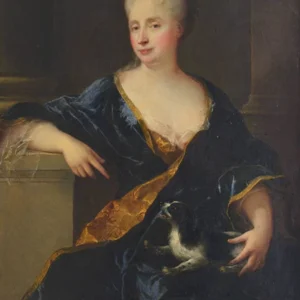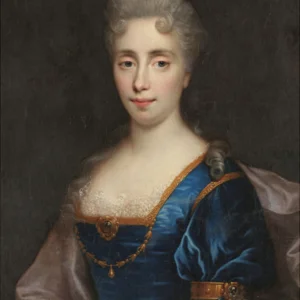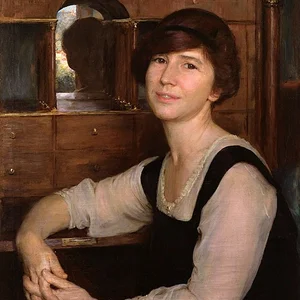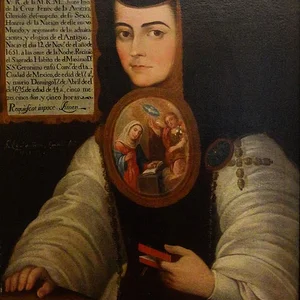

Juana Inés de la Cruz was a Mexican poet and playwright of the 17th century, a towering figure of Hispanic Baroque literature. A self-taught nun in New Spain, she championed women's right to knowledge in a colonial society dominated by men.
Sor Juana Inés de la Cruz(1651 — 1695)
Juana Inés de la Cruz
Empire espagnol
8 min read
Frequently asked questions
Famous Quotes
« Foolish men, who accuse women without reason, not seeing you are the cause of the very thing you blame.»
« I do not study to know more, but to ignore less.»
Key Facts
- Around 1651: born in San Miguel Nepantla, in New Spain (present-day Mexico)
- 1669: entered the Convent of San Jerónimo in Mexico City, where she devoted her life to study and writing
- 1680s–1690s: wrote her major works, including the Redondillas criticizing misogyny
- 1690–1691: wrote the Respuesta a Sor Filotea, a passionate defense of women's right to education
- 1695: died during an epidemic while caring for her fellow nuns at the convent
Works & Achievements
A major autobiographical letter in which Sor Juana defends women's right to education and intellectual life. A pioneering feminist manifesto, it justifies her passion for learning in the face of religious criticism.
A philosophical poem of over 900 lines exploring knowledge, the soul, and the universe. Considered her poetic masterpiece, it reveals the influence of Baroque aesthetics and Cartesian thought.
A three-act theatrical comedy blending romantic intrigue with social criticism. It stands as a significant contribution to seventeenth-century Mexican colonial theater.
The first published collection of her poetic and dramatic works, released in Madrid, containing sonnets, ballads, and villancicos. Its publication marked the recognition of her talent in the Spanish metropolis.
A poetic triumphal arch composed to celebrate the arrival of the Viceroy of Mexico. A commissioned work showcasing her mastery of complex poetic forms and mythological allegory.
A collection of sung poems composed for religious celebrations at Mexico City Cathedral. They demonstrate her ability to blend lyric poetry with music while exploring both spiritual and secular themes.
Anecdotes
Sor Juana Inés de la Cruz learned to read and write in secret, hidden away in her grandfather's library in Mexico. While girls of her era received little education, she devoured books with such passion that she had mastered Latin, Greek, Nahuatl, and several other languages before the age of ten.
At the court of the Viceroy of New Spain, Sor Juana astounded the assembly by correctly answering difficult questions posed by forty different scholars, as though she were a living encyclopedia. This display of extraordinary knowledge made her famous throughout New Spain.
Sor Juana took the veil and entered the Convent of San Jerónimo in Mexico City in 1668, as it was one of the few places where a woman could pursue her studies without marrying. In her convent cell, she transformed her room into a personal library housing more than four thousand volumes.
The Archbishop of Mexico published without permission a critical letter by Sor Juana titled the 'Carta Atenagórica,' then publicly reprimanded her for daring to comment on theological matters. This attack forced Sor Juana to give up writing and devote herself entirely to religious and charitable duties in the final years of her life.
Sor Juana wrote plays, poems, and philosophical texts that circulated throughout Spanish America and as far as Spain. Despite the restrictions imposed on learned women of her time, she remained one of the greatest intellectuals of seventeenth-century America.
Primary Sources
I confess that I have fallen into the labyrinth of these worldly studies, and that I cannot withdraw from them, even knowing that I work against my religious vows and that I must answer to God for the time I have spent on such profane things.
In silence I fell asleep, and in that slumber, the soul began its nocturnal flight through the spheres of knowledge, transcending the limits of the body to contemplate the universal order of creation.
Hombres necios que acusáis / a la mujer sin razón, / sin ver que sois la ocasión / de lo mismo que culpáis. (Foolish men who accuse women without reason, without seeing that you yourselves are the cause of the very thing you blame them for.)
This first compilation of her works contains sonnets, romances, and poetic compositions that demonstrate the breadth of her literary talent and her mastery of multiple poetic genres.
Key Places
A village in colonial Mexico where Juana Inés de la Cruz was born in 1651. It was in this small village near Mexico City that she spent her childhood and developed her remarkable intellectual precocity.
A convent in Mexico City where Sor Juana Inés de la Cruz entered religious life in 1669. She lived there for more than 25 years, writing the majority of her literary, scientific, and theological works while leading a life of meditation and study.
The capital of colonial Mexico where Sor Juana established her literary reputation. She moved among the intellectual and spiritual elite, received the patronage of nobles, and became a major figure in the cultural life of the 17th century.
The place where Sor Juana served as a lady-in-waiting and gained access to classical European culture. There she benefited from the patronage of the viceroy and enjoyed privileged contact with the intellectual elite.
An exceptional collection of more than 4,000 books that Sor Juana amassed at the Convent of San Jerónimo, bearing witness to her remarkable erudition and her research in theology, philosophy, science, and literature.
The broader geographical context of colonial New Spain where Sor Juana lived and wrote. She stands as an exceptional figure of Latin American Baroque literature and of women's writing in the 17th century.
Typical Objects
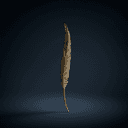
An essential writing instrument in the 17th century, the goose quill was Sor Juana's primary tool for composing her poetry, plays, and theological essays. It symbolizes her prolific literary output and her status as an intellectual.
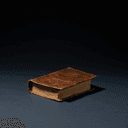
Bound volumes represent Sor Juana's vast learning — she owned an extensive personal library. These books speak to her erudition in theology, philosophy, literature, and science, fields she mastered to an exceptional degree.

The black-and-white garment of the Hieronymite order, worn by Sor Juana when she entered the convent of Santa Paula in Mexico City in 1668. It embodies her identity as a learned nun and her role in the intellectual life of colonial New Spain.

A vessel used to store the ink needed for handwriting, this object represents Sor Juana's daily creative practice in her convent cell, where she composed her major works.
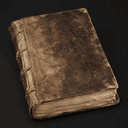
Her masterpiece poem, this lengthy work in decasyllabic verse explores the nature of knowledge and thought. It is one of her most significant texts and stands as a testament to her literary genius.
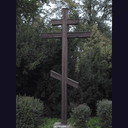
A symbol of Sor Juana's religious life in the convent, the cross represents her Christian faith and the Catholic New Spain context that shaped both her life and her work.
📷 CC BY-SA 3.0 · Wikimedia Commons ↗
A precious writing material in the 17th century, used for important documents and major compositions. It symbolizes the value placed on Sor Juana's intellectual works within colonial Mexican culture.
📷 CC BY 2.5 · Wikimedia Commons ↗School Curriculum
Vocabulary & Tags
Key Vocabulary
Tags
Daily Life
Morning
Sor Juana rises before dawn to attend the mandatory religious offices at the Convent of San Jerónimo in Mexico City. After Mass and morning prayers, she takes a simple meal (bread, chocolate, or atole) in the convent refectory, where an edifying text is read aloud.
Afternoon
She devotes the afternoon to personal study and literary composition in her cell, where she writes poems, plays, and theological texts. She also corresponds with the intellectual and religious figures who seek her out, while observing the convent's communal schedule.
Evening
Sor Juana joins her religious community for Vespers and the evening offices. As the day winds down, she reads theology and philosophy before the evening meal, then rests in her cell until the Great Silence of monastic night.
Food
Her diet is that of a cloistered nun: cornbread or wheat bread, beans, chili peppers, local vegetables, the occasional egg, and cheese. As a privileged intellectual within the convent, she has access to chocolate and certain fruits — luxuries that were relatively rare in seventeenth-century New Spain.
Clothing
She wears the white habit of the Hieronymite order, along with a scapular, a white veil, and a wimple covering her hair. As a nun, she forgoes all personal adornment, observing the modesty required by her religious vows and the conventions of her time.
Housing
She lives at the Convent of San Jerónimo in Mexico City in a private cell where she has assembled a remarkable personal library of several hundred volumes. This convent refuge affords her a degree of intellectual freedom while she observes the monastic rules of community life.
Historical Timeline
Period Vocabulary
Visual Style
Un style baroque colonial mexicain mêlant l'élégance lettrée de la Renaissance espagnole à la richesse chromatique des terres mexicaines. L'atmosphère combine l'intimité d'un cabinet de travail éclairé à la chandelle avec la magnificence de l'art religieux colonial, sublimant l'univers intellectuel et artistique de Sor Juana.
Sound Ambience
Une ambiance contemplative mêlant les sons d'un couvent colonial mexicain du XVIIe siècle : chants grégoriens, bruit de plume sur parchemin, cloches d'église, et les murmures discrets d'une vie monastique consacrée à l'étude et à la spiritualité.
Liens externes & ressources
Références
Œuvres
Respuesta a sor Filotea de la Cruz (Réponse à sœur Philothée de la Croix)
1691
Primero Sueño (Le Premier Rêve)
1692
Los Empeños de una casa (Les Efforts d'une maison)
1683
Inundación castálida (Inondation castalide)
1689
Neptuno Alegórico (Neptune allégorique)
1680
Villancicos et compositions musicales
1670-1690