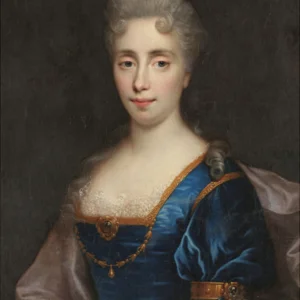

17th-century French writer and pioneer of the psychological novel. Author of The Princess of Clèves, a landmark work exploring the inner feelings and intimate conflicts of its characters. A prominent figure in the literary and cultural life of Louis XIV's court.
Madame de La Fayette(1634 — 1693)
Madeleine de La Vergne, Comtesse de La Fayette
royaume de France
7 min read
Frequently asked questions
Key Facts
- 1634: Born in Paris
- 1661: Married the Comte de La Fayette
- 1678: Anonymous publication of The Princess of Clèves, the first great French psychological novel
- 1680: Publication of Zayde, a romance novel
- 1693: Died in Paris
Works & Achievements
First novella published anonymously, it establishes the foundations of Madame de La Fayette's psychological style by exploring the conflicts between love, honor, and duty among the nobility of the 16th century.
Novel signed under Segrais's name but largely attributed to Madame de La Fayette, it blends romantic adventures with analysis of feelings set against a Spanish and Moorish backdrop.
Masterpiece of French literature and the first modern psychological novel, it explores a woman's inner struggle between passion and virtue at the Valois court, leaving a lasting influence on French literature.
Short novella published after her death, darker and more direct than her previous works, dealing with adultery and its tragic consequences.
Biographical account of her friend Henrietta of England, sister-in-law of Louis XIV, a valuable historical testimony on court life in the 17th century.
Historical document recounting events at the court of Versailles under Louis XIV, offering a lucid and informed perspective on the workings of royal power.
Anecdotes
Madame de La Fayette maintained a deep and lasting friendship with La Rochefoucauld, the author of the Maximes. For nearly twenty years, they met daily in her Parisian salon, collaborating intellectually and reading their works to each other. Some historians believe this friendship profoundly influenced the writing of La Princesse de Clèves.
La Princesse de Clèves, published anonymously in 1678, caused a scandal from the moment it appeared. Le Mercure galant conducted a genuine public poll among its readers to determine whether the princess had been right to confess her passion to her husband: all of Parisian society became passionately engaged with this moral question, something entirely unprecedented for a novel.
Although she is now considered the author of La Princesse de Clèves, Madame de La Fayette never officially claimed authorship of the work during her lifetime. She even wrote in a letter that she did not recognise the novel as her own, which fuelled centuries of controversy over its authorship.
Madame de La Fayette moved among the greatest minds of her era: Madame de Sévigné was her closest friend since childhood, and she mingled with Racine, Boileau, and Molière in the Parisian literary salons. Her own salon on the rue de Vaugirard was one of the most celebrated in Paris.
Madame de La Fayette had been introduced to court at a young age by Queen Henrietta of England, sister-in-law of Louis XIV, of whom she became a lady-in-waiting and close friend. She also wrote the Mémoires de la cour de France for the years 1688–1689, a valuable record of life at Versailles.
Primary Sources
There appeared at court a beauty who drew all eyes upon her, and one must believe it was a perfect beauty, since she inspired admiration in a place where one was so accustomed to seeing beautiful persons.
Here is a small book that I had printed, and which I am sending you. I beg you to read it, and to let me know what you think of it. [...] I do not acknowledge it as mine, and I find it too gallant and too full of things for me.
Everyone sought to advance themselves at court, and one was hardly esteemed there except by the distinctions one obtained from the king or his ministers.
She had a natural grandeur and majesty that struck one at first, but which took nothing away from the gentleness and charm of her manners.
Key Places
Madame de La Fayette's Parisian residence where she held her famous literary salon, frequented by La Rochefoucauld, Madame de Sévigné, and the greatest minds of the era.
Madame de La Fayette regularly stayed there as a lady of the high nobility close to the court. The atmosphere and intrigues of Versailles shaped the setting of The Princess of Clèves.
Madame de La Fayette lived in the Saint-Germain-des-Prés neighbourhood and was interred at the Church of Saint-Sulpice in 1693.
The property of her husband the Count of La Fayette in Auvergne, which Madame de La Fayette often managed from Paris, rarely staying there due to her busy social and literary life in the capital.
Typical Objects

The writer's daily tool, the trimmed goose quill was used to compose her novels and her extensive correspondence. Madame de La Fayette was renowned for the elegance and precision of her style.

Madame de La Fayette refined her texts through successive readings with her learned friends. Annotated manuscripts bear witness to a collective and polished form of writing, typical of the salons of the 17th century.

An indispensable means of transport for travelling to the court of Versailles or to the Parisian salons. Madame de La Fayette was part of the Parisian high nobility who regularly moved between Paris and Versailles.

Candlelight was the norm in aristocratic interiors of the 17th century. Salon gatherings were often held in the evening by the glow of candelabras, creating an atmosphere conducive to literary discussions.

Madame de La Fayette collected and read the great works of her time, notably La Rochefoucauld's Maximes. These readings nourished her reflection on human passions, a theme that runs throughout her novels.

A prestige object in the noble interiors of the Grand Siècle, the mirror also symbolised introspection and moral lucidity — central themes in the work of Madame de La Fayette.
School Curriculum
Vocabulary & Tags
Key Vocabulary
Tags
Mouvement
Daily Life
Morning
Madame de La Fayette rose early and devoted her mornings to correspondence, writing long letters to Madame de Sévigné and close friends. She also supervised the management of her Parisian household before receiving the first visits from men of letters and friends.
Afternoon
The afternoon was dedicated to reading, drafting her works, or visiting neighboring salons. She would sometimes go to court to maintain her relationships with the high nobility and gather the information and anecdotes that fed her writing.
Evening
Evenings were held in her salon on the Rue de Vaugirard, where she gathered La Rochefoucauld, learned abbots, poets, and courtiers. They debated morality, literature, and court news, sometimes until late into the night.
Food
Like nobles of her rank, Madame de La Fayette followed a refined diet: roasted meats, fish, soups, pastries, and candied fruits, accompanied by Burgundy wines. Meals in company were moments of conviviality as much as social display.
Clothing
She wore the aristocratic attire of the Grand Siècle: grand corps gowns in silk or taffeta, whalebone corsets, farthingale skirts, and fine lace cuffs. Her outfits were elegant but without the excess of some court ladies, reflecting a sober distinction.
Housing
She resided in a private mansion on the Rue de Vaugirard in Paris, in the aristocratic Saint-Germain-des-Prés neighborhood. Her home was tastefully decorated: fine wood furniture, tapestries, paintings, and a well-stocked library, reflecting her rank and intellectual tastes.
Historical Timeline
Period Vocabulary
Visual Style
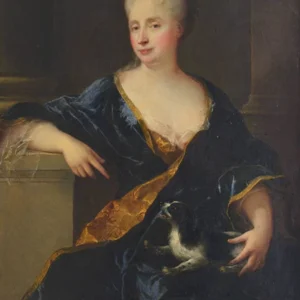
Portrait aristocratique baroque français : lumière au clair-obscur, drapés de soie bleu-gris et or, intérieur somptueux, expression grave et intérieure.
Sound Ambience
L'atmosphère feutrée d'un salon parisien du Grand Siècle : conversations raffinées au coin du feu, froissement de soieries et musique de clavecin en sourdine.
Liens externes & ressources
Références
Œuvres
La Princesse de Montpensier
1662
La Princesse de Clèves
1678
La Comtesse de Tende
1718 (posthume)
Histoire de Madame Henriette d'Angleterre
1720 (posthume)
Mémoires de la cour de France pour les années 1688 et 1689
1731 (posthume)