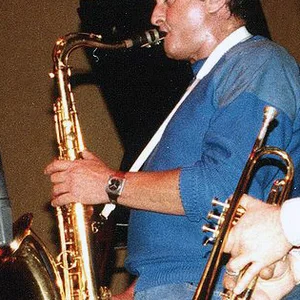

American tenor saxophonist and a leading figure of 1950s “cool” jazz. Nicknamed “The Sound” for the warm, lyrical tone of his instrument, he popularized bossa nova in the United States in the early 1960s.
Stan Getz(1927 — 1991)
Stan Getz
États-Unis
6 min read
Frequently asked questions
Key Facts
- Born February 2, 1927, in Philadelphia; died June 6, 1991, in Malibu, California
- Member of the “Four Brothers” in Woody Herman's orchestra in the late 1940s
- An iconic figure of cool jazz in the 1950s, nicknamed “The Sound”
- The album “Jazz Samba” (1962) with Charlie Byrd, whose track “Desafinado” launched the bossa nova craze in the United States
- The album “Getz/Gilberto” (1964) with João Gilberto and Antônio Carlos Jobim, featuring “The Girl from Ipanema” and honored with several Grammy Awards
Works & Achievements
A brief solo of great delicacy that revealed Getz's talent and launched his career as a soloist.
An ambitious album blending saxophone and string orchestra, arranged by Eddie Sauter; Getz considered it one of his crowning achievements.
The first album to widely spread bossa nova across the United States; its track “Desafinado” became a major hit.
A landmark album marking the meeting of jazz and bossa nova, crowned Album of the Year at the Grammy Awards.
A song that became a worldwide hit, named Record of the Year and now a classic of the 20th century.
A refined album that reveals Getz's openness to the new sounds of modern jazz.
Recorded with Chick Corea and younger musicians, it illustrates Getz's ability to reinvent himself.
A moving duo album recorded shortly before his death, regarded as a deeply touching farewell.
Anecdotes
Stan Getz was nicknamed "The Sound" because the tone of his tenor saxophone was so warm, smooth, and recognizable among thousands. He had shaped that velvety timbre by admiring Lester Young, and many saxophonists spent years trying to imitate it without ever succeeding.
At just 21 years old, in 1948, Getz played a short solo on the tune "Early Autumn" in Woody Herman's orchestra. Those few bars, of rare delicacy, made him famous almost overnight and launched his career as a soloist.
In 1962, Getz discovered Brazilian bossa nova and recorded the album "Jazz Samba." Two years later, with "The Girl from Ipanema
he set off a genuine bossa nova craze in the United States: the song played everywhere on the radio and introduced this Brazilian style to the entire world.
Getz's life was also marked by his battles against addiction. In 1954, in Seattle, suffering from morphine withdrawal, he clumsily tried to rob a pharmacy with his finger pointed inside his pocket like a weapon; overcome with remorse, he immediately phoned to apologize. He was arrested, but he later found his way back to music.
His friend
the saxophonist Zoot Sims
summed up Getz
s changeable nature with a now-famous quip: "He
s a lovely guy... as long as you catch him on a good day.
A genius of melody but a tormented man
Getz could shift from tenderness to anger in an instant.
Primary Sources
My life is music. In some vague, mysterious, and unconscious way I have always been driven by an inner spring that has compelled me, almost compulsively, to seek perfection in music — often at the expense of everything else.
We'd all play like Stan Getz... if only we could.
Stan? He's a hell of a guy — several guys, actually, all at once.
Key Places
Birthplace of Stan Getz, born on February 2, 1927 into a family of immigrants.
Getz grew up here and learned music; as a young man, he played in the clubs of 52nd Street, the beating heart of New York jazz.
Getz settled here in the late 1950s, like many American jazzmen drawn by Europe's enthusiastic welcome.
Site of the 1954 pharmacy incident, which brought his struggles with addiction into the open.
Getz spent his final years here and died on June 6, 1991 of liver cancer.
Typical Objects

The instrument of his whole life: it was on this renowned model that Getz forged his warm, lyrical tone nicknamed “The Sound.”

A small strip of cane fixed to the mouthpiece that vibrates to produce the sound; Getz chose his reeds with great care, as they determined the softness of his timbre.

The piece placed at the mouth end of the instrument; adjusting the mouthpiece and the reed allowed Getz to achieve a particularly velvety sound.

The long-playing vinyl on which his albums such as “Getz/Gilberto” were released; it was through this format that his music entered millions of homes.

A major award in the American recording industry; Getz won several, notably for “The Girl from Ipanema.”

Like the jazz musicians of his era, Getz performed in a sharp suit, an image of refinement associated with “cool jazz.”
School Curriculum
Vocabulary & Tags
Key Vocabulary
Tags
Daily Life
Morning
As a musician of the night, Getz often woke up late, since concerts ended in the early hours of the morning. Mornings were for rest, sometimes for adjusting his reeds and maintaining his saxophone.
Afternoon
Afternoons were devoted to rehearsals and recording sessions in the studio. Getz worked tirelessly on his tone, endlessly searching for the perfect melodic phrase.
Evening
In the evening, it was time for concerts in jazz clubs, in New York, in Europe, or on tour. Under the spotlights and the smoke of the venues, this was the moment when he gave the best of himself, sometimes until late into the night.
Food
His touring life meant meals grabbed on the go, between trains, hotels, and clubs. Like many jazzmen of his era, he also knew the ravages of alcohol and drugs, against which he struggled for a long time.
Clothing
On stage, Getz wore elegant suits, shirt and tie, reflecting the polished and “cool” image of the jazz musicians of the 1950s and 1960s.
Housing
His life was nomadic: a child of the Bronx, he then lived according to the demands of touring, spent several years in Copenhagen, and finally settled in California, in Malibu, for his final years.