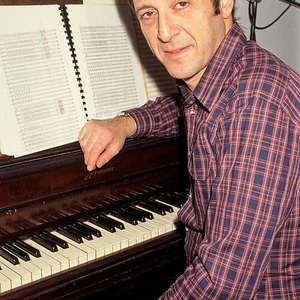

Steve Reich is an American composer born in 1936, a major figure of minimalist music. With his techniques of phasing and repetition, he profoundly renewed Western art music in the second half of the 20th century.
Steve Reich(1936 — ?)
Steve Reich
États-Unis
5 min read
Frequently asked questions
Key Facts
- Born on October 3, 1936, in New York
- Composes his first tape works using phasing in 1965-1966 (It's Gonna Rain, Come Out)
- Creates Music for 18 Musicians in 1976, an emblematic work of minimalism
- Receives the Pulitzer Prize for Music in 2009 for Double Sextet
- Influenced by African music (Ghana) and the Balinese gamelan, which he studied in the 1970s
Works & Achievements
Foundational tape-music piece that introduced the phasing technique using a recorded voice.
First application of phasing to live instruments, with two pianists gradually shifting the same pattern out of sync.
Sweeping work for percussion inspired by his stay in Ghana, a major landmark of minimalism.
Piece for two performers who simply clap their hands in shifting patterns, with no instruments at all.
A masterpiece of minimalism, a vast pulsing fabric of strings, percussion, keyboards, and voices that left its mark on 20th-century music.
A setting of psalms in Hebrew, reflecting his return to the Jewish tradition.
Work for string quartet and tape blending personal memories with the memory of the Holocaust, awarded a Grammy.
Work for twelve instruments awarded the Pulitzer Prize for Music in 2009.
Anecdotes
In 1965, Steve Reich recorded a Black street preacher named Brother Walter and layered two copies of the tape that gradually drifted out of sync: this was *It's Gonna Rain*. This discovery of phasing, born from a chance accident with two poorly synchronized tape recorders, would become the signature of all his music.
Passionate about African rhythms, Reich flew to Ghana in 1970 to study percussion with master drummers. Falling ill after five weeks, he returned to the United States but transposed what he had learned into *Drumming*, a sprawling work of about an hour for percussion.
For *Different Trains* (1988), Reich drew on his own childhood memories: during the war, he constantly traveled back and forth across the United States by train between his divorced parents. He realized that at the same moment, in Europe, trains were carrying Jewish children to the camps. He then wove recorded voices together with the string quartet.
As a young man, Reich studied philosophy at Cornell University before turning to composition. He also worked as a taxi driver in New York to earn a living while his music, deemed too repetitive, struggled to find an audience in the 1960s.
In 2009, Reich received the prestigious Pulitzer Prize for Music for *Double Sextet*. Long pushed to the margins by the dominant serialist avant-garde, the “minimalist” had become one of the most performed and influential living composers in the world, admired even in rock and electronic music.
Primary Sources
I am interested in perceptible musical processes. I want to be able to hear the process happening throughout the sounding music.
The gradual phase-shifting of a pattern against itself creates music that reveals itself to the ear little by little, with no hidden surprises.
As a child, I often traveled by train between New York and Los Angeles. Today I understand that, had I been in Europe at that time, as a Jew I would have been riding very different trains.
Key Places
Steve Reich's birthplace and the center of his artistic life. There he founded his ensemble and created most of his works.
Reich studied philosophy here from 1953 to 1957, notably Wittgenstein, before devoting himself to music.
He studied here under Luciano Berio and Darius Milhaud in the early 1960s and earned a master's degree in composition.
Reich stayed here in 1970 to study African percussion, a decisive experience for his rhythmic writing.
In the mid-1960s, Reich composed his first tape phasing pieces here, such as "It's Gonna Rain".
Typical Objects

A device that records sound onto magnetic tape. Reich uses it to layer and shift recorded voices, thereby inventing the phasing technique.

A large instrument with wooden bars struck with mallets. Its warm tone and repeated patterns are at the heart of works like 'Drumming' or 'Music for 18 Musicians'.

A percussion instrument with metal bars and resonators, with a crystalline timbre. Reich uses it notably to signal changes in 'Music for 18 Musicians'.

A Ghanaian drum played with curved sticks. Reich studied it in Ghana, which shaped his conception of rhythm and collective pulse.

An ensemble of two violins, viola, and cello. In 'Different Trains', Reich has this classical quartet converse with voices recorded on tape.

A device that beats time at a steady tempo. The mechanical regularity of the pulse is a fundamental principle of Reich's music.
School Curriculum
Vocabulary & Tags
Key Vocabulary
Tags
Daily Life
Morning
Reich devotes his mornings to composition, often at the piano or electric keyboard, patiently searching for short patterns that he loops and shifts out of phase. The work is slow and methodical, grounded in repeated listening.
Afternoon
Afternoons are often dedicated to rehearsals with his ensemble 'Steve Reich and Musicians', where each musician must count with extreme precision. There, Reich tests in real conditions what he wrote in the morning.
Evening
Evenings may be filled with concerts, in galleries, lofts, or contemporary music halls. For a long time, Reich himself played the percussion or keyboards within his own works.
Food
Reich, attached to his Jewish roots, follows the ordinary diet of a twentieth-century New York city-dweller. Nothing exceptional sets his meals apart, divided between family life and touring.
Clothing
He wears the plain, comfortable clothes of a New York musician: a shirt, a simple jacket, and, very often, a canvas cap that has become almost his trademark.
Housing
Reich lives mainly in New York, in apartments and lofts typical of the Manhattan art scene, spaces well suited to rehearsal and creation.